Posted Date : 06 Aug 2026
Introduction to Performance Marketing Conversion Tracking
What Is Performance Marketing?
Understanding Conversion Tracking
Why Conversion Tracking Is Essential
How Conversion Tracking Works
Types of Marketing Conversions
Macro Conversions
Micro Conversions
Key Benefits of Conversion Tracking
Popular Conversion Tracking Platforms
Google Ads Conversion Tracking
Meta Ads Conversion Tracking
Google Analytics 4 and Event Tracking
Server-Side Tracking and Privacy
Common Conversion Tracking Methods
Important Metrics to Monitor
Common Conversion Tracking Mistakes
Best Practices for Accurate Tracking
Conversion Tracking Across Different Industries
Challenges in Conversion Tracking
Future Trends in Performance Marketing Tracking
Final Thoughts
Frequently Asked Questions
Modern digital marketing is driven by measurable outcomes rather than assumptions. Businesses invest significant budgets into online advertising with the expectation of generating leads, sales, app installs, phone calls, or other valuable customer actions. Without accurate conversion tracking, it becomes nearly impossible to determine whether those investments are producing meaningful returns.
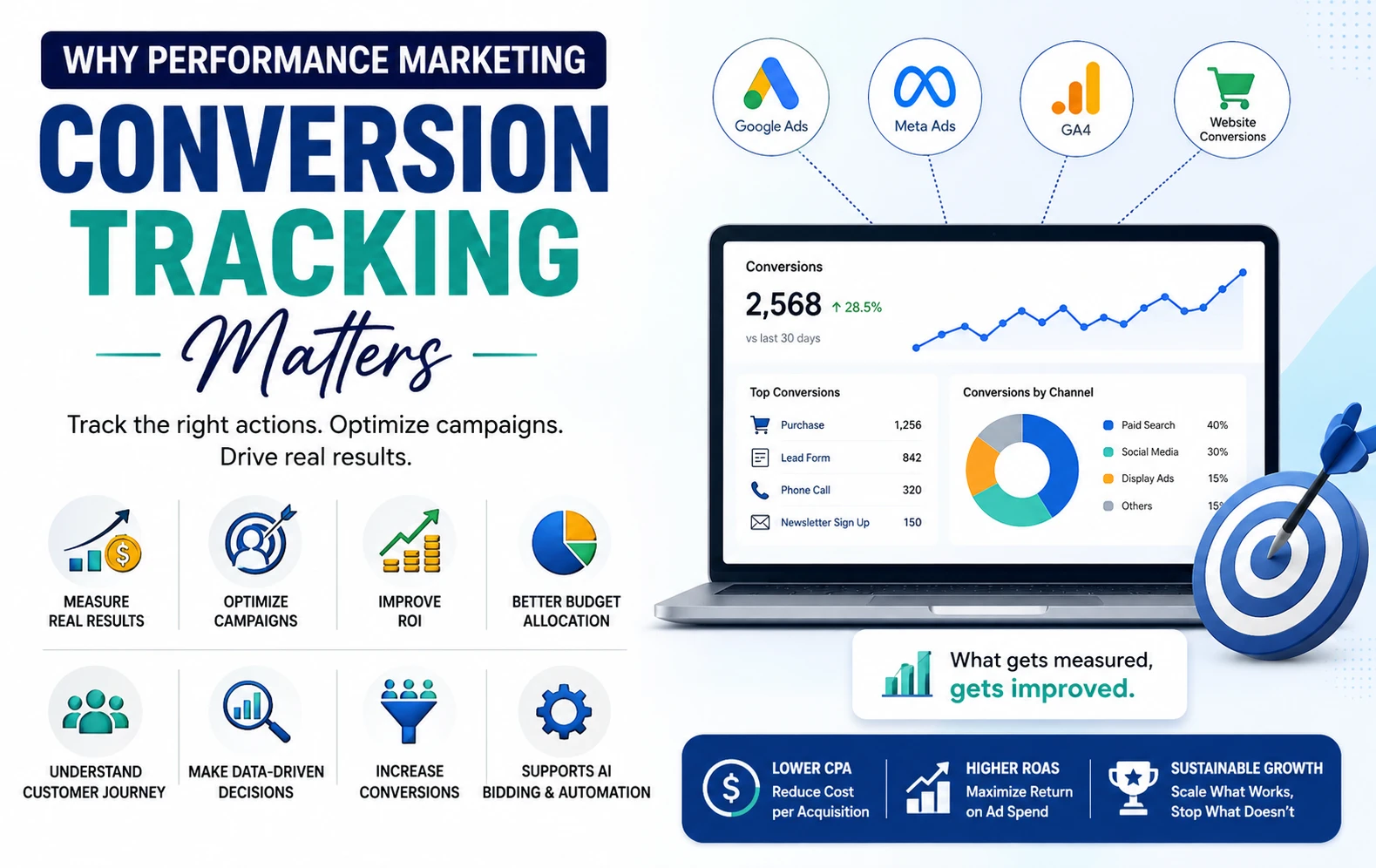
Performance Marketing Conversion Tracking provides advertisers with the visibility needed to understand how campaigns influence customer behavior. Instead of relying on impressions or clicks alone, marketers can measure actual business results and make informed decisions backed by reliable data.
Performance marketing is a digital advertising strategy where businesses pay for measurable outcomes instead of simply paying for exposure. These outcomes may include purchases, form submissions, newsletter signups, phone calls, downloads, or qualified leads.
Unlike traditional advertising, performance marketing emphasizes accountability. Every campaign can be analyzed based on predefined objectives, making it easier to optimize spending and maximize return on investment.
Popular performance marketing channels include:
Google Ads
Meta Ads
LinkedIn Ads
Microsoft Ads
TikTok Ads
Affiliate Marketing
Display Advertising
YouTube Advertising
Each of these platforms depends heavily on accurate conversion tracking to evaluate campaign performance.
Conversion tracking is the process of recording user actions that contribute to business goals. These actions occur after a visitor interacts with an advertisement, website, or landing page.
A conversion may include:
Product purchase
Lead form submission
Phone call
Appointment booking
Newsletter subscription
Mobile app installation
PDF download
WhatsApp inquiry
Tracking technologies capture these actions and send the data back to advertising platforms, allowing marketers to evaluate campaign effectiveness.
Conversion tracking transforms marketing from guesswork into precision-based decision-making.
Without tracking, advertisers only know how many people clicked an advertisement. They do not know whether those visitors became paying customers.
Accurate tracking enables businesses to:
Identify profitable campaigns
Reduce wasted advertising spend
Improve customer acquisition
Understand customer journeys
Optimize bidding strategies
Scale successful campaigns confidently
Every optimization decision becomes grounded in measurable evidence rather than intuition.
Conversion tracking typically follows a structured process.
A user clicks an advertisement.
The visitor lands on a website.
Tracking cookies or identifiers recognize the visitor.
The user completes a desired action.
The tracking system records the conversion.
The advertising platform attributes the conversion to the appropriate campaign.
Modern tracking may also utilize:
Google Tag Manager
Google Analytics 4
Meta Pixel
Conversion API
Enhanced Conversions
Server-side tagging
Together, these technologies create a comprehensive measurement framework.
Macro conversions represent primary business objectives.
Examples include:
Product purchases
Qualified lead submissions
Service bookings
Paid subscriptions
These conversions directly contribute to revenue generation.
Micro conversions indicate user engagement before the final conversion.
Examples include:
Watching product videos
Adding items to cart
Downloading brochures
Creating accounts
Visiting pricing pages
Clicking contact buttons
Although they do not generate immediate revenue, they often predict future conversions.
Conversion tracking delivers numerous strategic advantages.
Advertising budgets can be shifted toward campaigns producing the highest returns.
Marketers can pause underperforming ads while expanding successful ones.
Businesses understand exactly how much revenue each campaign generates.
Tracking reveals which audience segments convert most frequently.
Businesses gain valuable information about customer preferences and purchasing behavior.
Several platforms support sophisticated conversion tracking.
Tracks purchases, leads, phone calls, downloads, and offline conversions.
Measures actions across Facebook and Instagram using Pixel and Conversion API.
Captures detailed event-based customer interactions.
Tracks B2B lead generation and professional audience engagement.
Measures conversions from Bing search campaigns.
Google Ads allows advertisers to measure multiple conversion types.
Common tracked actions include:
Website purchases
Lead forms
Phone calls
Local actions
Offline sales
App installs
Smart bidding algorithms depend heavily on accurate conversion data. The better the tracking quality, the more effectively Google's machine learning can optimize campaigns.
Meta Ads primarily use two technologies.
Tracks browser-based user interactions.
Sends conversion events directly from servers, reducing data loss caused by browser restrictions and privacy changes.
Using both technologies together creates stronger event matching and improved reporting accuracy.
Google Analytics 4 introduced an event-driven measurement model.
Instead of focusing solely on page views, GA4 tracks user interactions such as:
Scroll depth
Button clicks
Video engagement
Downloads
Purchases
Form submissions
This flexible approach provides deeper behavioral insights and supports more sophisticated audience analysis.
Growing privacy regulations have reshaped digital analytics.
Server-side tracking offers improved reliability by processing events through secure servers rather than relying entirely on browsers.
Advantages include:
Better data accuracy
Improved security
Reduced ad blocker interference
Enhanced privacy compliance
Longer-lasting measurement capabilities
Many organizations now combine browser tracking with server-side implementations for maximum resilience.
Businesses can track conversions using several approaches.
Pixel tracking
JavaScript tags
Google Tag Manager
API integrations
CRM integrations
Offline conversion imports
QR code tracking
Call tracking software
Selecting the appropriate method depends on business objectives and technical infrastructure.
Successful marketers evaluate multiple performance indicators rather than relying on a single metric.
Key metrics include:
Conversion Rate
Cost Per Acquisition
Cost Per Lead
Return on Ad Spend
Return on Investment
Revenue Per Conversion
Average Order Value
Customer Lifetime Value
Click-Through Rate
Cost Per Click
Impression Share
Engagement Rate
Collectively, these metrics provide a comprehensive view of campaign performance.
Many businesses unknowingly compromise data quality.
Frequent mistakes include:
Duplicate conversion events
Incorrect event configuration
Missing thank-you page tracking
Broken tracking tags
Cross-domain tracking errors
Ignoring offline conversions
Poor attribution setup
Failure to test tracking regularly
Even small configuration issues can significantly distort reporting.
Reliable conversion tracking requires ongoing maintenance.
Recommended practices include:
Define clear conversion goals.
Use Google Tag Manager for centralized tag management.
Verify implementation using debugging tools.
Enable Enhanced Conversions where available.
Combine browser and server-side tracking.
Audit tracking monthly.
Maintain consistent naming conventions.
Test every conversion path after website updates.
These practices help ensure accurate measurement and dependable reporting.
Different industries prioritize different conversion actions.
Product purchases
Checkout completion
Add-to-cart events
Course inquiries
Demo registrations
Application submissions
Appointment bookings
Consultation requests
Property inquiries
Virtual tour bookings
Call tracking
Free trial registrations
Product demos
Subscription upgrades
Tracking should align with each industry's unique business objectives.
Despite technological advances, several challenges remain.
Common obstacles include:
Cookie restrictions
Ad blockers
Browser privacy updates
Cross-device attribution
Offline purchases
Consent management
Data fragmentation
Attribution complexity
Organizations must continually adapt to maintain accurate measurement.
The landscape continues to evolve rapidly.
Emerging trends include:
AI-powered attribution models
Predictive conversion analytics
Cookieless measurement
First-party data strategies
Enhanced server-side tracking
Privacy-preserving analytics
Machine learning optimization
Real-time customer journey analysis
Businesses that embrace these innovations will be better positioned to make data-driven decisions in an increasingly privacy-focused digital ecosystem.
Performance marketing conversion tracking is the foundation of successful digital advertising. It enables businesses to move beyond vanity metrics and focus on actions that directly impact growth and profitability. By accurately measuring customer behavior, marketers can optimize campaigns, improve budget efficiency, refine audience targeting, and increase return on investment.
As digital ecosystems continue to evolve with stricter privacy standards and more sophisticated advertising platforms, reliable conversion tracking becomes even more valuable. Organizations that invest in robust tracking frameworks, leverage first-party data, adopt server-side technologies, and regularly audit their implementations will gain a sustainable competitive advantage. Ultimately, effective conversion tracking is not just about collecting data—it is about transforming that data into informed decisions that drive measurable business success.
It is the process of measuring valuable customer actions, such as purchases, leads, or sign-ups, after users interact with digital marketing campaigns.
It helps businesses determine which campaigns generate real results, optimize advertising budgets, improve return on investment, and make informed marketing decisions.
Popular tools include Google Ads Conversion Tracking, Google Analytics 4, Google Tag Manager, Meta Pixel, Meta Conversion API, LinkedIn Insight Tag, and Microsoft Ads Universal Event Tracking.
Macro conversions are primary business goals like purchases or qualified leads, while micro conversions are smaller engagement actions such as video views, add-to-cart events, or brochure downloads that indicate progress toward a final conversion.
A comprehensive audit should be performed at least once a month and after any major website updates, advertising changes, or tracking implementation modifications to ensure data accuracy and consistency.
Audit Your Conversion Tracking in WEBBITECH
Have a project in mind? Let’s build something amazing together.
Webbitech — A Leading Web Design & Web Development Company with 15+ Years of SEO & Digital Marketing Expertise, Delivering Countless Success Stories
From idea to execution, we help businesses create high-performing websites and applications.
Start your journey today and take your brand to the next level.