Posted Date : 10 Oct 2026
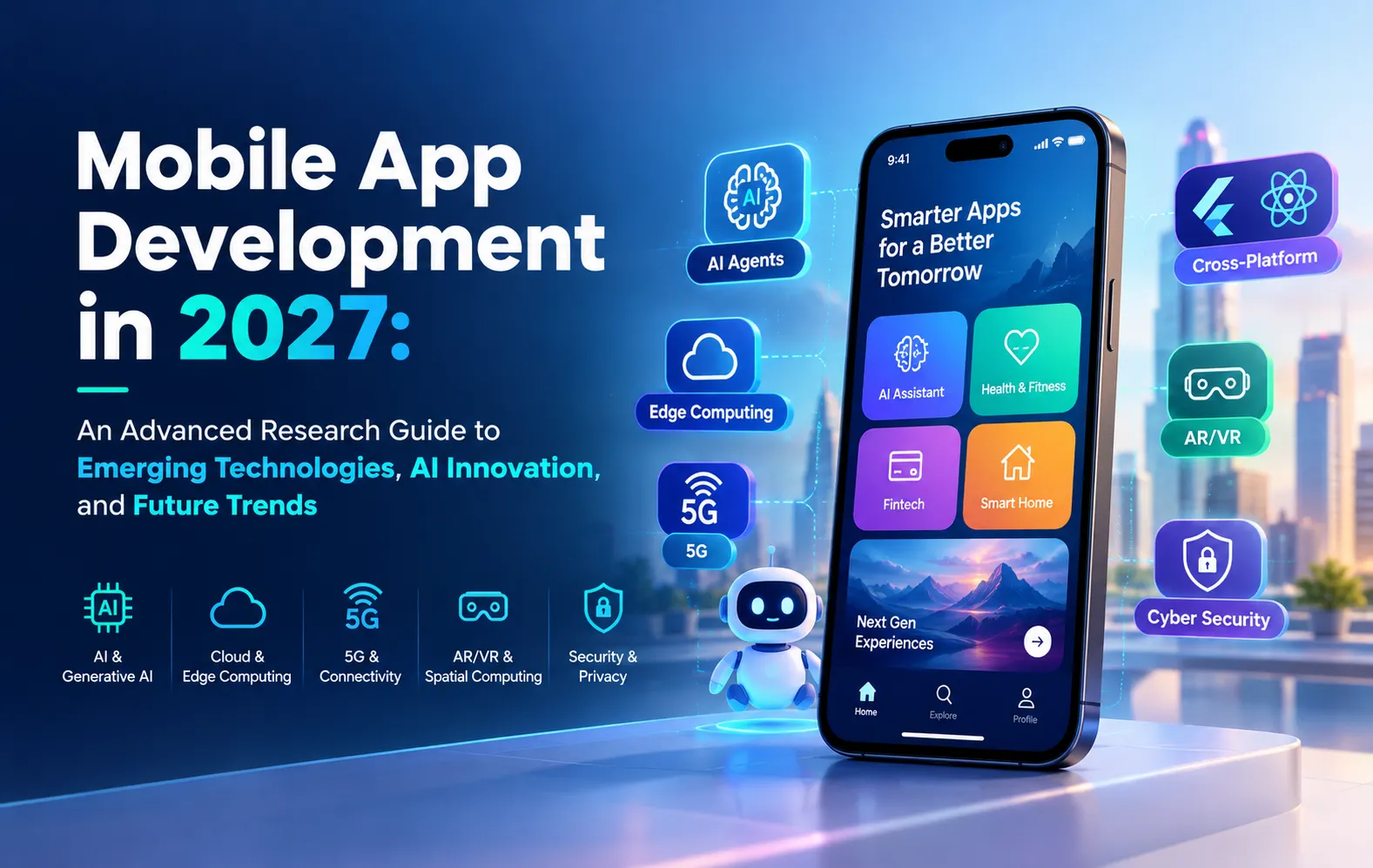
Mobile app development is entering its most significant transition since the launch of the app stores. In 2027, the central question is no longer which features an app has, but how much intelligence it carries, where that intelligence runs, and how safely it acts on a user's behalf.
This guide takes a research-led view of that transition. Rather than listing trends, it examines the data behind them, the architectural decisions they force, the platform changes announced in 2026, and the regulatory deadlines that will shape 2027. It is written for founders, product leaders, CTOs and development teams planning their next 12 to 36 months.
The mobile economy reached record highs in 2025, and generative AI was the main reason. Sensor Tower's State of Mobile 2026 report shows downloads, in-app revenue and time spent all hit all-time highs.
|
Metric (2025, iOS + Google Play) |
Value |
Source |
|---|---|---|
|
Global in-app purchase revenue |
$167 billion, up 10% year over year |
|
|
Non-game app vs game revenue |
$85.6 billion vs $81.8 billion |
|
|
Total time spent in apps |
5.3 trillion hours |
|
|
Generative AI app downloads |
3.8 billion, up 148% year over year |
|
|
Generative AI app revenue |
Over $5 billion, roughly tripled |
|
|
Time spent in generative AI apps |
48 billion hours, 3.6x 2024 |
Non-game apps now lead monetisation. For a decade, games set the standard for mobile revenue. In 2025, app spending overtook game spending for the first time, with generative AI and short-drama apps driving the change. Non-game in-app revenue grew 21% and is nearly three times what it was five years earlier.
Generative AI is now a mass-market app category. Generative AI became the second-largest app subgenre by downloads, behind only social media. ChatGPT joined TikTok and Google One as one of only three apps to pass $1 billion in annual in-app revenue.
Engagement is deepening, not just widening. AI app sessions passed one trillion in 2025 and grew faster than downloads. Sensor Tower reads this as a shift from acquiring users to deepening their engagement. For developers, it signals that users now expect AI to be woven into daily-use apps, not visited occasionally.
Mobile is becoming the primary AI interface. Around 110 million US chatbot users, more than half, used AI only through mobile apps, up from 13 million at the start of 2024.
The United States remains the largest revenue market, with consumers spending nearly $60 billion in 2025. India, discussed in Section 6, leads the world by downloads.
The market rewards apps that deliver ongoing, AI-enhanced value worth paying for. Subscription and hybrid monetisation models will keep growing, but so will user expectations. An app without intelligent features in a category where competitors have them will increasingly look outdated.
AI in mobile apps is evolving through three distinct layers, and 2027 is when all three operate together: generative features inside apps, a hybrid on-device and cloud architecture underneath them, and agents that act across apps on the user's behalf.
The first wave of mobile AI (2023–2025) bolted a chatbot onto an existing app. The second wave, now underway, builds AI into the core flow. Typical AI-native patterns in 2027 include:
The most important architectural decision for a 2027 app is where each AI task runs. Three tiers are now available to mainstream developers:
|
Tier |
Examples |
Strengths |
Limits |
|---|---|---|---|
|
On-device models |
Apple Foundation Models, Gemini Nano |
Private, offline, instant, no per-request cost |
Smaller models; device support varies |
|
Private cloud compute |
Apple Private Cloud Compute |
Larger models with strong privacy guarantees |
Platform-specific; network required |
|
Public cloud models |
Gemini, GPT, Claude and others via API |
Most capable reasoning and generation |
Cost per request, latency, data-handling duties |
Both platforms are pushing developers toward this hybrid model. At WWDC 2026, Apple extended its Foundation Models framework to span on-device processing, Private Cloud Compute and third-party models. At Google I/O 2026, Google released hybrid inference APIs and a Gemini Nano 4 preview, along with an Agent Development Kit (ADK) for Android that orchestrates workflows across on-device and cloud models.
The engineering skill that matters is routing. A well-designed app sends each request to the cheapest tier that can handle it well: on-device for classification, extraction and short summaries; cloud for complex reasoning or long documents. It also degrades gracefully when the network or a capable device is unavailable.
The deepest change is that apps are becoming tools that AI agents call, not just screens that people tap. Both platforms now formalise this:
This has a strategic consequence. Gartner estimates that by 2028, a third of user experiences will shift from native applications to agentic front ends. If a user asks an assistant to "order my usual groceries", the app that exposes a clean, reliable action gets the order. The app that does not is bypassed.
AI changes the cost structure of a mobile product. Cloud AI introduces a variable cost for every request, so a feature that is popular can become expensive. Three strategies keep economics healthy:
AI features introduce new failure modes that teams must plan for from the start: incorrect or invented answers, prompt injection through content the app processes, privacy leaks in prompts and logs, unpredictable costs, and agents taking actions the user did not intend. Mitigations include constrained outputs, confirmation steps for consequential actions, human escalation paths, red-team testing and clear disclosure of AI involvement.
Apple and Google used their 2026 developer conferences to make the same bet: the operating system becomes an intelligence layer, and apps plug into it. The apps that reach users in 2027 will be built on these announcements.
At WWDC 2026 on 8 June, Apple previewed a rebuilt Siri and next-generation Apple Intelligence, built on Foundation Models co-developed with Google's Gemini family. The announcements that matter most to app teams were:
Google described Android 17 as an intelligence system rather than just an operating system, with Gemini agents able to complete more tasks across apps. For developers, the key I/O 2026 releases were:
|
Shift |
Apple |
|
Action for 2027 |
|---|---|---|---|
|
Assistant reaches into apps |
App Intents, Siri AI |
AppFunctions, Gemini |
Expose core actions and content to the system |
|
On-device AI as a platform service |
Foundation Models |
Gemini Nano |
Use system models before bundling your own |
|
Hybrid AI |
Private Cloud Compute |
Hybrid inference APIs |
Design request routing across tiers |
|
Every screen size |
iPad, Vision Pro, foldables |
Adaptive-first Android 17 |
Build layouts that adapt, never lock |
|
AI-assisted building |
Xcode 27 agentic coding |
Android CLI, Studio agents |
Adopt agents with strong review and testing |
The common message is clear: an app's visual interface is no longer its only interface. In 2027, apps need a well-designed screen for people and a well-defined set of actions for AI.
Not every emerging technology deserves investment at the same time. Based on the market data, platform releases and hardware timelines above, mobile technologies fall into three readiness horizons.
Adopt now covers technologies with mature tooling, broad device support and proven returns. Delaying them mostly creates catch-up costs.
Pilot in 2027 is where competitive advantage will be won. Apple and Google shipped the APIs for agent-ready actions, hybrid AI and in-app agents in 2026, but best practices are still forming. A focused pilot now builds the experience needed to scale in 2028.
Prepare for 2028+ covers technologies whose platforms or hardware are still arriving. The right move is research, prototypes and architecture choices that keep options open, such as a clean action layer that could later power glasses or agent front ends.
New technologies only create value when the engineering underneath them is sound. These are the practices that separate durable 2027 apps from fragile ones.
|
Approach |
Choose when |
Watch out for |
|---|---|---|
|
Native (Swift, Kotlin) |
You need day-one platform features, advanced AR or peak performance |
Two codebases, higher cost |
|
Flutter |
You want one custom-designed UI across platforms and fast iteration |
Platform AI and intent APIs may need native bridges |
|
React Native |
Your team has strong web and TypeScript skills |
Performance tuning for heavy screens |
|
Kotlin Multiplatform |
You want shared logic with fully native UI |
Smaller ecosystem than Flutter or React Native |
Whichever you choose, plan for native modules where you integrate Foundation Models, Gemini Nano, App Intents and AppFunctions, since cross-platform support for these tends to arrive after the native APIs.
Traditional tests check that the same input produces the same output. AI features break that assumption, so testing must expand:
India is the world's largest app market by downloads and one of its most distinctive. It recorded 25.5 billion app downloads in 2025, up from 24.6 billion in 2024. Yet it does not rank in the top 20 markets for consumer spending. That gap shapes how successful apps are designed and monetised.
Indian users downloaded generative AI apps 602 million times in 2025, up from 198 million in 2024. ChatGPT ranked just behind Instagram in overall downloads in the country. Short-drama apps added over 350 million downloads and AI assistants 346 million. Domestic developers also grew their share of downloads from 33.9% to 36.5%.
UPI is now the default way Indians pay. NPCI data shows UPI processed a record 24.51 billion transactions worth ₹29.82 lakh crore in August 2026, up 22% in volume year over year. UPI is also accepted in 11 countries. For app makers, UPI-first checkout, UPI AutoPay for subscriptions and emerging credit-on-UPI features are now baseline expectations.
The next several hundred million Indian users will come largely from smaller towns and rural areas. Apps that win with them share common traits:
India's Digital Personal Data Protection Rules, 2025 were notified on 13 November 2025. Core obligations take effect on 13 May 2027, covering notice and consent, data-principal rights, security safeguards, processing children's data and cross-border transfers. Every app that processes personal data of users in India must be ready, regardless of company size.
For mobile teams, practical DPDP readiness means:
Teams that start now can build these into normal release cycles. Those that wait until early 2027 risk rushed, costly retrofits.
The trends that start in 2027 point to a very different mobile landscape by the end of the decade.
From apps to agent ecosystems. Gartner expects agents to collaborate within applications in 2027, a third of user experiences to move to agentic front ends by 2028, and multiagent ecosystems by 2029. Many interactions will begin with a conversation with an assistant rather than a tap on an app icon.
Glasses become a real platform. With Android XR display glasses expected at retail from 2027 and more devices following, the phone will increasingly act as the computing hub for glanceable, hands-free experiences.
Foldables go mainstream. Counterpoint expects cumulative foldable shipments to pass 100 million by the end of 2026 and to add the next 100 million within three years.
6G takes shape. Ericsson expects 6G to build on 5G Standalone with AI-native networks and integrated sensing and communication. Commercial launches are generally expected around 2030, with early adopters likely to be the same markets that led 5G.
Regulation matures. Privacy, AI transparency, accessibility and digital identity rules will become as standard a part of app development as app-store guidelines are today.
What is the single most important change for app developers in 2027?
Apps must work for AI as well as for people. Assistants such as Siri and Gemini increasingly perform tasks by calling app actions directly, so apps that expose well-defined actions will capture that traffic.
Should every app add generative AI?
No. Add AI where it clearly saves users time or effort, such as search, summaries, form filling or support. A focused, reliable AI feature beats several unreliable ones.
Is on-device AI good enough to replace cloud AI?
For many tasks, yes: classification, extraction, short summaries and personalisation. Complex reasoning, long documents and high-quality generation still benefit from larger cloud models. Most 2027 apps will use both.
How does the DPDP deadline affect apps built outside India?
The DPDP Act applies to processing of digital personal data within India and, in certain cases, to processing outside India connected with offering goods or services to people in India. Teams serving Indian users should seek legal advice on their specific obligations.
Which cross-platform framework is best for 2027?
There is no single winner. Flutter suits custom-designed UIs, React Native suits web-skilled teams, and Kotlin Multiplatform suits teams that want native UI with shared logic. All need some native code for the newest AI and assistant APIs.
Mobile app development in 2027 is defined by a shift from apps people operate to apps that understand, assist and act. The data shows AI already driving growth, the platforms have rebuilt themselves around intelligence, and regulators have set firm dates for trust and privacy.
The organisations that thrive will not be those that chase every new technology, but those that make deliberate choices: exposing their apps to AI agents, running AI where it makes most sense, designing for every screen and every user, and building trust into the product from the start.

Have a project in mind? Let’s build something amazing together.
Webbitech — A Leading Web Design & Web Development Company with 15+ Years of SEO & Digital Marketing Expertise, Delivering Countless Success Stories
From idea to execution, we help businesses create high-performing websites and applications.
Start your journey today and take your brand to the next level.