Posted Date : 22 Oct 2026
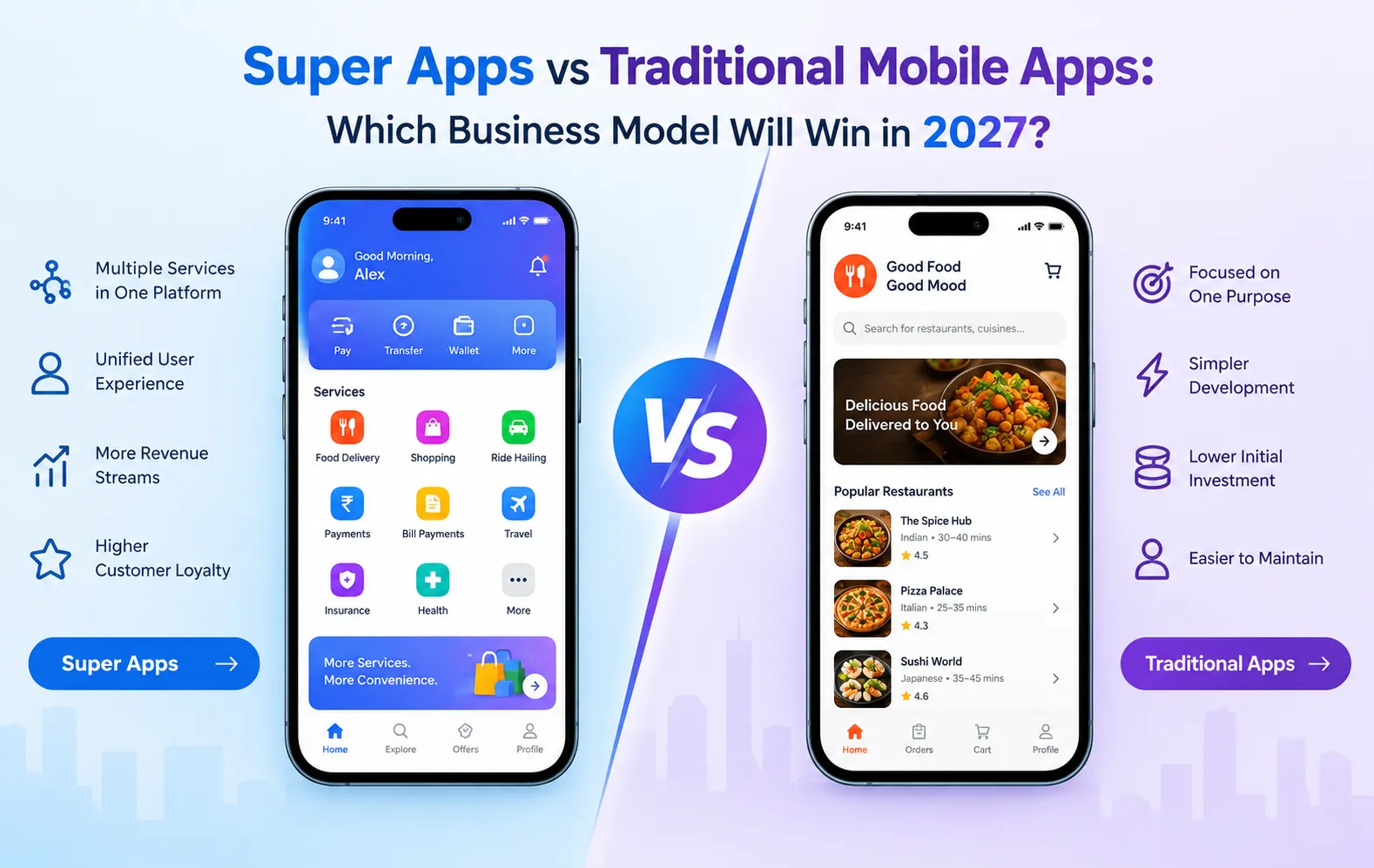
Mobile applications have become an important part of how businesses attract customers, deliver services, manage transactions, and build long-term relationships. As digital expectations evolve, businesses face an important decision: should they develop a super app that combines multiple services in one platform or a traditional mobile app designed around a specific purpose?
The debate around super apps vs traditional mobile apps is becoming increasingly relevant for startups, enterprises, e-commerce businesses, fintech companies, and service providers planning their digital growth in 2027.
A super app brings multiple services into one ecosystem, while a traditional mobile app typically focuses on a specific product, service, or business function. Both models offer advantages, but the right choice depends on your customers, business model, budget, technology, and growth strategy.
In this guide, we explore how super apps and traditional mobile apps work, their differences, business benefits, development challenges, and how to choose the right approach.
A super app is a mobile platform that integrates multiple services, features, or mini-app experiences within a single application.
Instead of downloading separate apps for different activities, users can access several connected services through one platform.
For example, a super app may combine:
Digital payments and money transfers
Shopping and ecommerce
Food ordering and delivery
Transportation and ride booking
Bill payments and recharges
Loyalty programmes and customer rewards
Popular examples include WeChat in China and Grab in Southeast Asia. Their service combinations and operating models differ, but they demonstrate how one app can support multiple customer needs.
6
Multiple services in one digital ecosystem
Shared user accounts and onboarding
Integrated payments or transaction capabilities, where supported
Connected customer data and experiences, subject to privacy requirements
APIs, modular architecture, or mini-app ecosystems
Cross-selling and customer retention opportunities
A super app is not simply a mobile application with many features. Its real value comes from connecting services that make the overall user experience more convenient.
A traditional mobile app is an application designed primarily to solve a specific customer problem or perform a defined set of related tasks.
For example:
A restaurant ordering app
A real estate property listing app
A fitness tracking app
A school management app
A business CRM application
A fashion ecommerce app
8
Traditional mobile apps usually focus on making a specific customer journey simple, fast, and effective.
For startups and small businesses, this approach can be practical because it allows teams to validate demand, launch faster, and improve the product based on real user feedback.
Understanding the difference between these two models can help businesses select the right development strategy.
|
Feature |
Super App |
Traditional App |
|---|---|---|
|
Primary purpose |
Multiple connected services |
Specific business needs |
|
User experience |
Multi-service ecosystem |
Focused user journey |
|
Development complexity |
High |
Low to high, depending on scope |
|
Initial investment |
Usually higher |
Often lower for an MVP |
|
Revenue opportunities |
Multiple revenue streams |
Focused monetization |
|
Maintenance |
Complex ecosystem management |
Comparatively simpler |
|
Target audience |
Multiple user segments |
Specific audience |
|
Scalability |
Across services and partners |
Through features and integrations |
Important: A traditional app is not necessarily simple, and a super app is not automatically more scalable or profitable. Architecture, market demand, execution, and customer experience determine performance.
Super apps typically scale by building on a successful core service and gradually introducing relevant adjacent services.
Taylor & Francis Online
There is no universal winner. The better business model depends on the problem your company solves and how frequently customers need your services.
A super app may be suitable if your business already operates multiple connected services or has a clear plan to build partnerships.
Consider this model when:
You have a substantial and engaged customer base.
Customers regularly use several related services.
Your business can support multiple revenue streams.
You have the capital and technical team to manage a complex platform.
You can provide a consistent experience across services.
Example: A large commerce business could connect shopping, payments, delivery tracking, loyalty rewards, and merchant services through a unified platform.
The key is to create genuine customer convenience instead of adding unrelated features.
A focused mobile app is often a suitable starting point for startups, SMEs, and businesses entering the digital market.
Choose this approach when:
You want to validate a business idea.
Your target audience has one primary need.
You have a limited initial development budget.
You need a faster route to market.
Your business model depends on a focused customer journey.
Example: A real estate company could launch an app that helps customers discover properties, schedule site visits, compare pricing, and contact sales representatives.
This focused experience can make it easier to measure leads, conversions, and customer satisfaction.
WeChat demonstrates how a messaging-led platform can expand into payments, mini programs, and other digital services.
Business lesson: Start with a high-value core service and build a connected ecosystem.
Grab
Grab illustrates how a mobility-focused business can expand into food delivery and financial services.
Business lesson: Expand into services that align with existing customer habits.
PhonePe
PhonePe illustrates how a payments-led platform can offer a broader set of financial and consumer services.
Business lesson: A frequent-use service can become a foundation for wider customer relationships.
These examples demonstrate different paths toward multi-service platforms, not a guarantee that the same strategy will work for every company.
Taylor & Francis Online
Mobile app development cost depends on features, integrations, design, platforms, security requirements, and development team experience.
There is no single standard price for either model.
|
Development type |
Main scope |
|---|---|
|
Traditional MVP |
Core features and essential integrations |
|
Advanced business app |
Multiple workflows, APIs, dashboards |
|
Super app MVP |
Core service with initial ecosystem capabilities |
|
Enterprise super app |
Multiple services, partner systems, governance and infrastructure |
For planning purposes, businesses should separate their budget into:
UI/UX design and product research
Android and iOS development
Backend development and cloud infrastructure
API and payment integrations
Security, testing, and compliance
Deployment, maintenance, and ongoing improvements
A super app may require additional investment in identity management, service orchestration, partner onboarding, monitoring, and ecosystem governance.
Cost-saving recommendation: If you are exploring a super app idea, begin with one core service and a clearly defined MVP. Expand after validating retention, demand, and unit economics.
Building a scalable mobile application requires selecting technology based on the product requirements rather than trends alone.
|
Technology |
Potential use |
|---|---|
|
Flutter |
Cross-platform mobile development |
|
React Native |
Cross-platform mobile development |
|
Swift |
Native iOS development |
|
Kotlin |
Native Android development |
|
Node.js / Java / .NET |
Backend services |
|
PostgreSQL |
Relational application data |
|
Cloud platforms |
Infrastructure, deployment, scaling |
|
APIs and modular services |
Integration and service expansion |
For a super app, businesses should consider:
Modular architecture to manage independent service domains
Secure authentication and role-based access
API gateway and service monitoring
Consent-aware data management
Scalable transaction processing
Reliable payment integration
Analytics and performance tracking
A modular monolith may be sufficient for an early product. Microservices are not automatically necessary. Architecture should evolve with actual operational requirements.
Although super apps provide opportunities, they also introduce significant challenges.
1. High development and operating costs Building multiple services requires more engineering resources, testing, and maintenance.
2. Complex user experience Too many features can create navigation problems and reduce usability.
3. Data privacy and security A connected ecosystem needs strong access controls, transparent consent practices, and responsible data handling.
4. Integration challenges Connecting payment providers, merchants, logistics partners, and third-party platforms can introduce technical dependencies.
5. Customer adoption Users will not necessarily adopt a new platform just because it offers more services.
6. Regulatory requirements Financial, healthcare, identity, and other regulated services may require additional approvals, safeguards, or compliance measures depending on the activity and jurisdiction.
Super app research also highlights the importance of privacy, governance, competition, and interoperability as platforms grow.
Taylor & Francis Online
AI is creating new opportunities for both super apps and traditional mobile applications.
In 2027, businesses can consider practical AI capabilities such as:
AI-powered customer support
Personalized recommendations
Intelligent search
Automated business workflows
Predictive analytics
AI-assisted booking and ordering
Fraud detection, where appropriate
AI agents may also help users complete tasks across services. However, agent-driven transactions require explicit authorization, security controls, confirmation flows, and clear accountability.
A focused mobile app can benefit from AI just as much as a super app. AI integration alone does not make an app a super app.
The long-term opportunity is to build mobile experiences that solve customer problems efficiently, whether through one specialized product or a connected platform.
Taylor & Francis Online
Before investing in mobile app development, evaluate these five factors.
Identify your primary customer problem. Define what users should accomplish when they open your app.
Validate market demand. Conduct customer interviews, competitor research, and MVP testing.
Evaluate business economics. Estimate customer acquisition costs, revenue potential, retention, and operating costs.
Plan your technology architecture. Choose an approach that supports your immediate requirements and realistic future growth.
Create a phased roadmap. Launch the core product, measure performance, and expand when customer evidence supports it.
Your app solves one focused problem
Recommended starting point: Traditional mobile app or MVP.
Your app connects multiple existing services
Recommended approach: Evaluate a super app or ecosystem platform.
You want to expand an existing successful app
Recommended approach: Add adjacent features or services incrementally.
If you are planning to develop a mobile application, choosing the right development partner can help you turn your business requirements into a practical product roadmap.
Webbitech helps businesses plan and develop digital products with a focus on functionality, user experience, and scalability.
Our mobile app development services can support:
Custom mobile app development
Android and iOS application development
Flutter and React Native development
UI/UX design and prototyping
Backend development and API integrations
Ecommerce and business applications
App testing, deployment, and maintenance
Whether you are planning a startup MVP, an ecommerce application, a service booking app, or a multi-service platform, the first step is to define your requirements and development scope.
Planning a mobile app for your business?
Explore our mobile app development services or contact Webbitech to discuss your project.
Service: Mobile App Development
Next step: Share your app idea, target audience, required features, and estimated launch timeline.
A super app integrates multiple connected services within one platform, while a traditional mobile app generally focuses on a specific product, service, or customer need.
Not always. Super apps may work well for businesses with multiple connected services and strong customer engagement. Traditional apps can be better for focused products, startups, and specialized business needs.
It can be more expensive because it may involve multiple services, complex integrations, security requirements, and ecosystem management. The actual cost depends on the scope and architecture.
Yes. A startup can begin with one core service and gradually introduce related capabilities. Validating customer demand before expanding is a practical strategy.
Common choices include Flutter, React Native, Swift, Kotlin, backend frameworks, APIs, cloud infrastructure, and modular application architectures.
The timeline depends on features, integrations, team size, testing, and compliance requirements. A focused MVP may take substantially less time than a full multi-service platform. A realistic timeline should be estimated after technical discovery.
Yes. An existing application can evolve into a broader platform by adding connected services, partner integrations, and shared user experiences over time.
Businesses should evaluate their target audience, market demand, budget, feature requirements, monetization model, security, maintenance, and long-term product roadmap.
Review the company's relevant portfolio, technical capabilities, development process, communication, security practices, support terms, and transparent project estimates before selecting a partner.
You can explore Webbitech's website to learn about its services and contact the team to discuss your mobile application requirements.
The competition between super apps and traditional mobile apps is not simply about which platform has more features.
Super apps can win through ecosystem convenience, while traditional apps can win through focus, simplicity, and specialized experiences.
For most businesses starting their mobile journey, a focused application with a clear value proposition can be a sensible first step. Companies with strong customer engagement, multiple complementary services, and the resources to manage an ecosystem may benefit from a super app strategy.
The winning model is the one that customers repeatedly use and businesses can sustainably operate.
Start with a customer problem, build a useful solution, measure results, and expand strategically.

Have a project in mind? Let’s build something amazing together.
Webbitech — A Leading Web Design & Web Development Company with 15+ Years of SEO & Digital Marketing Expertise, Delivering Countless Success Stories
From idea to execution, we help businesses create high-performing websites and applications.
Start your journey today and take your brand to the next level.