Posted Date : 15 Oct 2026
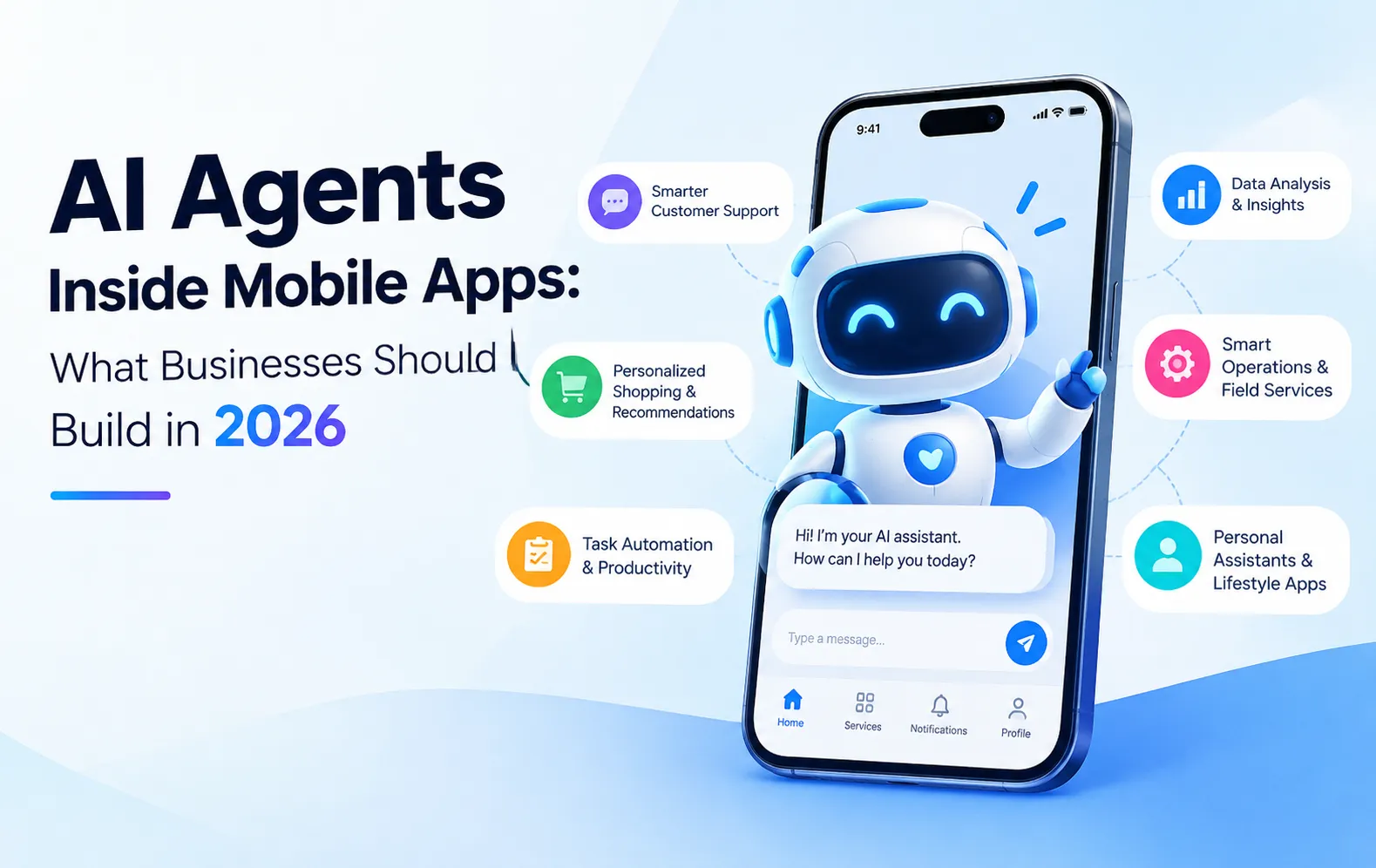
In 2026, the best mobile apps don't just answer questions. They get things done for the user.
For years, "AI in an app" meant a chatbot in the corner of the screen. You typed a question, it typed back, and you still had to do the work yourself. That model is fading fast.
In early 2026, phone makers shifted from chat-style AI to on-device agents that can actually carry out tasks. Google now lets Gemini work directly with Android apps. Apple's upgraded Siri can take actions inside third-party apps. And Gartner expects 40% of enterprise apps to include task-specific AI agents by the end of 2026, up from under 5% in 2025.
For a business, this raises two practical questions:
This guide answers both, in plain language, with real examples and a simple roadmap.
An AI agent is software that understands a goal, plans the steps and completes them using the app's own features. A chatbot talks; an agent acts.
Say a user types "Book my usual cleaning slot next week and pay with my saved card." A chatbot explains how to book. An agent checks the calendar, finds the slot, books it, processes payment and sends a confirmation, asking the user only when something needs approval.
|
|
Traditional chatbot |
AI agent |
|---|---|---|
|
What it does |
Answers questions |
Completes tasks end to end |
|
Steps |
One reply per message |
Plans and runs several steps |
|
Access |
Static FAQ or knowledge base |
Live app data, APIs and user context |
|
Memory |
Forgets after the chat |
Remembers preferences and history |
|
User effort |
User still does the work |
User approves; agent does the work |
|
Example |
"Here is how to reorder" |
Reorders, applies coupon, schedules delivery |
A useful way to think about it: your app's buttons and screens become tools that the agent can use on the user's behalf.
Three things changed this year: the money moved, Android opened up, and Siri finally shipped.
1. Businesses are spending on agents. Companies plan to roughly double AI budgets in 2026, with more than 30% aimed at agentic AI, and about 90% of executives expect measurable returns from agents this year (source). The AI agents market is valued at about $10.9 billion in 2026 and could reach $50 billion by 2030 (source).
2. Android lets agents use your app directly. Google introduced AppFunctions, an Android 16 feature that lets an app publish specific actions ("create note", "send message") that Gemini and other agents can find and run on the device. At Galaxy Unpacked in July 2026, Gemini's task automation expanded to more than 40 apps across shopping, restaurant bookings, travel and tickets.
3. Siri can now act inside apps. After two delays, the app-aware Siri arrived with iOS 26.4. It can see what's on screen, use personal context and act inside apps that adopt Apple's App Intents framework. Adoption is still thin, which is an opening: early adopters get noticed first.
The bigger point: apps are turning into execution layers. Apps that agents cannot easily use may slowly lose relevance, because users will simply ask their assistant to use a competitor's app instead.
Start with the agent that removes the most repeated work for your users or your team. These seven deliver value fastest.
Goes beyond FAQs: checks order status, processes returns, reschedules deliveries and raises a ticket with full context when a human is needed. Best for: e-commerce, telecom, SaaS, utilities.
Finds open slots, books appointments, sends reminders and handles cancellations in one conversation. Best for: clinics, salons, education counselling, service businesses, travel.
Understands requests like "a cotton kurta under ₹1,500 for a wedding next week", filters products, applies offers and completes checkout. Best for: retail, D2C brands, and grocery and food delivery.
Answers product questions, qualifies leads with a few smart questions, shares quotes and books a call with your sales team. Best for: real estate, B2B services, automobile dealers, education.
Shows spending, explains charges, sets payment reminders and flags unusual activity. Every money action needs user confirmation. Best for: banking, fintech, insurance, and billing apps.
Handles appointment booking, report sharing, medicine reminders and follow-ups. It supports admin work and patient engagement, not diagnosis. Best for: hospitals, diagnostic labs, pharmacies.
Inside internal apps, it submits leave, logs field visits, updates CRM records and pulls reports on request. Best for: field sales teams, logistics, manufacturing, any team with a staff app.

|
Agent |
Main benefit |
Build complexity |
|---|---|---|
|
Customer support |
Fewer support tickets, faster resolution |
Medium |
|
Booking and scheduling |
More completed bookings, fewer no-shows |
Low to medium |
|
Personal shopping |
Higher conversion and order value |
Medium to high |
|
Sales and lead qualification |
Better-quality leads, faster follow-up |
Low to medium |
|
Finance assistant |
Higher engagement and trust |
High |
|
Healthcare admin |
Less front-desk workload |
Medium to high |
|
Employee productivity |
Hours saved per employee each week |
Medium |
Our tip: If you are a small or mid-size business, start with a booking agent or a lead-qualification agent. They are quick to build, easy to measure and pay back fast.
An in-app agent has three parts: a model that understands the request, the app actions it can use, and memory of the user.
[embed: node/9a299977-6e18]
The agent reads the request, checks the user's history, and plans the steps. Safe steps run straight away; anything involving money or personal data waits for the user's approval. The same app actions can also be exposed to Gemini or Siri, so customers can use your app without opening it.
Simple tasks such as sorting or short replies can run on the phone's own AI model for speed and privacy. Harder reasoning goes to a cloud model.
Building your own agent is half the job. The other half is letting the phone's assistant use your app, so customers can say "order my usual from [your brand]" without opening it.
|
|
Android |
iOS |
|---|---|---|
|
Framework |
||
|
Assistant |
Gemini and other agent apps |
Siri and Apple Intelligence |
|
Requirement |
Android 16 or higher |
iOS 26.4 on supported iPhones |
|
Status (Oct 2026) |
Experimental; Gemini integration in private preview |
Live; third-party adoption still early |
Practical steps for your development team:
One caution: AppFunctions is Android-only. If your app is built in Flutter or React Native, plan native modules for each platform.
Most AI agent projects fail because of messy data and unclear scope, not because of the AI model.
Gartner research warns that organisations will abandon 60% of AI projects through 2026 for lack of AI-ready data (source). Plan for these risks early:
Cost depends on the agent's scope, the number of integrations and whether you are adding it to an existing app. A focused agent added to an existing app (one use case, a few actions) is the cheapest route. A full AI-native app with many integrations costs far more. Also budget for monthly AI usage fees, which grow with your users.
In 2026, the question is no longer whether your app needs AI. It is which tasks your app should complete for users without being asked twice.
Start with one agent tied to a clear business result, such as more bookings, fewer support calls or better leads. Make your core actions available to Gemini and Siri. Then grow from there.
Planning an AI-powered mobile app? Talk to the Webbitech team. We'll help you pick the right first agent, scope a pilot and build an app that is ready for the agent era. Contact us.
It is an AI feature that understands what a user wants and completes the task using the app's functions, such as booking, ordering or paying, instead of only replying with text.
A chatbot answers questions. An AI agent plans and carries out multi-step tasks, uses live app data and remembers user preferences.
Yes. A focused agent for bookings, lead qualification or order tracking is affordable and shows results quickly.
Yes. Most agents are added to existing apps by connecting an AI model to the app's current APIs and actions. A full rebuild is rarely needed.
They are platform frameworks that let your app publish actions Gemini (Android) and Siri (iOS) can run for users, so customers can use your app through their phone's assistant.
They can be, with limited permissions, user confirmation for sensitive actions, activity logs and clear privacy controls.

Have a project in mind? Let’s build something amazing together.
Webbitech — A Leading Web Design & Web Development Company with 15+ Years of SEO & Digital Marketing Expertise, Delivering Countless Success Stories
From idea to execution, we help businesses create high-performing websites and applications.
Start your journey today and take your brand to the next level.