Posted Date : 12 Aug 2026
I. Introduction
Something changed. Quietly. Without a press release or a viral announcement, the way people search for information has been rewired. Where a query once meant typing a fragmented phrase into a search bar and scanning ten blue links, it now increasingly means asking a full, conversational question to an AI system and receiving a single, synthesized answer. This is not a minor UX tweak. It is a structural realignment of the entire discoverability ecosystem, and most businesses have not caught up.
This article dissects the mechanics behind Answer Engine Optimization (AEO), explains why it is gaining ground faster than most marketers anticipated, and lays out exactly how the discipline of SEO is being subsumed — not abandoned, but absorbed — into a broader, AI-centric visibility strategy. By the end, the urgency behind adapting now, rather than later, should be unmistakable.
Search Engine Optimization, in its classical form, is the practice of tailoring content, structure, and backend signals so that a webpage ranks favorably on a search engine results page (SERP). It relies on a triad of levers: relevant keywords, authoritative backlinks, and technical crawlability. For over two decades, this triad has been the bedrock of digital visibility strategy.
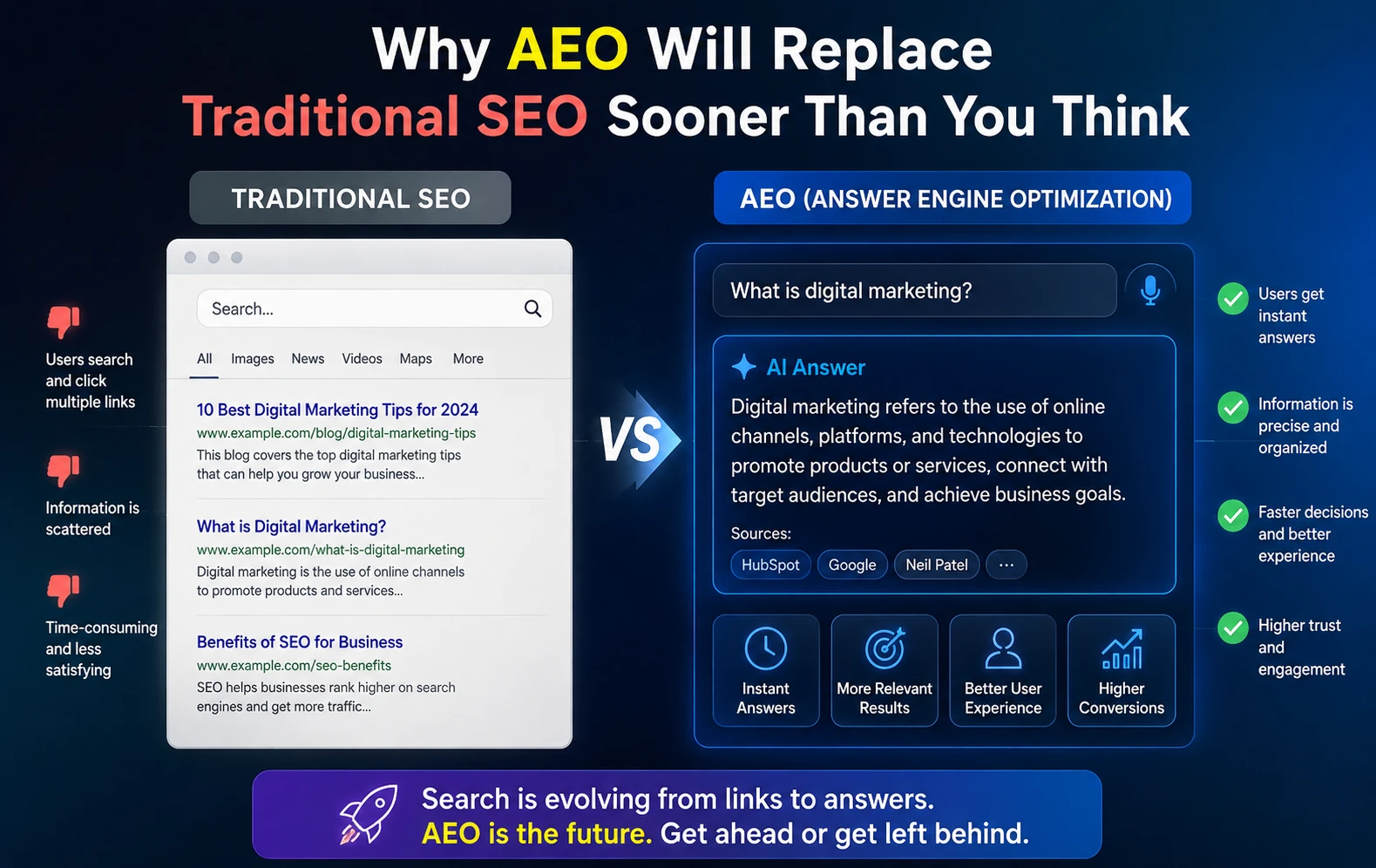
Answer Engine Optimization flips the objective. Rather than optimizing to appear in a list of results, AEO optimizes content to be extracted, synthesized, and delivered as the answer by AI-driven systems — chatbots, voice assistants, and generative search overviews. The unit of success is no longer a ranking position; it is a citation, a mention, a direct quotation embedded inside someone else's response.
Ranking implies competition for attention within a crowded list. Being the answer implies singular selection — your content, and often only your content, becomes the substance of the response the user receives. This is a categorically different kind of visibility, and it carries a different set of incentives, risks, and rewards.
Tools like ChatGPT, Perplexity, and Claude have normalized a new interaction pattern: ask a full question, get a full answer, follow up conversationally. This paradigm sidesteps the traditional search bar entirely, and with it, the traditional SERP.
Industry data has shown a steady climb in searches that end without a single click to an external website. Users get what they need directly from the results interface — a definition, a comparison, a summary — and move on. This trend, already pronounced in traditional search, is amplified exponentially in AI-native interfaces.
When a generative AI summary sits atop a results page, synthesizing the very content that ten websites spent years optimizing to produce, the incentive to scroll further diminishes sharply. The overview becomes the destination. The websites beneath it become raw material, uncredited more often than not.
Younger demographics in particular are gravitating toward AI-first research habits. They don't browse; they interrogate. This behavioral migration is not a fad — it is a generational recalibration of how information consumption works.
Algorithms — both traditional and generative — have grown far too sophisticated to reward crude keyword repetition. Semantic understanding has replaced lexical pattern-matching as the dominant evaluative lens, rendering old-school density tactics not just ineffective but occasionally punitive.
Backlinks once functioned as a proxy for trust — a vote of confidence from one site to another. AI answer engines, however, weigh comprehensiveness, clarity, and factual accuracy far more heavily than link equity alone. A well-linked but poorly structured page can still be passed over entirely.
Classic ranking algorithms prioritized signals like domain authority and click-through rate. Generative systems prioritize whether they can understand and extract your content cleanly. Comprehension has quietly eclipsed classic authority metrics as the gatekeeping variable.
Content that is broken into digestible, self-contained units — clear headers, concise answers, logical hierarchies — is dramatically easier for large language models to parse and quote. Sprawling, unstructured prose becomes a liability rather than an asset.
AEO rewards unambiguous language. Vague, jargon-laden, or evasive phrasing confuses extraction models. Precision, specificity, and directness are the new lingua franca of visibility.
Structured data — FAQPage, HowTo, Article schema — functions as a Rosetta Stone between your content and the machines parsing it. It removes ambiguity about what a piece of content is, what it answers, and how it should be categorized.
Original research, cited data, transparent authorship, and topical depth carry disproportionate weight. Generative systems, wary of hallucination and inaccuracy, gravitate toward sources that demonstrate verifiable expertise rather than superficial keyword alignment.
Early adopters — often in SaaS, finance, and health verticals — have restructured their content libraries around question-first formats and are already seeing outsized citation rates in AI-generated answers, independent of their traditional SERP rankings.
Publishers reliant on ad-driven pageviews, affiliate marketers dependent on click-through volume, and informational content mills face the steepest existential threat. When the answer is delivered without a click, the entire monetization model built on traffic volume begins to erode.
Invisibility in AI-generated answers is not a neutral outcome — it is a competitive disadvantage with compounding effects. As more consumer research happens through AI intermediaries, brands absent from those answers effectively vanish from a growing share of the buyer's journey.
Begin by assessing whether existing content answers direct questions clearly within the first few sentences, whether it employs structured formatting, and whether it carries verifiable authority signals. Most legacy content fails at least one of these criteria.
AEO does not obsolete SEO; it extends it. Technical SEO fundamentals — site speed, crawlability, mobile usability — remain the substrate on which AEO performance is built. The winning strategy treats AEO as a refinement layer atop sound SEO infrastructure, not a replacement discipline.
Traditional KPIs like keyword rankings and organic sessions must now be supplemented with newer metrics: AI citation frequency, brand mention rate within generative answers, and share-of-voice across answer engines. Measurement frameworks are still maturing, but early movers are already tracking these signals manually.
The migration from search engines to answer engines is not a distant, speculative trend — it is unfolding in real time, accelerating with every model update and every new AI-native interface that reaches mainstream adoption. Brands that treat AEO as an afterthought risk a slow fade into irrelevance, invisible to the very systems increasingly mediating consumer decisions. The pragmatic move is not to abandon SEO, but to evolve it — deliberately, structurally, and without delay.
Have a project in mind? Let’s build something amazing together.
Webbitech — A Leading Web Design & Web Development Company with 15+ Years of SEO & Digital Marketing Expertise, Delivering Countless Success Stories
From idea to execution, we help businesses create high-performing websites and applications.
Start your journey today and take your brand to the next level.