Posted Date : 29 Jul 2026
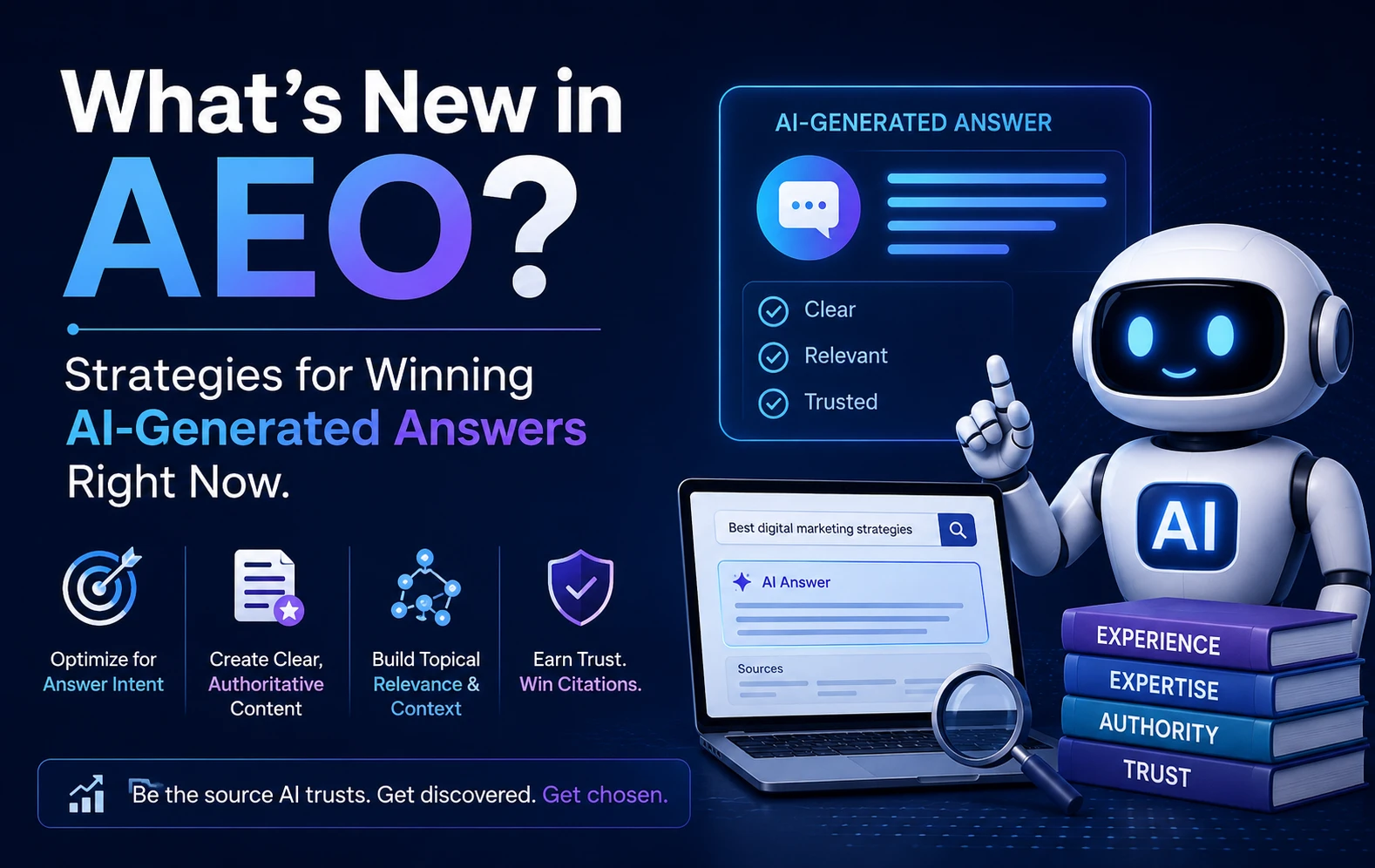
Two years ago, "Answer Engine Optimization" sounded like a buzzword someone invented to sell a course. Today, it's one of the fastest-moving disciplines in digital marketing — and the tactics that worked even six months ago are already starting to lag behind. AI assistants have gotten better at reasoning, retrieval systems have gotten faster, and the businesses winning visibility inside AI-generated answers are playing a noticeably different game than the ones still treating AEO like a side project of SEO.
If you're trying to keep up, here's what's actually changing, and what's working right now.
The single biggest shift is that "AEO" no longer means one thing. It has split into two related but distinct disciplines, and conflating them is why a lot of strategies underperform.
Training-data influence is about shaping what a model "knows" from the massive corpus it was trained on — the slower-moving, harder-to-influence layer. This is where your brand's long-term reputation, historical content footprint, and third-party mentions accumulate weight.
Live retrieval optimization is about how tools like Perplexity, ChatGPT's browsing mode, Google's AI Overviews, and Copilot pull and cite real-time web content when answering a question right now. This layer behaves much more like classic technical SEO — crawlability, structured data, freshness, and page-level clarity all matter enormously here, and changes can show up in results within days rather than months.
The brands seeing the fastest wins right now are the ones treating these as two separate workstreams with two separate timelines, instead of throwing generic "AI-friendly content" at the problem and hoping it works for both.
Marketing copy that's built to persuade a human reader — layered claims, emotional framing, brand storytelling before the substance — is consistently getting passed over by models in favor of content that states things plainly and specifically.
What's winning right now:
A page that opens with "We're passionate about delivering excellence in customer service" gives a model nothing to extract. A page that opens with "Our average first-response time is 4 minutes, and 92% of tickets are resolved within 24 hours" gives it something concrete to cite.
This trend has intensified rather than faded. Community platforms—Reddit especially, but also niche forums, Quora, and product-specific communities—are carrying outsized weight in how models form opinions about brands and recommend alternatives.
What's changed recently is the sophistication of how brands are engaging with this. The crude approach (posting fake glowing reviews) is increasingly detectable and actively penalized in sentiment. The strategies actually working now involve:
For tools that browse the live web, recency is becoming a heavier ranking factor than it was a year ago. Content that's regularly updated — even lightly, with new data points, updated pricing, or refreshed examples — is being favored over static pages that haven't changed in years, even if the older page is technically more comprehensive.
This is pushing more brands toward a "living page" model for their most important content: pillar pages and cornerstone service pages that get revisited quarterly rather than published once and left alone. Timestamps, visible "last updated" dates, and changelogs are becoming small but meaningful trust signals.
As more people interact with AI through voice assistants and multimodal apps rather than typed prompts, the phrasing of winning content is shifting again. Voice queries tend to be longer, more conversational, and closer to natural speech ("what's a good place near me for emergency dental work on a weekend?") than typed search queries ever were.
Brands ahead of this curve are restructuring FAQ sections and headers around full conversational questions rather than fragment-style SEO keywords and are seeing those pages surface more often in voice and conversational AI responses as a result.
As AI-generated content floods the web, models are increasingly able to detect and deprioritize generic, derivative writing — the kind that just recombines what's already been said elsewhere. What stands out now is original: proprietary survey data, internal performance benchmarks, first-hand case studies with real numbers, and unique perspectives that can't be found phrased identically anywhere else.
This is pushing more companies to publish original research reports, internal data breakdowns, and detailed case studies specifically because that kind of content is difficult for a model to have already "seen" elsewhere, which increases both its citation value and its resistance to being drowned out by competitors saying similar things.
Models cross-reference information about a business across many sources, and inconsistencies — a different address on your Google Business Profile than on your website, an outdated service list on a directory, a discontinued product still listed on a review site — actively erode confidence in the accuracy of everything else associated with your brand.
The strategy gaining traction is treating entity consistency as an ongoing audit, not a one-time cleanup: periodically checking how your business is described across your website, major directories, social profiles, and review platforms, and correcting drift before it compounds.
Basic organization and product schema are now table stakes. What's moving the needle further is more granular structured data: FAQ schema tied to the exact questions your content answers, HowTo schema for process-based content, and Review/AggregateRating schema kept genuinely current. Models parsing pages for retrieval lean on these structured hooks to extract clean, unambiguous facts rather than having to infer meaning from prose.
Until recently, one of the biggest frustrations with AEO was the lack of any real way to measure it — brands were optimizing blind. That's changing. Dedicated AI visibility tracking tools now let businesses test how they appear across ChatGPT, Gemini, Perplexity, and Copilot for a defined set of prompts, monitor changes over time, and benchmark against competitors.
This is arguably the most important shift of all, because it moves AEO from a guessing game into something that can be tracked, reported on, and iterated against like any other marketing channel.
The throughline across all of these trends is the same: AI systems are getting better at rewarding substance and penalizing noise. Thin, generic, persuasion-heavy content is losing ground. Specific, structured, regularly refreshed, and genuinely original content is gaining it.
Brands that treat AEO as a real discipline—with its own audit process, its own content standards, and its own measurement—are pulling ahead of competitors still treating it as an SEO afterthought. Given how quickly this space is moving, that gap is likely to widen before it narrows.
If you haven't checked how your brand actually appears across AI assistants recently, that's the logical first step. Everything above only matters once you know where you're starting from.

Have a project in mind? Let’s build something amazing together.
Webbitech — A Leading Web Design & Web Development Company with 15+ Years of SEO & Digital Marketing Expertise, Delivering Countless Success Stories
From idea to execution, we help businesses create high-performing websites and applications.
Start your journey today and take your brand to the next level.