Posted Date : 23 Jun 2026
For years, businesses have focused on Search Engine Optimization (SEO) to improve their visibility on Google and other search engines. Ranking on the first page of search results has been one of the most effective ways to attract website traffic, generate leads, and increase sales.
However, the search landscape is changing rapidly.
With the rise of AI-powered search experiences such as ChatGPT, Google's AI Overviews, Microsoft's Copilot, Perplexity AI, and other generative search engines, users are increasingly receiving direct answers instead of traditional lists of web pages.
This shift has introduced a new term into the digital marketing world:
Generative Engine Optimization (GEO).
Many marketers are asking whether GEO is simply a new buzzword or the next evolution of SEO.
More importantly:
Do businesses actually need it?
Let's explore what GEO is, how it works, and whether it's something your business should prioritize.
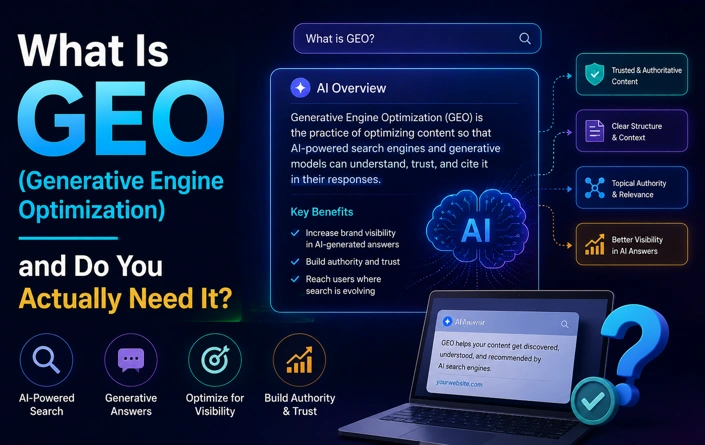
Generative Engine Optimization (GEO) refers to the process of optimizing content so that AI-powered search engines and large language models can discover, understand, trust, and reference it when generating answers.
Unlike traditional SEO, which focuses on ranking webpages in search results, GEO focuses on increasing the likelihood that your content is included in AI-generated responses.
For example:
Traditional SEO aims to rank your website when someone searches:
"Best website design company in Chennai."
GEO aims to make your content a source that AI systems cite, summarize, or recommend when users ask:
"Which website design companies are known for quality web development services?"
The goal shifts from earning clicks to becoming a trusted information source.
Search engines are no longer just displaying links.
Modern AI systems now:
Summarize information
Answer questions directly
Compare products and services
Recommend solutions
Generate personalized responses
Instead of opening ten different websites, users often receive comprehensive answers instantly.
This creates a new challenge for businesses.
If AI provides answers without requiring users to visit websites, how can brands remain visible?
That's where GEO comes into play.
While GEO and SEO are closely related, they serve different purposes.
| Traditional SEO | Generative Engine Optimization |
|---|---|
| Focuses on rankings | Focuses on AI visibility |
| Targets search engine algorithms | Targets AI understanding |
| Optimizes for clicks | Optimizes for mentions and citations |
| Relies heavily on keywords | Relies on context and authority |
| Measures rankings and traffic | Measures visibility in AI responses |
The good news is that strong SEO often supports strong GEO.
The two strategies work together rather than compete.
AI-powered search experiences are growing quickly.
Users now ask conversational questions, such as:
"What's the best CRM for small businesses?"
"Which digital marketing strategies work in 2026?"
"What are the top web development companies for startups?"
Instead of browsing multiple websites, users receive synthesized answers.
If your content becomes part of those answers, your brand gains visibility even before a user visits your website.
Benefits include:
Increased brand awareness
Higher authority perception
Greater trust from users
More qualified traffic
Improved lead generation opportunities
Businesses that become recognized sources may gain a significant advantage as AI search adoption increases.
Many people assume AI randomly selects information.
In reality, AI systems typically prioritize content that demonstrates:
Well-established websites with expertise in a specific subject are more likely to be referenced.
Factually correct and trustworthy information performs better.
Comprehensive content often provides stronger context for AI systems.
Updated information tends to be favored, especially for evolving topics.
Content that is easy to understand, organized, and well-formatted helps AI extract relevant information.
The clearer your content is, the easier it becomes for generative engines to use it.
If you want your content to perform well in AI-driven search environments, focus on the following strategies.
Generic articles are less likely to stand out.
Instead:
Share original insights
Include practical examples
Demonstrate expertise
Answer specific user questions
Depth and quality matter more than ever.
AI systems often favor websites that consistently publish content around a specific area of expertise.
For example:
A web development company should create content about:
Website design
Web development
UX/UI design
Website security
SEO
Digital marketing
This helps establish credibility within a niche.
Organize content using:
Headings
Subheadings
Bullet points
FAQs
Tables
Lists
Structured content is easier for both users and AI systems to understand.
Instead of targeting only keywords, answer the questions users genuinely ask.
Examples:
How much does website development cost?
What makes a good eCommerce website?
Which SEO strategies work today?
The more useful your answers, the more likely they are to be referenced.
Schema markup helps search engines understand content context.
Useful schema types include:
FAQ Schema
Article Schema
Organization Schema
Service Schema
Review Schema
Structured data improves content clarity and discoverability.
AI systems often recognize brands that are mentioned consistently across trusted websites.
Focus on:
Digital PR
Guest posting
Industry publications
Customer reviews
Thought leadership content
Brand authority contributes to GEO success.
The short answer is
Yes—but not as a separate strategy.
Most small businesses should not abandon traditional SEO in favor of GEO.
Instead, they should create high-quality content that naturally supports both.
A strong SEO strategy already includes many GEO-friendly practices:
Helpful content
Topic authority
Clear site structure
Technical optimization
Trustworthiness
Businesses that execute SEO properly are already laying the foundation for GEO.
SEO remains extremely important.
Search engines still drive massive amounts of traffic worldwide.
GEO complements SEO rather than replacing it.
Not entirely.
Many users still want detailed information, comparisons, reviews, and direct interactions with businesses.
Websites remain essential.
Smaller businesses with highly specialized expertise can often outperform larger competitors in AI-generated responses.
Authority matters more than size.
As AI becomes increasingly integrated into search experiences, GEO will likely evolve from a niche concept into a standard marketing practice.
Businesses that:
Publish expert content
Build trust
Demonstrate authority
Provide accurate information
will be better positioned for future search environments.
The brands that focus on helping users rather than gaming algorithms are likely to benefit the most.
Generative Engine Optimization (GEO) represents the next stage in how businesses approach online visibility.
While traditional SEO focuses on ranking web pages, GEO focuses on ensuring that AI-powered search systems recognize and trust your content.
The good news is that businesses don't need to choose between SEO and GEO.
The most effective strategy is to create high-quality, authoritative, user-focused content that serves both search engines and AI systems.
If your website consistently provides valuable information, answers real questions, and demonstrates expertise, you'll be well-positioned for both today's search landscape and tomorrow's AI-driven future.
Rather than asking whether you need GEO, the better question is:
Is your content trustworthy enough for AI to recommend it?

Have a project in mind? Let’s build something amazing together.
Webbitech — A Leading Web Design & Web Development Company with 15+ Years of SEO & Digital Marketing Expertise, Delivering Countless Success Stories
From idea to execution, we help businesses create high-performing websites and applications.
Start your journey today and take your brand to the next level.