Posted Date : 30 Jul 2026
Introduction
Search behavior has changed. People aren't just Googling anymore — they're asking ChatGPT, Claude, Gemini, and Perplexity for recommendations, comparisons, and advice. And when an AI assistant answers, it names names. If your business isn't one of them, you're losing customers before they ever reach your website.
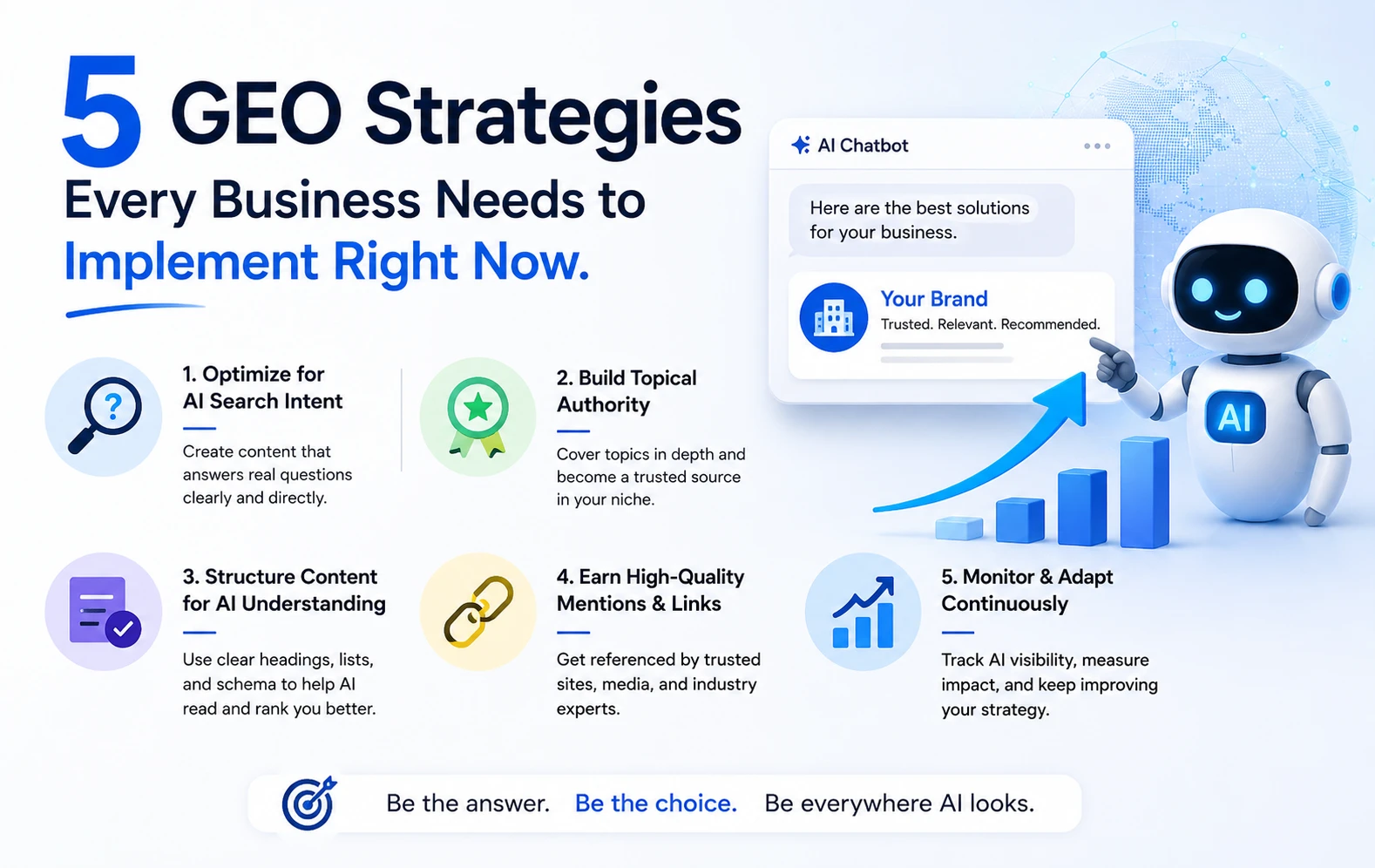
This is where Generative Engine Optimization (GEO) comes in. Unlike traditional SEO, which optimizes for search engine rankings, GEO optimizes for something more direct: getting mentioned, cited, and recommended inside AI-generated answers.
The good news? GEO is still new enough that most businesses haven't caught on yet — which means the ones who act now have a real first-mover advantage. Here are five strategies you can start implementing today.
You can't fix what you haven't measured. Before building a strategy, find out exactly where you stand.
How to do it:
This audit becomes your baseline. Repeat it monthly to track whether your GEO efforts are actually moving the needle.
AI models are trained to extract clear, factual information — not persuasive marketing copy. If your content reads like an ad, it's less likely to be pulled into an AI-generated answer.
How to do it:
Think of every page as a potential answer an AI might quote. Write it that way.
When someone asks an AI assistant to compare products or find alternatives, it needs a source to pull from. If that source doesn't exist on your site, the AI will use a competitor's content — or worse, a competitor's own comparison page that frames you unfavorably.
How to do it:
This is one of the highest-leverage GEO tactics available, because these pages are exactly what AI tools reference when users ask comparison-style questions.
AI models weigh independent, third-party validation heavily — often more than what you say about yourself. Reviews, forum discussions, and roundup articles all shape how AI systems perceive and describe your brand.
How to do it:
Community and review signals are difficult to fake and carry real weight — which is exactly why they matter so much for GEO.
AI models cross-reference multiple sources when forming an answer. If your website says one thing, your G2 listing says another, and your Crunchbase profile is outdated, the AI either picks the wrong version — or drops you from the answer entirely due to conflicting signals.
How to do it:
Consistency isn't glamorous, but it's often the difference between being confidently recommended and being quietly left out.
GEO isn't a future trend — it's already shaping how customers discover and choose businesses today. The strategies above aren't complicated, but they do require consistency and patience: AI models update gradually, so expect results to build over weeks and months, not days.
The businesses that start now — auditing their visibility, publishing factual content, and strengthening third-party trust signals — will be the ones AI assistants are recommending a year from now. The ones who wait will be playing catch-up in a space that's only getting more competitive.
Suggested primary keyword: GEO strategies Suggested internal links: Link to your AEO implementation checklist and AI visibility audit page Suggested CTA: "Not sure where your brand currently stands in AI search? Get a free AI visibility audit and find out."

Have a project in mind? Let’s build something amazing together.
Webbitech — A Leading Web Design & Web Development Company with 15+ Years of SEO & Digital Marketing Expertise, Delivering Countless Success Stories
From idea to execution, we help businesses create high-performing websites and applications.
Start your journey today and take your brand to the next level.