Posted Date : 01 Aug 2026
For nearly two decades, search engine optimization has been the undisputed backbone of digital visibility. Marketers built entire careers around backlinks, keyword density, and the elusive art of pleasing Google's crawlers. But a quieter, more disruptive discipline has entered the arena: answer engine optimization. While the two share a common ancestor, they operate on fundamentally different logic, and conflating them can leave brands invisible in the very places their audience is now looking.
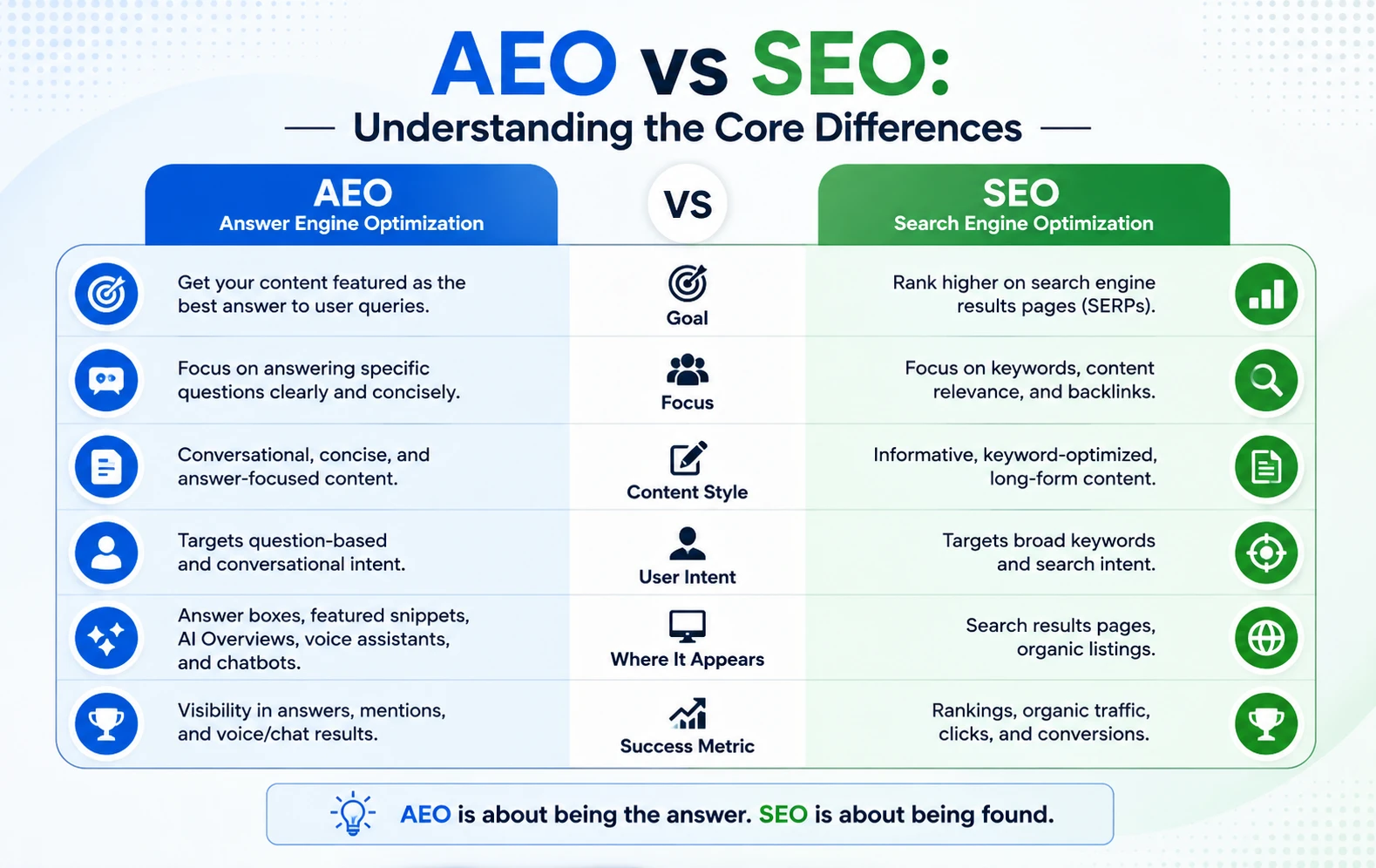
SEO was built to help a page rank among a list of results. Its entire architecture assumes the user will scroll, compare, and click. AEO, by contrast, assumes no such patience. It exists to help a machine formulate a single, synthesized response—often without ever sending the user to your website at all. This is a subtle but seismic distinction. One discipline optimizes for placement; the other optimizes for extraction.
Where SEO practitioners obsess over ranking position, AEO practitioners obsess over retrievability—whether a large language model or voice assistant can lift a discrete, self-contained answer from your content and present it as gospel. Your prose isn't just competing for attention anymore; it's competing to be quoted.
Classic SEO leans heavily on a well-worn toolkit: backlink profiles, domain authority, keyword placement, page speed, and dwell time. These metrics, refined over years of algorithmic iteration, still matter for organic rankings—but they tell only half the story in an answer-driven ecosystem.
Answer engines weigh a different constellation of signals. Semantic clarity often outweighs keyword frequency. A paragraph that answers "what causes tidal locking" in three crisp sentences may outperform a 2,000-word treatise stuffed with target phrases. Structured data, entity recognition, and contextual disambiguation become paramount—machines need to parse meaning, not just match strings.
Consider these contrasting priorities:
SEO tends to reward:
AEO tends to reward:
The overlap is real—authoritative, well-structured content tends to satisfy both paradigms simultaneously. But when the two diverge, the tiebreaker often comes down to how surgically extractable your information is. A meandering introduction, however well-written for human readers, can become a liability when an AI system is scanning for a terse, unambiguous fact.
There's also a temporal wrinkle worth noting: answer engines frequently prioritize recency and corroboration across multiple sources. A single authoritative page might rank beautifully in traditional search yet get passed over by an answer engine that prefers convergence—several independent sources stating the same fact in slightly different words, reinforcing its credibility through consensus rather than singular dominance.
It would be a strategic blunder to treat AEO as a replacement for SEO. The two are less like rivals and more like symbiotic organisms—each strengthening the other's foothold in an increasingly fragmented information landscape.
Strong SEO fundamentals—crawlability, site architecture, and authoritative backlinks—still form the substrate upon which answer engines build their trust models. A page with negligible domain authority is unlikely to be surfaced by an AI system, regardless of how elegantly its answers are phrased. Conversely, a technically pristine SEO strategy that ignores answer-friendly formatting risks becoming invisible in the growing share of zero-click and conversational queries.
The pragmatic path forward is hybridization. Build the deep, comprehensive content that satisfies traditional ranking algorithms, but embed within it the crisp, extractable answer blocks that AI systems crave. Think of SEO as the foundation and AEO as the finishing layer—the polish that ensures your carefully constructed expertise doesn't just rank but gets cited, voiced, and trusted by the machines increasingly mediating human curiosity.
Brands that master this duality won't just survive the transition to answer-driven search. They'll become the default voice that both algorithms and audiences reach for.
Have a project in mind? Let’s build something amazing together.
Webbitech — A Leading Web Design & Web Development Company with 15+ Years of SEO & Digital Marketing Expertise, Delivering Countless Success Stories
From idea to execution, we help businesses create high-performing websites and applications.
Start your journey today and take your brand to the next level.