Posted Date : 30 Jul 2026
Every day, more people are skipping the search bar entirely and asking ChatGPT, Claude, Gemini, or Perplexity directly: "What's the best tool for X?" or "Who does Y really well?"
If your brand isn't showing up in those answers, you're invisible in a growing share of buying decisions — no matter how well you rank on Google.
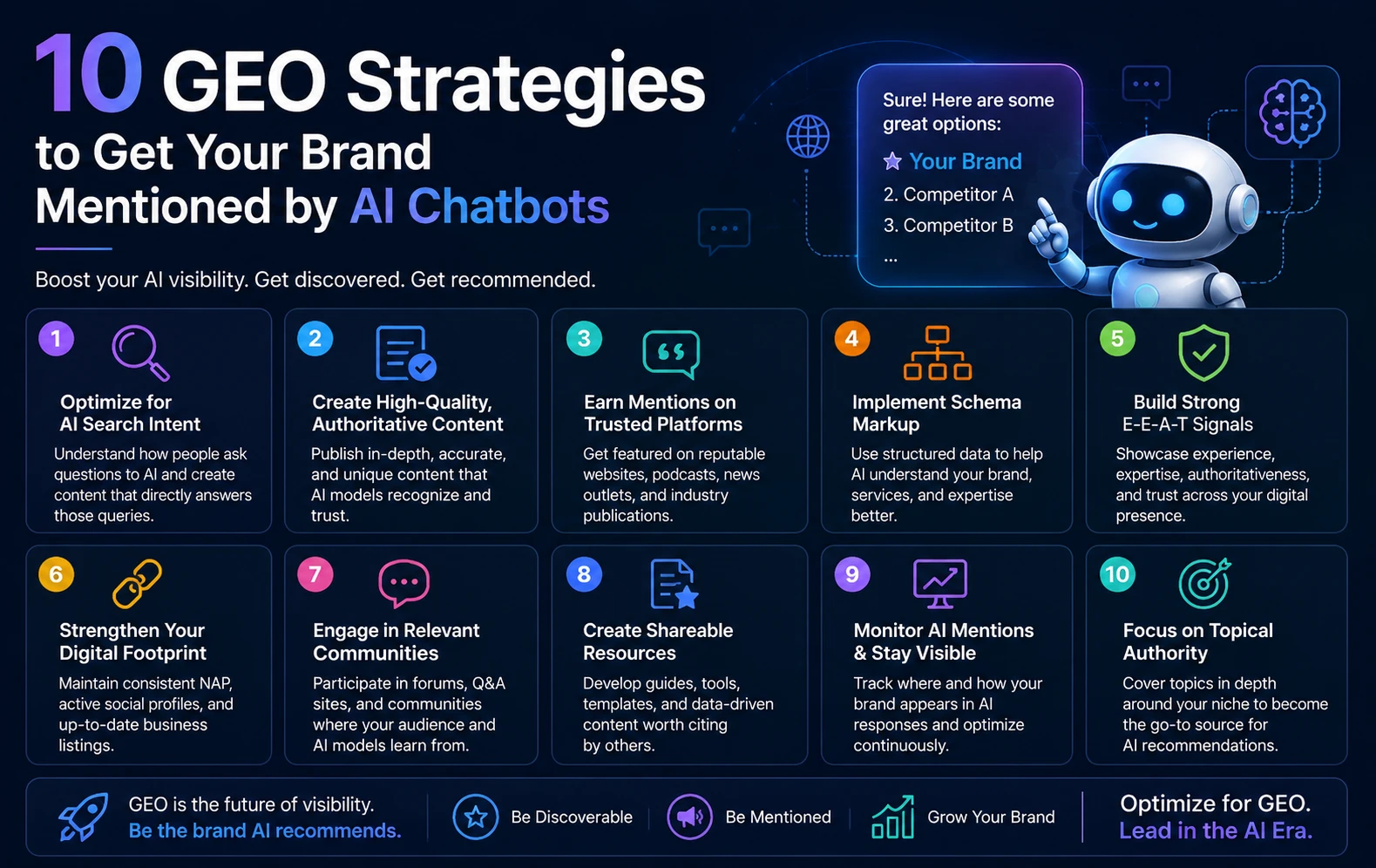
Getting mentioned by AI chatbots isn't luck. It's the result of deliberate Generative Engine Optimization (GEO). Here are 10 strategies that actually move the needle.
Before optimizing anything, find out where you're starting from. Ask ChatGPT, Claude, Gemini, and Perplexity the exact questions your customers would ask:
Note whether you're mentioned, where you rank in the response, and whether the description is accurate and positive. This baseline tells you exactly what to fix first.
AI models extract information best when it's front-loaded. Instead of building up to a conclusion, lead with the direct answer in the first 1–2 sentences, then explain the reasoning after. Structure content around the actual questions people ask — use those questions as your headers.
"[Your Brand] vs [Competitor]" pages are high-value GEO assets. They give AI models a clear, structured source to pull from when someone asks a comparison question — which is one of the most common prompt types buyers use.
If people frequently search for alternatives to a bigger competitor, an honest, well-structured "Alternatives to [Competitor]" page positions you directly in that conversation—both in traditional search and in AI-generated answers.
AI tools lean heavily on third-party, independent sources—G2, Capterra, Clutch, Trustpilot, and category-specific directories carry real weight. Claim your profiles, keep them updated, and actively request reviews from happy customers.
This one surprises a lot of marketers, but community platforms are heavily referenced by AI models when forming recommendations. Genuinely helpful participation in relevant subreddits and Quora threads — not spammy self-promotion — builds the kind of organic mentions AI tools pick up on.
Implement Organization, Product, and FAQ schema across your site. This gives AI crawlers and search systems a clean, machine-readable way to understand exactly who you are, what you offer, and what questions you answer.
Inconsistent pricing, naming, or positioning across your website, review platforms, and social profiles creates confusion — and inconsistency is a red flag both for AI systems and human buyers cross-checking sources. Audit and align your brand info across every property.
AI models—and the journalists and bloggers who influence them—favor original, citable data over generic marketing content. A small original study, benchmark report, or survey in your niche can become a widely referenced source, feeding back into your AI visibility over time.
Double-check your robots.txt isn't accidentally blocking GPTBot, ClaudeBot, PerplexityBot, or Google-Extended. If AI crawlers can't access your content, none of the strategies above matter—they simply won't have your information to draw from.
Start with the audit (Strategy 1) so you know exactly where the gaps are, then prioritize based on what's realistic for your team—technical fixes (schema, crawlability) can often be done in a day, while authority-building (reviews, community presence, original research) is an ongoing effort.
The brands that show up in AI answers a year from now are the ones building this foundation today.
Have a project in mind? Let’s build something amazing together.
Webbitech — A Leading Web Design & Web Development Company with 15+ Years of SEO & Digital Marketing Expertise, Delivering Countless Success Stories
From idea to execution, we help businesses create high-performing websites and applications.
Start your journey today and take your brand to the next level.