Posted Date : 21 Jul 2026
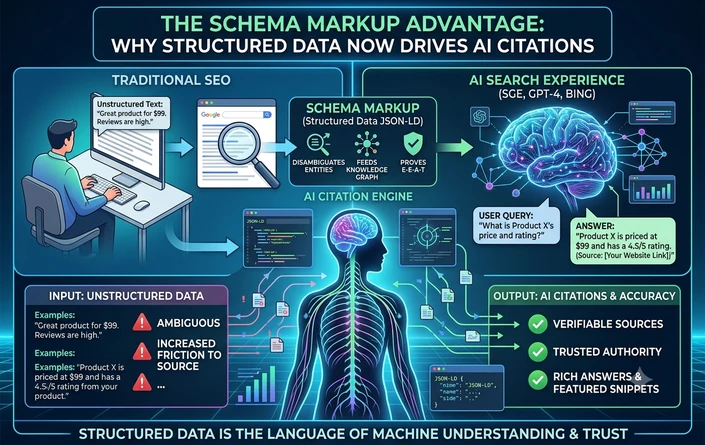
For years, schema markup was treated as a technical nice-to-have — something that might earn you a rich snippet or a slightly better click-through rate, but rarely a priority on the roadmap. That calculus has changed. In 2026, schema markup isn't just a search engine courtesy; it's one of the clearest, most measurable levers for getting cited by AI systems like ChatGPT, Perplexity, and Google's AI Overviews.
And the numbers make the case better than any theory could.
Sites that combine proper AI crawler permissions, real-time indexing, and structured markup earn AI citations at a rate 61.7% higher than sites that skip these fundamentals. That's not a marginal SEO improvement—that's the difference between showing up in the answer an AI gives your prospective customer and not existing in that conversation at all.
The three pillars behind that lift work together: explicitly allowing AI crawler user-agents in robots.txt, implementing the IndexNow protocol for near-real-time indexing, and adding properly populated schema markup that gives large language models structured context about your content. Schema is the piece that turns raw content into something a machine can confidently understand and reuse.
Traditional search engines could get away with parsing unstructured text reasonably well—crawl the page, extract keywords, and rank based on relevance signals. AI systems operate differently. They're not just indexing your page; they're trying to understand entities, relationships, and factual claims well enough to synthesize an answer or make a recommendation on your behalf.
That's a much higher bar, and it's exactly where schema earns its value. Structured data explicitly labels what a piece of content is—a product, an article with a specific author and publish date, a business with a location, a video, or a review—removing the ambiguity that a language model would otherwise have to infer. The clearer the label, the more confidently an AI system can cite it.
Not all markup carries equal weight for AI visibility. The types making the biggest difference right now include:
Populating these thoroughly—not just technically validating them—is what separates sites earning the citation lift from sites that added schema once and never revisited it.
There's a reason an attribute-rich schema performs better than sparse, minimal implementations. AI systems are effectively making a trust judgment every time they decide whether to cite a source. Structured data that's complete, accurate, and consistent with the visible content on the page reads as a credible, well-maintained source — exactly the kind of signal that pushes an LLM toward citing you instead of a competitor with thinner markup.
This is also why schema can't be treated as a one-time technical task. Stale or inconsistent structured data—an author field that doesn't match the byline, a price in schema that doesn't match the page—actively undermines the trust signal you're trying to build.
Schema markup has quietly become one of the highest-leverage technical SEO investments available in 2026 — not because it changed, but because the systems reading it did. AI engines need structured, unambiguous signals to cite content with confidence, and the brands feeding them that clarity are the ones showing up in the answers customers actually see. If your schema implementation hasn't been revisited since before AI search became mainstream, that audit is likely your fastest path to measurable visibility gains.
Not sure how complete your current schema really is? Start by pulling up your highest-traffic pages and checking whether your structured data is fully populated — not just technically valid — against the priority types above.

Have a project in mind? Let’s build something amazing together.
Webbitech — A Leading Web Design & Web Development Company with 15+ Years of SEO & Digital Marketing Expertise, Delivering Countless Success Stories
From idea to execution, we help businesses create high-performing websites and applications.
Start your journey today and take your brand to the next level.