Posted Date : 07 Aug 2026
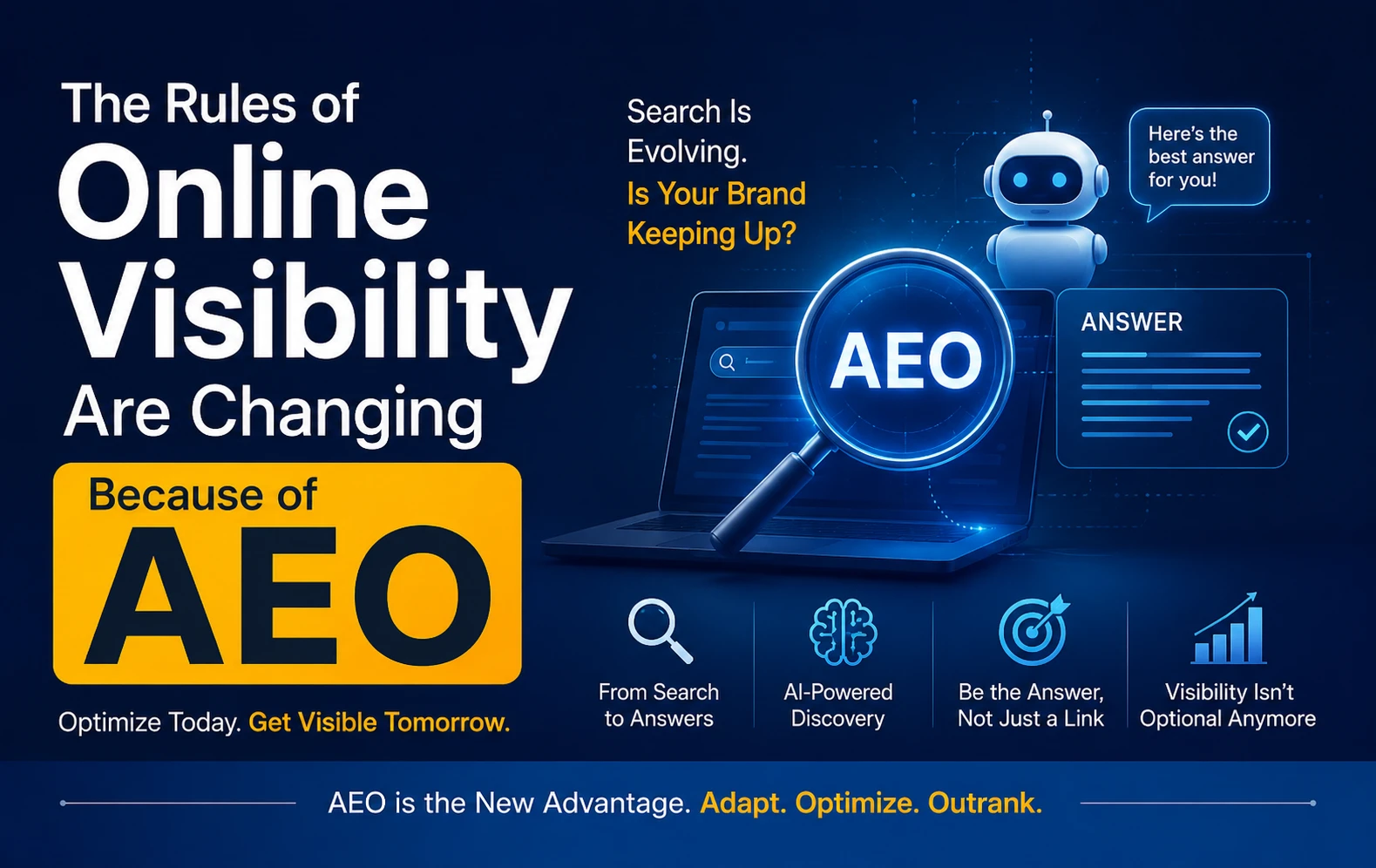
Nobody sent out a press release when the internet changed its mind about how people find information. There was no single headline, no dramatic announcement. Yet somewhere between the rise of conversational AI and the quiet decline of the traditional search click, the entire architecture of online visibility shifted beneath marketers' feet. This transformation has a name now: Answer Engine Optimization, or AEO. And it is not a passing trend — it is a structural realignment of how discovery works.
AEO is the discipline of shaping content so that it can be extracted, understood, and confidently cited by AI systems that generate direct answers rather than lists of links. Where search engine optimization courted algorithms designed to rank pages, AEO courts language models designed to synthesize answers. The distinction sounds subtle. Its consequences are not. A brand invisible to answer engines risks becoming invisible to an entire generation of information seekers who no longer click through ten results—they simply ask and trust what they're told.
For a generation, the search results page followed a predictable liturgy: a query, then ten ranked links, then a click. That format is eroding. AI Overviews sit atop search results and often answer the question before a single link is touched. Chat-based assistants skip the list entirely. The blue link, once the atomic unit of the internet economy, is losing its monopoly on how answers travel.
A search engine's job was retrieval—hand the user a menu and let them choose. An answer engine's job is synthesis — read the menu on the user's behalf and hand back a conclusion. This shift moves the point of decision upstream. Instead of competing to be chosen by a human scrolling a page, brands now compete to be selected by a model assembling a paragraph. The battlefield has moved from the results page to the training and retrieval layer itself.
Large language models do not cite randomly. They favor content that is unambiguous, well-structured, and corroborated elsewhere. A claim stated plainly and confirmed across multiple credible sources is far more likely to surface in a generated answer than a claim buried in marketing flourish. Models are, in a sense, skeptical editors — they reward clarity and consensus, and they quietly discard noise.
It would be a mistake to treat AEO as a replacement for SEO. The two disciplines share DNA. Technical fundamentals — site speed, crawlability, clean architecture — still matter enormously. What changes is the endpoint. SEO optimizes for a ranked position a human will scroll toward. AEO optimizes for an extractable unit of meaning a machine will lift wholesale. The savviest content strategies now build for both destinations simultaneously.
A growing share of queries now resolve without a single click to a publisher's website. This is often mourned as a loss of traffic, and in raw numbers, it is. But it also represents a new opportunity: brand impression without the friction of a visit. Being the source behind an AI's answer, even without a click, builds a form of ambient authority that traditional analytics struggle to measure but audiences absolutely notice.
Sprawling, unstructured prose is difficult for a model to parse cleanly. Content organized into discrete, well-labeled sections — each answering a single, specific question — is dramatically easier to extract and cite. Length alone no longer signals authority. Legibility does.
The opening line of any section now carries outsized weight. Answer engines frequently lift the first sentence or two of a passage as the core of their response, treating everything after as elaboration. Burying the answer beneath a paragraph of preamble is a habit AEO punishes swiftly. State the conclusion first. Justify it after.
Where SEO once rewarded the repetition of exact-match keywords, AEO rewards conceptual precision. Language models parse meaning, not just tokens. A sentence that clearly and unambiguously explains a concept, even without repeating a target keyword verbatim, often performs better than a keyword-stuffed alternative that obscures its own point.
Authorship transparency, citation of primary sources, consistency with established facts, and corroboration across independent domains all function as trust signals to answer engines. Content that reads as confidently vague, or that contradicts widely established consensus without strong evidence, is far less likely to be treated as reliable.
Marketers have spent two decades optimizing dashboards for click-through rate. That metric is losing its primacy. The emerging currency is the citation—being named, quoted, or summarized inside an AI-generated answer. Citations build brand recall and authority even in the absence of a visit, and forward-thinking teams are beginning to track "share of answer" the way they once tracked share of voice.
Voice assistants were an early preview of the answer-engine future. A spoken query typically receives exactly one response — no scrolling, no comparing options. The content that wins voice queries has always needed the traits AEO now demands broadly: concise, direct, unambiguous answers to specific questions.
Definitional statements, comparison tables, numbered steps, and FAQ-style question-and-answer blocks consistently outperform dense narrative prose in AEO contexts. These formats mirror the shape of the questions users actually ask, making the alignment between query and answer nearly frictionless for a model to detect.
Schema markup gives machines an explicit, unambiguous map of a page's content — what is a product, what is a review, what is a frequently asked question. While schema alone does not guarantee inclusion in an AI answer, it removes interpretive ambiguity, making it easier for automated systems to trust and parse what a page contains.
Exaggeration and vague superlatives, once tolerable in marketing copy, now carry real risk. Answer engines increasingly cross-reference claims against other sources, and content that cannot withstand that scrutiny is quietly filtered out of the answers being generated. Precision is not just an ethical preference anymore; it is a functional requirement for visibility.
A brand's story told inconsistently across its own website, review platforms, directories, and social profiles creates ambiguity that undermines an AI model's confidence in any single version. Uniform, corroborated messaging across the entire web presence strengthens the likelihood that a model treats a brand's claims as reliable.
Traditional analytics platforms were not built to measure being quoted inside someone else's generated answer. New measurement approaches are emerging — tracking brand mentions across AI outputs, monitoring referral patterns from AI platforms, and auditing how a brand is described when directly queried inside major assistants. These practices are nascent, but they are quickly becoming as essential as rank tracking once was.
Many organizations chase AEO by simply adding an FAQ section without restructuring their core content. Others obsess over one AI platform while ignoring the broader shift entirely. A more common error still is treating AEO as a one-time technical fix rather than an ongoing editorial discipline that must be revisited as models and their behaviors evolve.
An effective workflow bakes AEO principles into creation from the outset: draft with the direct answer first, structure around real user questions, verify claims against credible sources before publishing, and audit periodically to confirm how AI platforms are representing the content. This is not a bolt-on tactic. It is a shift in editorial habit.
Brands that ignore this shift are not merely missing a trend; they risk a slow erosion of relevance in exactly the moments when potential customers are asking the questions that matter most. Invisibility inside an AI-generated answer is a quieter, less measurable loss than a dropped search ranking, but it compounds just as steadily.
The rules of online visibility have not been abolished so much as rewritten by a new class of reader—one that reads at scale, synthesizes instantly, and answers on a brand's behalf whether that brand is prepared or not. AEO is the emerging discipline of meeting that reader on its own terms: with clarity, structure, and substantiated authority. The brands willing to adapt early will find themselves quoted in the conversations that matter. The rest will simply go unheard.
Have a project in mind? Let’s build something amazing together.
Webbitech — A Leading Web Design & Web Development Company with 15+ Years of SEO & Digital Marketing Expertise, Delivering Countless Success Stories
From idea to execution, we help businesses create high-performing websites and applications.
Start your journey today and take your brand to the next level.