Posted Date : 30 Jul 2026
For the last two decades, marketers have obsessed over one question: "Where do we rank on Google?" SEO built entire careers, budgets, and business strategies around that single blue-link results page.
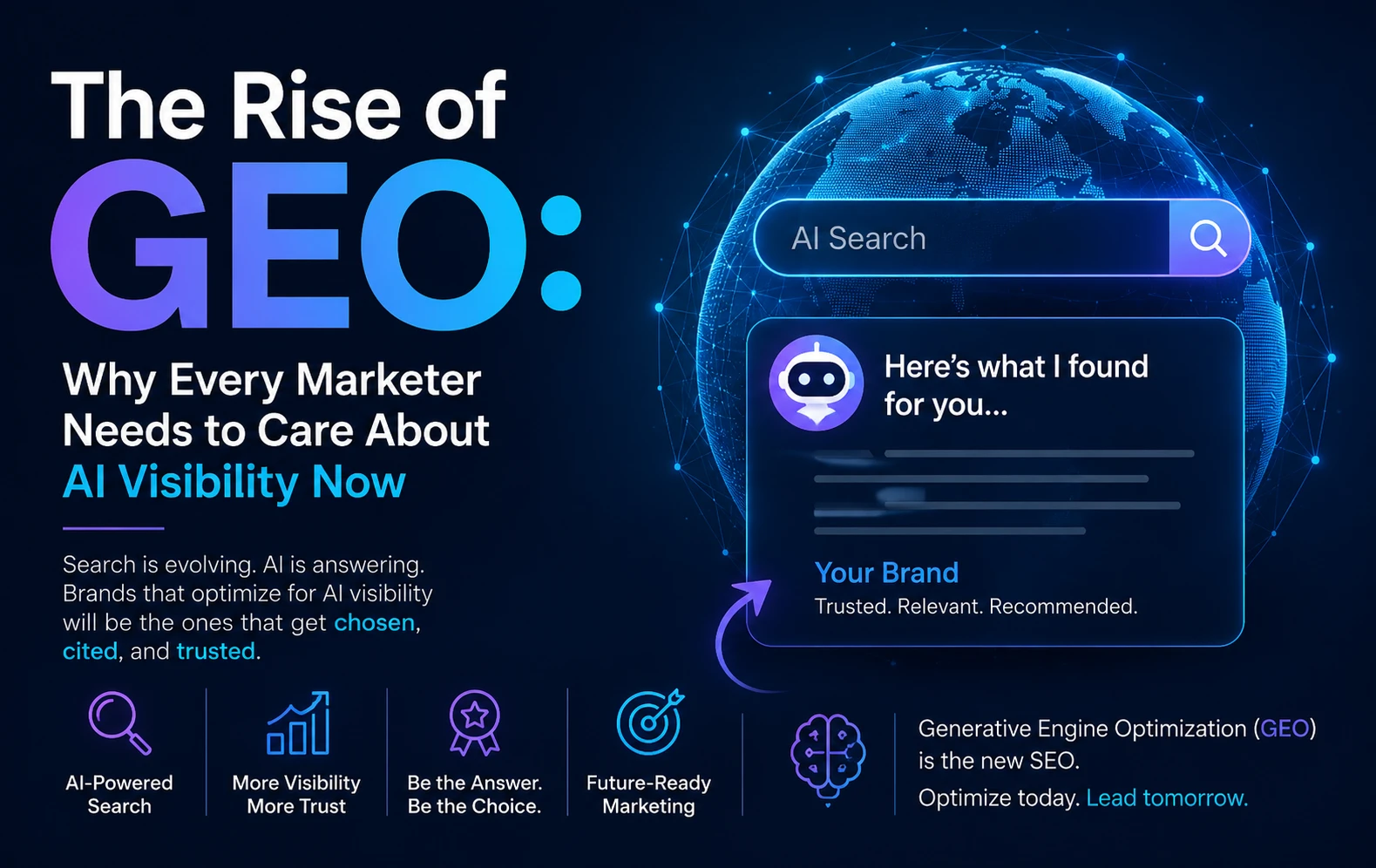
But there's a quieter shift happening right now — and it's already changing how people find businesses, products, and answers. It's called GEO: Generative Engine Optimization, and if you're not paying attention to it yet, your competitors probably already are.
GEO is the practice of optimizing your brand's content and online presence so that AI systems — ChatGPT, Claude, Gemini, Perplexity, Copilot, and Google's AI Overviews — mention, recommend, and cite you when people ask questions.
Think about how search behavior is changing:
In each of these moments, there's no scrolling, no second page, no ten blue links to compete across. There's often just one answer. And if your brand isn't part of that answer, you don't exist in that moment — no matter how well you rank on page one of traditional Google search.
That's the entire premise behind GEO: optimizing for the moment AI generates an answer, not just the moment a search engine returns a list of links.
People increasingly start their research in AI chat tools instead of a search bar. Product discovery, service comparisons, "best of" recommendations, and even purchase decisions are happening inside a conversation with an AI assistant — often before a traditional search ever takes place.
In classic SEO, ranking #4 or #5 still got you clicks. In GEO, there's frequently no ranking list at all — just a handful of brands mentioned by name inside a generated response. Being "close" to visible isn't the same as being visible.
Whether you've optimized for it or not, AI tools already have something to say when someone asks about your industry, your product, or even your company by name. The only question is whether what they're saying is accurate, favorable, and complete — or outdated, incomplete, and skewed toward your competitors.
AI models lean heavily on Reddit threads, review platforms, comparison articles, and independent third-party content — often more than they lean on your own website copy. This is a meaningful shift from traditional SEO, where owned content and backlinks did most of the heavy lifting.
| Traditional SEO | GEO | |
|---|---|---|
| Goal | Rank high in search results | Get mentioned/cited in AI-generated answers |
| Success metric | Click-through rate, rankings | Presence, sentiment, and position within AI answers |
| Content style | Keyword-optimized, link-driven | Clear, factual, directly answerable |
| Key influencers | Backlinks, domain authority | Reddit, reviews, comparison content, structured data |
| User experience | Multiple results to browse | One synthesized answer, often with no click at all |
GEO doesn't replace SEO — it builds on it. Many of the same fundamentals (authority, structure, credibility) still matter. But how they're evaluated and what gets rewarded has shifted.
1. Audit your current AI visibility. Ask ChatGPT, Claude, Gemini, and Perplexity the exact questions your customers would ask—"best [category] for [use case]," "[your brand] vs. [competitor]," and "alternatives to [competitor]." See if you show up, where you rank in the response, and how accurately you're described.
2. Publish clear, structured, answer-first content. AI models favor content that gets straight to the point. Lead with the direct answer, then explain. Use headers that mirror real questions. Build comparison tables AI tools can easily extract and reference.
3. Strengthen your third-party footprint. Get listed and reviewed on relevant platforms (G2, Capterra, Clutch, Trustpilot, industry-specific directories). Participate genuinely in Reddit and Quora communities where your audience is asking real questions.
4. Keep your information consistent everywhere. Inconsistent pricing, naming, or positioning across your website, review platforms, and social profiles creates confusion — for both AI systems and human buyers.
5. Treat it as an ongoing program, not a one-time fix. AI visibility changes slowly and requires re-testing and refreshing content regularly, since model training and retrieval data can lag behind real-world changes.
SEO isn't dead — but it's no longer the whole game. A growing share of buying decisions, recommendations, and brand discovery is happening inside AI conversations that never touch a traditional search results page.
Marketers who start building AI visibility now—through structured content, third-party credibility, and consistent, accurate information—will be the brands AI assistants recommend by default over the next few years. The ones who wait will be optimizing for a search landscape that's already moved on.
The question isn't whether GEO matters. It's about whether your brand will be part of the answer—or left out of the conversation entirely.

Have a project in mind? Let’s build something amazing together.
Webbitech — A Leading Web Design & Web Development Company with 15+ Years of SEO & Digital Marketing Expertise, Delivering Countless Success Stories
From idea to execution, we help businesses create high-performing websites and applications.
Start your journey today and take your brand to the next level.