For Business Enquiry: +91 97892 39293
WEBBITECH

Task-Specific AI Agents Are Coming to 40% of Enterprise Apps by 2026 — Is Your App Ready?

Task-Specific AI Agents Are Coming to 40% of Enterprise Apps by 2026 — Is Your App Ready?

Task-Specific AI Agents Are Coming to 40% of Enterprise Apps by 2026 — Is Your App Ready?

Task-Specific AI Agents Are Coming to 40% of Enterprise Apps by 2026 — Is Your App Ready?

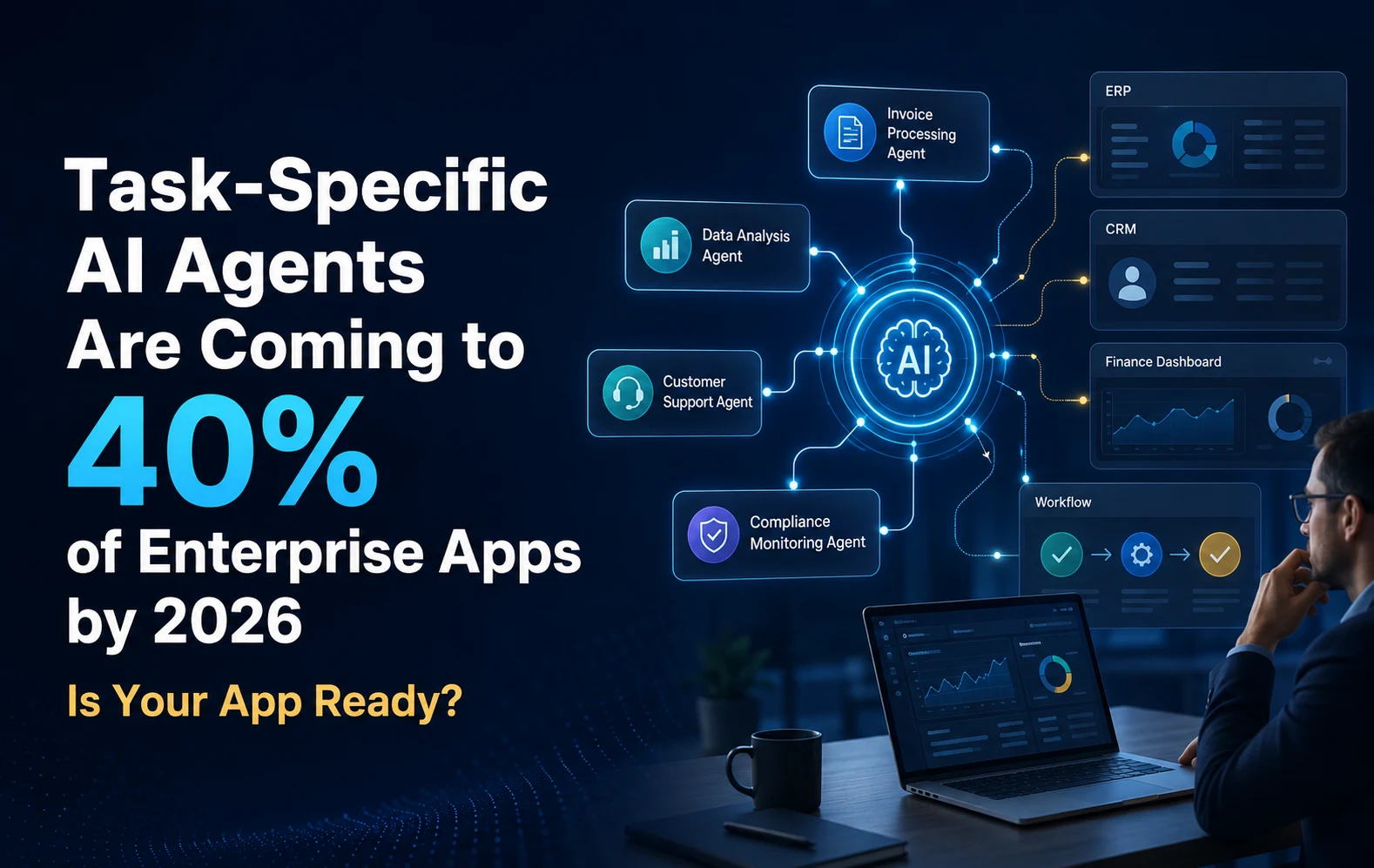
Two years ago, "AI integration" in a mobile app usually meant one thing: bolting a chatbot onto an existing product and calling it innovation. That era is over. According to Gartner, task-specific AI agents will be embedded in 40% of enterprise applications by the end of 2026, up from less than 5% in 2025 — an eightfold jump in roughly two years.

That's not a niche trend anymore. It's a shift in how enterprise mobile apps are architected, funded, and expected to perform. If your app roadmap still treats AI as an add-on feature rather than core infrastructure, you're already behind the curve—and the gap is widening fast.

What "Task-Specific AI Agents" Actually Means

It's worth being precise here, because the term gets diluted fast in marketing copy.

A task-specific AI agent isn't a general chatbot that answers questions. It's a purpose-built system that:

  • Owns a defined task end-to-end (approving an expense, triaging a support ticket, reconciling an invoice)
  • Makes decisions and takes actions without waiting for a human to confirm each step
  • Operates within guardrails specific to its domain, rather than trying to be a general-purpose assistant
  • Integrates directly into the app's core workflow, not a side panel or help widget

The difference matters. A chatbot answers, "How do I request time off?" An agent actually processes the time-off request, checks it against policy and team calendars, and either approves it or escalates it inside the app, without a human touching every step.

Why This Is Accelerating Right Now

Three forces are converging to push this shift from "interesting" to "necessary":

1. The economics finally work. Running task-specific agents in production used to require custom infrastructure that only the largest enterprises could justify. Cheaper inference, better tooling, and mature agent frameworks have collapsed that cost curve. What required a dedicated ML team in 2023 is now achievable by a mid-sized product team.

2. User expectations have moved. Consumers and enterprise users alike have gotten used to AI that does things, not just AI that talks. An app that still requires five manual taps to complete something an agent could handle in one now feels dated—and dated apps lose engagement.

3. Competitive pressure is real, not hypothetical. When 40% of enterprise apps are shipping agentic capabilities, the remaining 60% aren't competing on a level playing field. Procurement teams and end users increasingly ask, "Does this have AI-native workflows?" as a baseline requirement, not a differentiator.

What This Looks Like in Production

Task-specific agents are already showing up in recognizable patterns across industries:

  • Fintech apps using agents to flag and resolve transaction discrepancies before a human ever sees a ticket
  • Healthcare apps using agents to triage patient intake forms and route to the right department automatically
  • Field service apps using agents to reschedule technician visits in real time based on traffic, part availability, and priority
  • HR and internal tools using agents to process routine approvals (PTO, expense reports, access requests) without manager intervention for standard cases

The common thread: these agents aren't replacing the app's UI. They're replacing the manual decision-making that used to sit behind the UI.

The Architecture Shift Behind the Trend

Adding a task-specific agent isn't a matter of dropping an API call into an existing screen. Teams that are shipping this successfully are making structural changes:

  • API-first design. The agent needs to act on the same backend the UI does, so API layers are being built before — not after — the interface.
  • Scoped permissions. Agents are given narrow, auditable access to specific functions rather than broad system access, both for safety and for regulatory compliance.
  • Human-in-the-loop escalation paths. Well-designed agentic features don't remove humans entirely — they define clearly when a case needs to be escalated, which is often the difference between a trustworthy feature and a liability.
  • Observability built in from day one. Because agents take autonomous action, teams need logging and monitoring that shows exactly what decision was made and why, not just what the output was.

Where Teams Get This Wrong

Not every attempt at agentic AI succeeds, and the failure pattern is consistent:

  • Treating the agent as a feature instead of a workflow. Teams that try to wedge an agent into an existing screen without rethinking the underlying process usually ship something that feels bolted on and gets ignored.
  • No clear escalation boundary. Agents that are given too much autonomy without a defined "hand this to a human" threshold create trust problems fast, especially in regulated industries.
  • Skipping the groundwork. Agents perform only as well as the data and APIs behind them. Teams that skip clean API design end up with agents that are unreliable in exactly the situations where reliability matters most.

Is Your App Actually Ready?

A few honest questions worth asking before committing engineering time:

  1. Is there a task in your app right now that's still fully manual, high-frequency, and rule-governed enough that an agent could reasonably own it?
  2. Does your backend expose that task through a clean API, or is the logic buried in UI code?
  3. Do you have a plan for what happens when the agent gets it wrong — not just a hope that it won't?
  4. Are you building this because it solves a real user friction point, or because "AI agent" looks good in a pitch deck?

Teams that can answer all four clearly are the ones actually shipping production agents in 2026. Teams that can't are the ones producing the AI-feature-as-afterthought products that users quietly stop using.

The Bottom Line

The 40%-by-2026 figure isn't a prediction to watch from the sidelines—it's a snapshot of what's already shipping. The apps pulling ahead aren't the ones with the flashiest AI marketing copy. They're the ones that picked one real, recurring task, built the API and guardrails to support it properly, and let an agent quietly own it end-to-end.

The question isn't whether task-specific agents are coming to enterprise mobile apps. They're already here. The question is whether your app is architected to support one—or whether you're still planning to bolt one on later and hope it holds.

About the Author

Webbitech is a leading website design and web development company in Coimbatore,

🚀 Get Your Project Started

Have a project in mind? Let’s build something amazing together.

🏆#1 Website Design & Web Development Company - Trusted by 500+ Business Owners

Webbitech — A Leading Web Design & Web Development Company with 15+ Years of SEO & Digital Marketing Expertise, Delivering Countless Success Stories

🚀Let’s Build Something Amazing Together

From idea to execution, we help businesses create high-performing websites and applications.
Start your journey today and take your brand to the next level.
Related Articles

Top 10 Mobile App Development Companies and App Developers in Bangalore (2026)

Top 10 Mobile App Development Companies and App Developers in Bangalore (2026)

Task-Specific AI Agents Are Coming to 40% of Enterprise Apps by 2026 — Is Your App Ready?

Task-Specific AI Agents Are Coming to 40% of Enterprise Apps by 2026 — Is Your App Ready?

MCP Apps Explained: How Claude Now Renders Interactive UIs Inside Chat

MCP Apps Explained: How Claude Now Renders Interactive UIs Inside Chat

Claude + MCP in 2026: From Anthropic Side Project to Linux Foundation Standard

Claude + MCP in 2026: From Anthropic Side Project to Linux Foundation Standard

MCP's Biggest Update Yet: What the July 2026 Spec Release Means for Developers

MCP's Biggest Update Yet: What the July 2026 Spec Release Means for Developers

WhatsApp Webbitech Get Free Consulting Get In Touch