Posted Date : 09 Sep 2026
For most of its life, ChatGPT was ad-free by design. That changed fast. OpenAI began showing sponsored placements to logged-in Free and ChatGPT Go users in the United States on February 9, 2026, and by May 5 it had opened a self-serve Ads Manager to any eligible business—no minimum spend required. By August, the platform had expanded into the UK, Mexico, Brazil, Japan, South Korea, and more than 30 European markets.
If you're running an app-based startup, that's a real question mark on your acquisition roadmap: a brand-new, high-intent channel with hundreds of millions of weekly users—but also one with immature attribution, limited targeting, and a price tag that isn't automatically cheaper than the channels you already know.
This guide breaks down what ChatGPT ads actually are, what they cost, how they stack up against Meta and Google for app growth, and a practical framework for deciding whether your startup should test the channel now or wait.
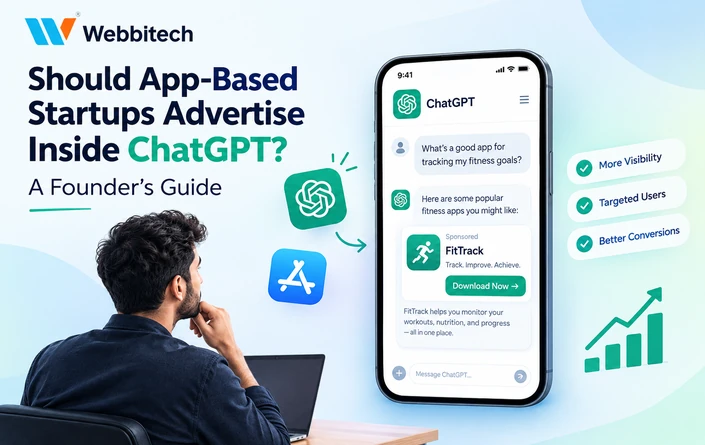
ChatGPT ads aren't banner ads or video pre-rolls. They're a single sponsored unit—business name, small logo, headline, short description, and a link—that appears in a visually distinct, clearly labeled box below an AI-generated answer. There's no separate ad feed and no scrolling; the ad shows up in the flow of a real conversation, matched to what the user is currently asking about.
A few structural details matter for founders evaluating the channel:
The pace of change here is unusually fast, which matters if you're budgeting off an article that's more than a couple of months old:
OpenAI has said it plans to keep expanding markets and ad formats through the rest of the year, so treat any pricing or feature detail—including everything below—as a snapshot, not a permanent spec sheet.
There's no fixed rate card, but industry reporting and OpenAI's own bid guidance converge on a fairly consistent range:
| Bidding model | Typical range | Notes |
|---|---|---|
| CPM (Reach) | $25–$60 per 1,000 impressions | $60 was the original launch-era max bid; real clearing prices have softened as inventory scaled |
| CPC (Clicks) | $3–$5 per click | Software and finance CPCs run higher, around $8–$18; ecommerce sits closer to $3–$5 |
| CPA (conversions) | Varies by advertiser | Rolling out to accounts with pixel or Conversions API tracking already in place; early OpenAI benchmarking found conversion-optimized bidding delivered a meaningfully lower cost per result than click bidding in the same accounts. |
| Minimum daily budget | As low as $20–$25/day | Down from a reported $200,000 minimum commitment at launch |
Bids that come in noticeably below the $3 CPC floor tend to fail to clear delivery thresholds entirely—the auction simply won't spend the budget rather than deliver cut-rate impressions.
App-based startups live and die by user acquisition cost, and ChatGPT introduces a genuinely different kind of impression than anything in your current media mix.
The intent signal is unusually strong. A person asking ChatGPT "what's the best app for tracking macros" or "how do I split rent with roommates" is further down the decision funnel than someone scrolling Instagram. That's closer to a Google Search moment than a social discovery moment — arguably a better fit for utility, productivity, finance, health, and habit-tracking apps than for pure entertainment or impulse-driven categories.
There's no native app-install objective yet. Google UAC and Meta App Ads are purpose-built for driving installs, with deep-linking, install attribution, and app-store creative formats baked in. ChatGPT Ads currently send users to a landing page or link — you're responsible for routing that click into an app store listing or a mobile web experience, and attribution runs through OpenAI's newer Conversions API and pixel rather than a mature mobile measurement partner integration like Meta or Google offer.
Reach is still small relative to installed-base channels. Ads only show to Free and Go tier users, and the platform is still expanding market by market. If your growth model depends on volume at scale today, ChatGPT alone won't move the needle the way Meta or TikTok can.
Category restrictions are inconsistent. OpenAI's published category rules have been described as internally conflicting — legal services and healthcare appear on both the "limited" and "disallowed" lists in current policy documentation, even though ads in those verticals have been observed running. If your app touches health, finance, or legal use cases, get compliance sign-off before committing meaningful budget.
| Factor | ChatGPT Ads | Meta App Ads | Google UAC |
|---|---|---|---|
| Targeting | Contextual, conversation-based | Detailed interest/lookalike/behavioral | Automated, signal-based across Search, Play, YouTube |
| Native app-install format | Not yet | Yes, deep integration | Yes, purpose-built |
| Typical cost | $3–$5 CPC, $25–$60 CPM | Varies widely by vertical, often lower CPM | Varies by category and competition |
| Attribution maturity | New (pixel + Conversions API, May 2026) | Mature (MMP integrations, SKAN) | Mature (Play/App Store linked) |
| Audience reach | Free/Go tier users only, expanding markets | Billions of users globally | Billions of users globally |
| Competitive density | Low—most advertisers haven't arrived yet. | High—auction pressure is significant. | High—especially in competitive app categories |
The honest read: ChatGPT Ads today is a discovery and awareness channel with promising intent signals, not a mature, install-optimized performance channel. Early data from ad-tech partner Criteo has suggested ChatGPT-referred traffic converts at a notably higher rate than other referral sources—but that's traffic-to-conversion on a landing page, not install-to-retained-user data specific to mobile apps.
Consider testing ChatGPT Ads now if:
Hold off for now if:
Not yet. There's no native install objective or app-store deep-linking; ads link out to a URL you control, so most app startups run a web landing page as the conversion point.
There's no formal minimum commitment anymore—daily budgets can start as low as $20–$25—though bids below roughly $3 CPC often fail to deliver impressions at all.
Not necessarily. CPCs of $3–$5 are comparable to or higher than many Meta app-install campaigns, and the audience is smaller since ads only show to Free and Go tier users.
Utility-driven categories—productivity, finance tracking, learning, health habits, and scheduling—tend to fit the conversational, problem-solving nature of ChatGPT usage better than entertainment or impulse-purchase apps.
Self-serve access is expanding market by market. As of August 2026, ads have launched or are launching in the UK, Canada, Australia, New Zealand, Mexico, Brazil, Japan, South Korea, and dozens of European markets, with more planned.
ChatGPT Ads is a real, live channel—not a rumor or a beta waitlist—and the intent signal it captures is genuinely different from anything in the social or search stack. For app-based startups, that makes it worth a contained, well-measured test, especially if your product solves a problem people ask AI assistants about directly.
It is not, today, a replacement for Meta or Google UA as your primary install engine. Treat it as a discovery and validation channel: small budget, clean attribution, a fixed test window, and a clear-eyed comparison against the acquisition costs you already know before you decide whether it earns a permanent line in your budget.
Have a project in mind? Let’s build something amazing together.
Webbitech — A Leading Web Design & Web Development Company with 15+ Years of SEO & Digital Marketing Expertise, Delivering Countless Success Stories
From idea to execution, we help businesses create high-performing websites and applications.
Start your journey today and take your brand to the next level.