Posted Date : 16 Sep 2026
Search behavior is changing.
People no longer use search engines only by typing short keywords such as “digital marketing company in Coimbatore.” They also ask complete questions, use voice search, and increasingly rely on AI platforms to research businesses, compare services, find recommendations, and get direct answers.
This evolution has made three optimization strategies increasingly important:
SEO—Search Engine Optimization
AEO — Answer Engine Optimization
GEO — Generative Engine Optimization
Although these strategies overlap, they are designed for different search experiences.
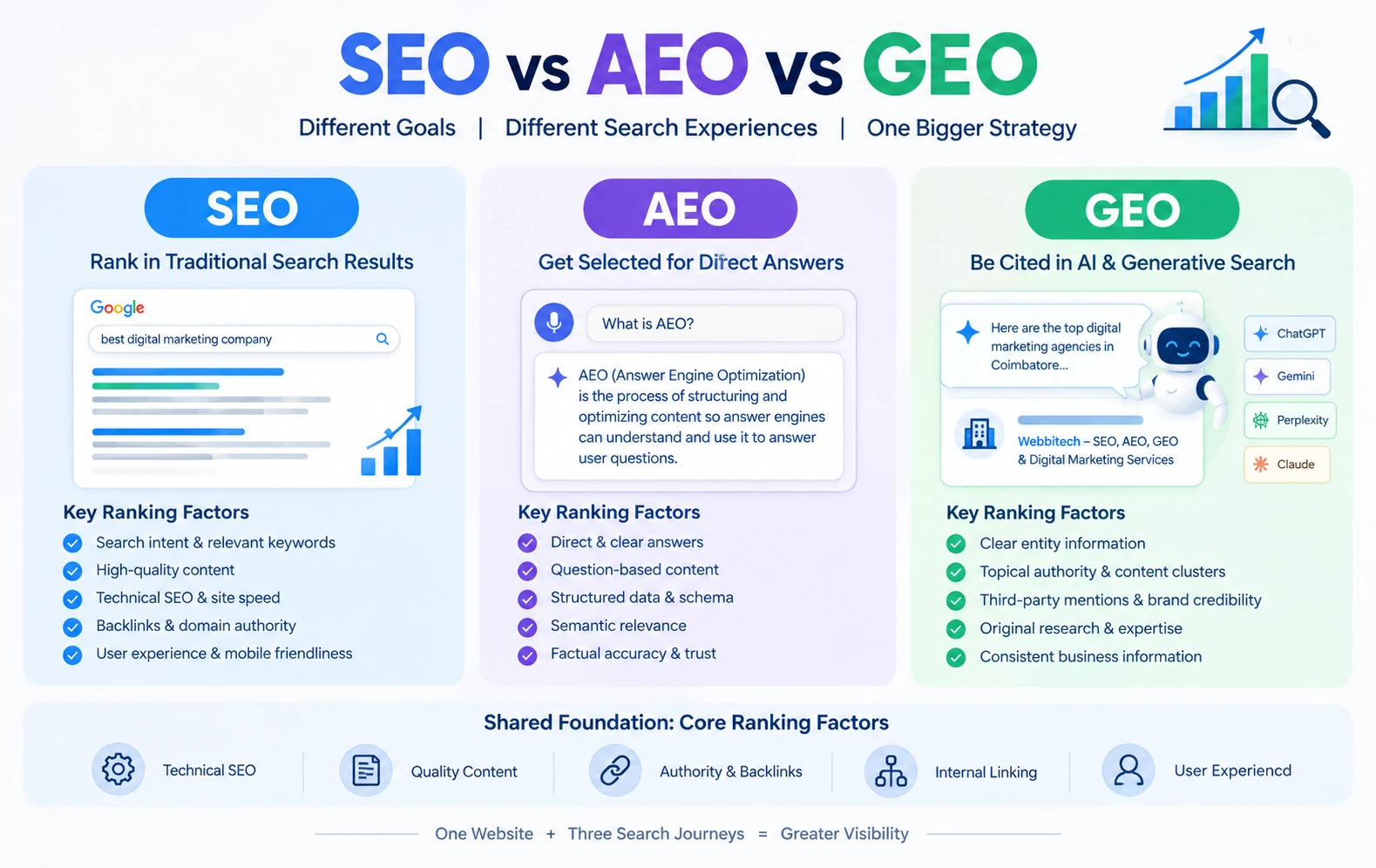
SEO focuses on ranking webpages in traditional search results. AEO focuses on getting content selected for direct answers and answer-focused search experiences. GEO focuses on improving the likelihood that a brand, website, or content is accurately understood, cited, or mentioned by generative AI systems.
The key is not to treat SEO, AEO, and GEO as three completely separate activities. A strong digital presence increasingly requires a combined approach.
SEO (Search Engine Optimization) is the process of improving a website and its content so that search engines can understand, crawl, index, and rank its pages for relevant searches.
Traditional SEO commonly focuses on platforms such as Google and Bing.
For example, if someone searches:
“Best website development company in Coimbatore”
SEO helps your website compete for visibility in the search results.
SEO involves many signals rather than one single ranking factor.
Understanding why someone is searching is fundamental.
Search intent can include:
Informational—"What is SEO?”
Commercial—"Best SEO agency in Coimbatore”
Transactional—"Buy SEO service”
Navigational—"Webbitech SEO services”
Content should satisfy the actual intent behind the query rather than simply repeat keywords.
Content should provide useful information that answers the user's query comprehensively.
Strong content generally:
Answers the primary question
Covers related questions
Uses accurate information
Provides examples
Demonstrates expertise
Avoids unnecessary keyword stuffing
Is written for humans first
Keywords remain useful for helping search engines understand the topic of a page.
However, modern SEO is not simply about repeating the same keyword.
A page targeting:
“SEO services in Coimbatore”
could naturally cover related concepts such as:
SEO agency
local SEO
technical SEO
keyword research
content optimization
Google Business Profile
link building
SEO reporting
Search engines need to access and understand your website efficiently.
Important technical factors include:
Crawlability
Indexability
XML sitemap
Robots.txt
Canonical URLs
HTTPS
Mobile usability
Site architecture
Internal linking
Page speed
Core Web Vitals
Structured data
Links from relevant, trustworthy websites can help establish authority and credibility.
Quality matters more than simply accumulating large numbers of backlinks.
Relevant mentions, digital PR, industry publications, partnerships, and useful resources can contribute to a stronger authority profile.
Internal links help search engines discover related pages and understand the relationship between topics.
For example:
Digital Marketing → SEO → Local SEO → Google Business Profile Optimization
A logical internal-linking structure can strengthen topical organization.
A website should be easy to use on both desktop and mobile devices.
Important considerations include:
Readability
Navigation
Page loading
Mobile experience
Intrusive elements
Clear calls to action
Accessible content
AEO (Answer Engine Optimization) focuses on optimizing content so that answer engines can identify and provide your information when users ask questions.
Instead of only targeting:
“SEO services Coimbatore”
AEO considers conversational queries such as:
“What does an SEO agency in Coimbatore do?”
or:
“How much does SEO cost for a small business?”
The goal is to make your content easy for systems to extract as a clear, useful answer.
Traditional SEO often asks:
How can my webpage rank for this search query?
AEO asks:
How can my content provide the clearest answer to this question?
This changes how content should be structured.
For example, instead of writing a long introduction before answering:
What is AEO?
A strong AEO-focused page can provide the answer immediately:
AEO, or Answer Engine Optimization, is the practice of structuring and optimizing content so answer engines can understand and use it to respond to user questions.
The explanation can then expand with examples and supporting information.
Answer the primary question clearly and quickly.
Use formats such as:
Short definitions
Direct answers
Step-by-step instructions
Lists
Tables
FAQs
Build content around the questions your audience actually asks.
For example:
What is SEO?
What is AEO?
What is GEO?
How does SEO work?
How is AEO different from SEO?
Does GEO replace SEO?
How can businesses optimize for AI search?
Answer engines need to interpret content efficiently.
Useful structures include:
Question → Direct answer → Explanation → Example
This is particularly effective for FAQ and educational content.
AEO isn't only about exact-match keywords.
Content should demonstrate an understanding of the broader topic and related entities.
For example, an article about local SEO could naturally discuss:
Google Business Profile
Reviews
Local citations
NAP consistency
Local landing pages
Maps visibility
Local search intent
Structured data helps communicate information about a webpage to search engines.
Depending on the content, relevant schema types may include:
Article
FAQPage
Organization
Local Business
Product
Service
BreadcrumbList
Review
Structured data does not guarantee that content will appear as an answer, but it can help machines interpret page information.
Answer-focused content needs to be reliable.
Use:
Accurate claims
Clear sources where appropriate
Updated information
Author expertise
Supporting evidence
Avoid making unsupported claims simply to obtain visibility.
GEO (Generative Engine Optimization) focuses on improving a brand's visibility and representation within generative AI search experiences.
Generative systems can synthesize information from multiple sources and provide conversational responses rather than displaying only a traditional list of links.
Examples include AI-powered search and conversational search experiences.
A user might ask:
“Which digital marketing agencies in Coimbatore offer SEO, AEO, and GEO services?”
Instead of receiving only ten blue links, the user may receive a synthesized response mentioning several companies.
GEO aims to make your business and content:
Discoverable
Understandable
Credible
Relevant
Citable
Consistently represented
GEO is still an evolving field, so there is no universal public ranking formula for every generative AI system.
However, several practical factors are important when optimizing content for AI-driven discovery.
AI systems need to understand who you are and what you do.
Your website should clearly communicate:
Brand name
Services
Locations
Industry expertise
Contact information
Company information
Team expertise
Products or services
Relationships between your brand and its offerings
For example:
Webbitech → Digital Marketing Agency → SEO → AEO → GEO → Coimbatore
Clear entity relationships can make a website easier for machines to interpret.
Keep important business information consistent across relevant sources.
For example:
Business name
Website
Location
Phone number
Services
Company descriptions
Inconsistent information can make entity understanding more difficult.
A single article rarely establishes strong authority around an entire subject.
Create interconnected content covering the topic from multiple perspectives.
For example:
What is SEO?
Technical SEO Guide
Local SEO Guide
On-Page SEO
Off-Page SEO
SEO for Small Businesses
SEO vs PPC
What is AEO?
AEO Ranking Factors
How to Optimize FAQs for AEO
Voice Search Optimization
AEO vs SEO
What is GEO?
GEO Ranking Factors
SEO vs AEO vs GEO
How to Optimize Content for AI Search
AI Search Visibility Guide
This creates a stronger topical ecosystem.
Generative systems can use information from multiple sources.
Relevant third-party references can therefore be valuable for establishing a consistent online presence.
Examples include:
Industry publications
Business directories
Professional organizations
Interviews
Reviews
News coverage
Relevant community discussions
Partner websites
The focus should be on relevant and trustworthy mentions, not mass directory submissions.
Original research, case studies, statistics, expert commentary, and first-hand experience can make content more useful and distinctive.
For example:
“Our 19-day Meta Ads campaign generated 444 leads from ₹14,925.79 in spend.”
A real case study provides substantially more useful information than generic statements such as:
“Meta Ads can generate many leads.”
Generative systems need useful information that can be synthesized.
Make important facts easy to identify.
For example:
AEO is the process of optimizing content so answer engines can understand and use it to answer user questions.
This is clearer than hiding the definition inside a 500-word introduction.
Demonstrate who created the content and why they are qualified to discuss the topic.
Useful elements include:
Author bio
Professional experience
Business information
Case studies
Credentials
Original research
Editorial standards
Updated dates
This supports trust and helps establish context around the information.
| Factor | SEO | AEO | GEO |
|---|---|---|---|
| Primary Goal | Search visibility | Answer visibility | AI/generative visibility |
| Main Experience | Search results | Direct answers | AI-generated responses |
| Core Focus | Ranking webpages | Answering questions | Being understood/cited/mentioned |
| Keywords | Important | Questions + semantic relevance | Topics, entities + concepts |
| Content | Comprehensive | Direct and structured | Clear, authoritative, and context-rich |
| FAQs | Useful | Highly important | Useful for question understanding |
| Technical SEO | Essential | Important | Important foundation |
| Structured Data | Important | Helpful | Helpful |
| Backlinks | Strong authority signal | Useful | Relevant authority/mentions |
| Entity Optimization | Important | Important | Critical |
| Third-Party Mentions | Valuable | Valuable | Particularly useful |
| Original Research | Valuable | Valuable | Highly useful |
| User Intent | Critical | Critical | Critical |
Not completely.
Think of them as layers.
Make your website:
Crawlable → Indexable → Relevant → Authoritative → User-friendly
Make your content:
Question-focused → Direct → Structured → Easy to understand
Make your brand and content:
Entity-clear → Context-rich → Trustworthy → Consistently represented → Easy for AI systems to understand
This means a technically poor website will have difficulty supporting all three strategies.
A practical optimization framework can be divided into seven areas.
Focus on:
HTTPS
Mobile responsiveness
Crawlability
Indexability
Site speed
Core Web Vitals
XML sitemap
Robots.txt
Canonicals
Clean URL structure
Primary relevance: SEO
Also supports: AEO + GEO
Create content that is:
Helpful
Accurate
Original
Relevant
Comprehensive
Updated
Written for the intended audience
Primary relevance: SEO + AEO + GEO
Understand the user's actual goal.
For every page, ask:
What does the user want to accomplish with this search?
Then create content that satisfies that intent.
Primary relevance: SEO + AEO + GEO
Identify real questions and answer them directly.
Useful sources include:
Google autocomplete
Related searches
People Also Ask
Customer enquiries
Search Console data
Community discussions
Sales conversations
AI search queries
Primary relevance: AEO + GEO
Also supports: SEO
Clearly establish:
Who → What → Where → Services → Expertise → Relationships
For a business:
Brand → Industry → Services → Location → Customers → Expertise
Use consistent information across your website and relevant external sources.
Primary relevance: GEO
Also supports: SEO + AEO
Build credibility through:
Relevant backlinks
Expert contributions
Industry publications
Reviews
Case studies
Original research
Brand mentions
Partnerships
Primary relevance: SEO + GEO
Use:
Heading hierarchy
Lists
Tables
FAQs
Schema markup
Breadcrumbs
Clear definitions
Author information
Service information
The objective is to make information easier for both people and machines to understand.
Primary relevance: SEO + AEO + GEO
Suppose your target topic is
“SEO vs AEO vs GEO”
Instead of creating three disconnected articles, create one comprehensive resource.
Use the primary topic naturally in:
Title
H1
Introduction
Relevant H2s
Meta title
Meta description
URL
Start with a concise explanation:
SEO improves visibility in traditional search results, AEO focuses on providing direct answers to questions, while GEO focuses on improving visibility and representation within generative AI search experiences.
Cover:
What is SEO?
SEO ranking factors
What is AEO?
AEO visibility factors
What is GEO?
GEO visibility factors
SEO vs AEO vs GEO
How they work together
Optimization checklist
FAQs
Don't only explain concepts.
Show how a business could optimize:
Homepage → Service page → Location page → Blog → FAQ → Case study
Connect the article to relevant pages such as
SEO services
AEO services
GEO services
Local SEO
Digital marketing
Case studies
Use structured data that accurately represents the page and follows search-engine guidelines.
AI search, search features, and optimization practices continue to evolve.
Review important content periodically rather than publishing it once and leaving it unchanged.
Repeating:
SEO agency Coimbatore SEO agency Coimbatore SEO agency Coimbatore
doesn't create useful content.
Write naturally and cover the topic comprehensively.
Content should solve the user's problem.
A page that ranks but fails to satisfy the visitor won't create a strong long-term business outcome.
Adding dozens of generic questions doesn't automatically create AEO or GEO visibility.
FAQs should answer real, relevant questions.
Using AI to draft content isn't the same as demonstrating expertise.
Review, fact-check, improve, and add genuine experience.
GEO should not become a strategy of creating artificial mentions everywhere.
Focus on building a credible, consistent digital presence.
A business shouldn't abandon SEO simply because AI search is growing.
Technical accessibility, relevant content, authority, internal linking, and strong website architecture remain foundational.
Search intent identified
Keyword research completed
Helpful content created
Technical SEO checked
Mobile experience optimized
Internal links added
Relevant backlinks earned
Metadata optimized
Structured data implemented where appropriate
Real questions identified
Direct answers provided
FAQ content created where useful
Clear heading structure used
Definitions are concise
Lists and tables used where appropriate
Content is factually accurate
Conversational queries addressed
Business entity clearly defined
Brand information is consistent
Services clearly explained
Location information is consistent
Author expertise demonstrated
Original case studies included
Relevant third-party mentions developed
Content is easy to understand and reference
Topic clusters built
Important information is regularly updated
Search is becoming more conversational and increasingly capable of synthesizing information.
The user journey may look like this:
Google Search → Website → FAQ → AI Search → Brand Comparison → Conversion
A business therefore needs more than keyword rankings.
It needs a searchable, answerable, and understandable digital presence.
SEO helps search engines discover and rank your webpages.
AEO helps answer-oriented systems understand and surface direct answers.
GEO helps generative AI systems understand your brand, content, expertise, and relationships across the web.
The three strategies work best when they support one another.
SEO, AEO, and GEO are not competing strategies. They address different layers of modern search visibility.
SEO provides the technical and content foundation.
AEO makes information easier to use as direct answers.
GEO focuses on making brands and information understandable and discoverable within generative AI experiences.
For businesses preparing for the future of search, the practical approach is to build a strong foundation first and then expand it with question-focused content, structured information, entity clarity, topical authority, original expertise, and a consistent online presence.
The goal is no longer simply to rank a webpage.
The broader goal is to make your business discoverable, understandable, useful, and trustworthy wherever your potential customers search for information.

Have a project in mind? Let’s build something amazing together.
Webbitech — A Leading Web Design & Web Development Company with 15+ Years of SEO & Digital Marketing Expertise, Delivering Countless Success Stories
From idea to execution, we help businesses create high-performing websites and applications.
Start your journey today and take your brand to the next level.