Posted Date : 19 Aug 2026
Ask ten small business owners what search engine optimization actually involves, and you will likely receive ten different, half-formed answers. Some picture a mysterious algorithm that punishes the unworthy. Others assume it is a magic switch that, once flipped, sends floods of customers pouring through the door. Neither picture is accurate. The truth sits somewhere quieter, more methodical, and frankly more achievable than the myths suggest. This confusion is not the fault of business owners; it is the byproduct of an industry saturated with hyperbole, outdated advice, and self-proclaimed gurus peddling shortcuts. Untangling fact from fiction is the first, indispensable step toward building a search presence that actually generates revenue.
At its core, SEO is the disciplined practice of aligning a website's structure, content, and reputation with what search engines deem trustworthy and relevant. For small businesses, this typically means a bundle of services: technical audits, on-page optimization, local listing management, content development, and ongoing performance tracking. It is not a single tactic but rather an orchestrated ecosystem of interdependent efforts. A competent provider treats these components as gears in a machine, not isolated checkboxes. When one gear turns, the others respond. Understanding this interconnectedness is essential before evaluating any myth or misconception that follows.
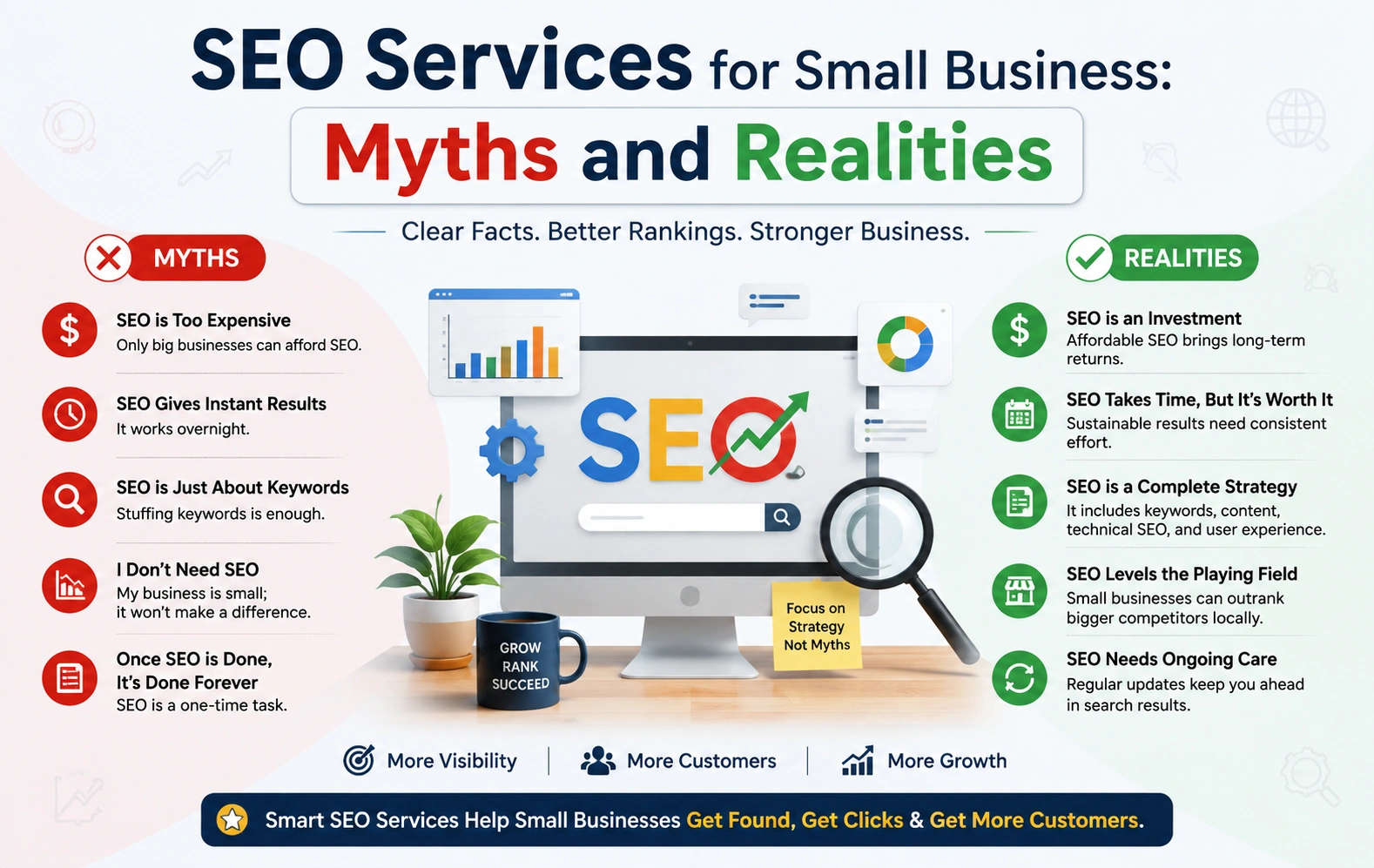
There is a pervasive belief that SEO exists exclusively in the budgets of sprawling corporations with seven-figure marketing departments. This notion discourages countless proprietors from even requesting a quote, let alone signing a contract. The fear is understandable; enterprise SEO campaigns can indeed cost tens of thousands of dollars monthly. But that figure represents one extreme on a wide spectrum, not the baseline.
Reputable agencies and freelance specialists offer tiered, modular packages specifically calibrated for modest budgets. A local bakery does not require the same investment as a national retailer with thousands of product pages. Many providers structure engagements around a handful of priority actions, think citation cleanup, a handful of optimized landing pages, and a monthly reporting cadence, rather than an exhaustive, enterprise-grade overhaul. The financial barrier, while real for some premium tiers, is far more permeable than the myth implies.
Perhaps no misconception causes more frustration than the expectation of overnight success. Business owners, accustomed to the immediacy of paid advertising, sometimes assume organic rankings should behave the same way: pay, appear, profit. When week two arrives without a first-page ranking, disillusionment sets in swiftly.
Search engines evaluate trust incrementally, not instantaneously. Algorithms weigh historical consistency, content depth, and authority signals accumulated over months. A brand-new website, however well-optimized, must still earn its stripes. This is not a flaw in the system but a deliberate mechanism to prevent manipulation. The upside is durability: rankings built methodically tend to persist far longer than those chased through paid channels alone, and the compounding effect means month twelve often outperforms month one by an exponential margin.
Some proprietors assume that because their storefront serves a five-mile radius, digital visibility is irrelevant. Word of mouth, they reason, has sustained the business for years; why fix what isn't broken?
Local search is arguably where small businesses hold the greatest competitive advantage over larger rivals. When a consumer searches "plumber near me" or "best coffee shop downtown," proximity and relevance often outweigh brand recognition. Optimizing a Google Business Profile, accumulating authentic reviews, and ensuring consistent name-address-phone citations across directories can propel a modest operation above regional chains in local map packs. This is not a peripheral tactic; it is often the single highest-leverage activity available to brick-and-mortar businesses.
A relic of early-2000s optimization tactics, keyword stuffing, the practice of cramming a target phrase repeatedly into a page, persists as a stubborn myth among those unfamiliar with modern algorithmic sophistication.
Contemporary algorithms leverage natural language processing and semantic analysis to interpret context, intent, and topical authority. A page densely packed with the same phrase now reads as spam and risks demotion rather than promotion. Effective copy today employs varied phrasing, related terminology, and genuine reader value. Search engines have grown remarkably adept at distinguishing authentic expertise from mechanical repetition, rendering the old brute-force approach not merely outdated but actively counterproductive.
Some business owners treat a website launch as the finish line: build the site, optimize it once, and consider the job complete indefinitely.
Search landscapes are perpetually in flux. Competitors publish new content, algorithms update, consumer behavior shifts, and technical elements degrade over time, broken links accumulate, page speed can erode, and mobile compatibility standards evolve. Treating SEO as a static project rather than an ongoing discipline is akin to fertilizing a garden once and expecting perpetual bloom. Sustained visibility demands recurring audits, fresh content, and adaptive strategy.
With platforms like Instagram and TikTok dominating marketing conversations, some assume a robust social following renders traditional search optimization obsolete.
Social media excels at brand-building, community engagement, and viral discovery. Search engine optimization, by contrast, captures intent-driven traffic, users actively searching for a solution, product, or service at the precise moment of need. These channels are complementary, not interchangeable. A viral post might generate a temporary spike, but a well-optimized service page continues attracting qualified visitors for years, functioning as a durable, evergreen asset rather than an ephemeral impression.
Armed with a handful of blog posts and free browser extensions, some entrepreneurs conclude that professional guidance is an unnecessary expense.
Amateur optimization efforts frequently introduce more harm than benefit: duplicate content issues, improper redirects, or over-optimized anchor text can trigger algorithmic penalties. Professional practitioners bring pattern recognition earned across dozens of campaigns, an intuition for what search engines reward that cannot be replicated by a weekend of tutorial-watching. The apparent savings of a DIY approach often evaporate once remediation costs, lost traffic, or missed opportunities are tallied.
Beyond myth-busting, it is worth articulating what tangible value a competent SEO partnership delivers. Increased organic visibility reduces long-term reliance on paid advertising, lowering customer acquisition costs over time. Improved site structure enhances user experience, which in turn boosts conversion rates independent of ranking gains. Additionally, the credibility conferred by appearing prominently in search results, often perceived by consumers as an implicit endorsement, cannot be manufactured through paid placements alone.
Local optimization hinges on a triad of factors: proximity, relevance, and prominence. Agencies typically audit and standardize business listings across dozens of directories, eliminate conflicting information, and cultivate a steady cadence of customer reviews. Structured data markup, often overlooked by novices, helps search engines parse operating hours, service areas, and pricing with greater precision, increasing the likelihood of appearing in rich local features like map packs and knowledge panels.
Technical SEO addresses the underlying scaffolding of a website: crawlability, site speed, mobile responsiveness, and secure connections. Even the most compelling content will underperform if search engine crawlers cannot efficiently index it, or if visitors abandon a page due to sluggish load times. Practitioners often conduct comprehensive audits examining sitemaps, robots.txt configurations, and core web vitals, metrics measuring loading performance, interactivity, and visual stability, to ensure the foundation supports rather than sabotages visibility efforts.
Content remains the primary vehicle through which relevance is demonstrated to both algorithms and humans. A deliberate content strategy identifies the questions prospective customers are asking and answers them with genuine depth. This extends beyond blog posts to service pages, frequently asked questions, and locally relevant guides. Thin, generic content rarely ranks; substantive, well-researched material that addresses genuine informational gaps tends to accumulate authority organically, attracting backlinks and repeat visits without artificial promotion.
Backlinks, other websites referencing yours, remain a significant authority signal, but the methods for acquiring them have matured considerably. Purchased links or participation in link farms now carry substantial penalty risk. Ethical link acquisition instead involves guest contributions to reputable industry publications, local partnership features, sponsorship mentions, and digital public relations efforts that earn organic citations. Quality decisively outweighs quantity; a handful of authoritative, contextually relevant links outperforms hundreds of low-value directory submissions.
Without clear metrics, evaluating an SEO investment becomes guesswork. Business owners should monitor organic traffic trends, keyword ranking movement for priority terms, conversion rates from organic visitors, and, critically, phone calls or form submissions attributable to search. Vanity metrics like total impressions matter less than qualified leads generated. A trustworthy provider establishes baseline measurements before campaign commencement and reports transparently against those benchmarks on a recurring schedule.
Selecting a provider warrants the same diligence applied to hiring a key employee. Prospective partners should be evaluated on transparency of methodology, willingness to explain strategy in plain language, and demonstrable case studies within comparable industries. A provider unwilling to articulate their approach, or one that guarantees specific rankings, a technical impossibility given algorithmic volatility, should raise immediate skepticism.
Certain warning signs recur across problematic engagements: guaranteed first-page rankings within an unrealistically short timeframe, refusal to disclose specific tactics, opaque reporting that emphasizes activity over outcomes, and pricing dramatically below market norms, often indicative of outsourced, low-quality execution. Contracts lacking clear deliverables or cancellation terms similarly warrant caution. A legitimate practitioner welcomes scrutiny rather than deflecting it.
Clear communication upfront prevents downstream disappointment. Business owners should establish, in writing, anticipated timelines, the difference between leading indicators (ranking improvements) and lagging indicators (revenue growth), and the scope of deliverables included in a given retainer. Providers, in turn, bear responsibility for educating clients rather than allowing unrealistic assumptions to fester unaddressed.
Beyond vendor selection, several self-inflicted errors undermine campaigns: neglecting mobile optimization despite the majority of local searches originating from smartphones, inconsistent business information across platforms, abandoning content efforts after initial results plateau, and prioritizing volume of blog posts over substantive quality. Patience paired with consistency consistently outperforms sporadic, high-effort bursts followed by prolonged inactivity.
Emerging developments, including AI-driven search summaries, voice search proliferation, and evolving privacy regulations, continue reshaping the discipline. Small businesses that maintain adaptable, fundamentals-first strategies, prioritizing genuine user value over algorithmic exploitation, are best positioned to weather these shifts. The specific tactics will inevitably evolve, but the underlying principle, earning trust through relevance and authority, remains remarkably durable across every iteration of search technology.
The mythology surrounding SEO services for small business often does more damage than the absence of optimization itself, discouraging investment through exaggerated costs, unrealistic timelines, or unfounded assumptions of irrelevance. The reality is considerably more encouraging: scalable, ethical, and measurable strategies exist for businesses of every size and budget. Success requires patience, a willingness to invest in genuine expertise, and a commitment to ongoing refinement rather than a single decisive action. For small business owners willing to separate hype from substance, professional SEO services represent not a gamble but a calculated, compounding investment in long-term visibility and growth.

Have a project in mind? Let’s build something amazing together.
Webbitech — A Leading Web Design & Web Development Company with 15+ Years of SEO & Digital Marketing Expertise, Delivering Countless Success Stories
From idea to execution, we help businesses create high-performing websites and applications.
Start your journey today and take your brand to the next level.