Posted Date : 08 Jun 2026
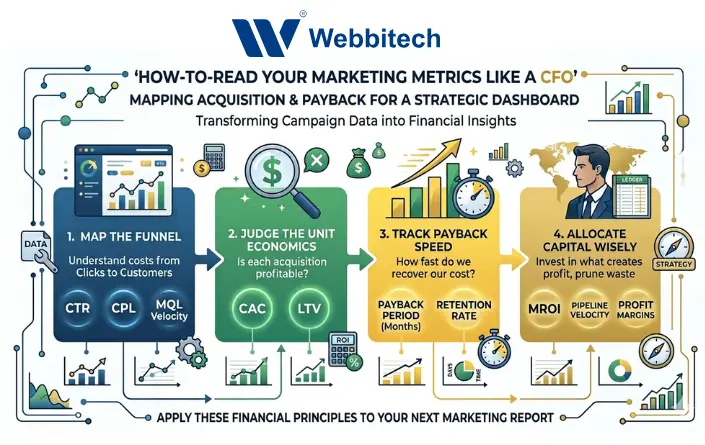
A marketer reads metrics to optimize a campaign. A CFO reads them to decide whether capital is earning a return. If you're a founder approving the marketing budget, you need the second lens. This guide shows you which numbers actually matter, which ones quietly mislead you, and the five questions to ask before you approve another dollar of spend.
Most founders inherit their marketing dashboards from a marketer or an agency. And those dashboards are built to make the marketing look good — high click-through rates, healthy "return on ad spend," conversions ticking up week over week.
The problem is that none of those numbers answer the only question a founder actually has: Is this spend making the business money, and how fast?
That's the gap between reading metrics like a marketer and reading them like a CFO. A marketer is optimizing a channel. A CFO is evaluating an investment. Same data, completely different question — and the CFO's question is the one that protects your runway.
Here's how to make the switch.
A marketer asks, "Is this campaign performing well?" A CFO asks, "Is this campaign returning more cash than it consumes, and when?"
Everything below flows from that difference. Once you start asking the second question, half your dashboard turns out to be noise.
These aren't useless — your marketing team needs them to do their job. But they shouldn't drive your decisions, because none of them tell you whether the business is making money.
If a report leads with these numbers, it was written to impress you, not to inform you.
Every ad platform reports its own "return on ad spend," and every platform takes generous credit. Meta and Google will frequently both claim the same sale, because each saw the customer at some point in the journey. Add up what every platform tells you and you'll often "earn" more revenue than your business actually booked.
The CFO fix is blended ROAS: total new-customer revenue divided by total marketing spend across every channel. It can only be counted once, so it can't lie to you the way platform numbers do.
When platform ROAS says 4x and blended ROAS says 1.6x, the truth is closer to 1.6x.
Total sales and marketing spend divided by new customers acquired in the same period. This is the real price of a customer, not the "cost per lead" your dashboard shows. Leads are not customers; only some of them convert.
What a customer is worth over their whole relationship with you — but counted in gross margin, not top-line revenue. A $200 sale at 50% margin is worth $100 to the business, not $200.
The single healthiest number to internalize. A ratio around 3:1 is generally considered sustainable. At 1:1 you're buying revenue at cost. Below 1:1 you're paying customers to buy from you.
How many months until a customer's contribution repays what you spent to acquire them. This is the metric marketers almost never show and CFOs care about most, because it's really a question about your cash flow and your runway.
Say you spend $15,000 in a month and acquire 100 new customers.
The marketer's view: "Meta is reporting 4x ROAS — every dollar is returning four. We should scale it."
The CFO's view: Let's run the real numbers.
That alone would terrify a marketer reading the platform dashboard, because the dashboard never showed it. But the CFO keeps going:
Now you actually understand the bet you're making: this channel is cash-flow negative for roughly five months per customer and only pays off if your retention holds. That's not "scale it tomorrow." That's "scale it carefully, and watch repeat-purchase rates like a hawk."
Notice that the marketer and the CFO looked at the identical campaign. One saw a winner. The other saw a financing decision. The founder needs to see the second picture.
The CFO's question that almost no one asks: "Would this have happened anyway?"
This is the most important and most ignored idea in marketing measurement, and it's called incrementality.
When a customer searches your brand name and clicks your ad, the platform counts a conversion — but that customer was already coming to you. You paid for a sale you'd have gotten for free. Strip those out and your true cost to acquire a genuinely new customer is higher than your dashboard suggests.
You don't need a data science team to start here. The simplest test: turn a channel off in one region or for a short, defined window, and watch whether total sales actually drop. If revenue holds steady while the channel is dark, that spend was buying credit, not customers.
You don't need to become a data analyst. You need to change the question you ask. Stop asking whether the marketing is performing and start asking whether it's paying — and how fast. The dashboards will look the same. Your decisions won't.

Have a project in mind? Let’s build something amazing together.
Webbitech — A Leading Web Design & Web Development Company with 15+ Years of SEO & Digital Marketing Expertise, Delivering Countless Success Stories
From idea to execution, we help businesses create high-performing websites and applications.
Start your journey today and take your brand to the next level.