Posted Date : 08 Jun 2026
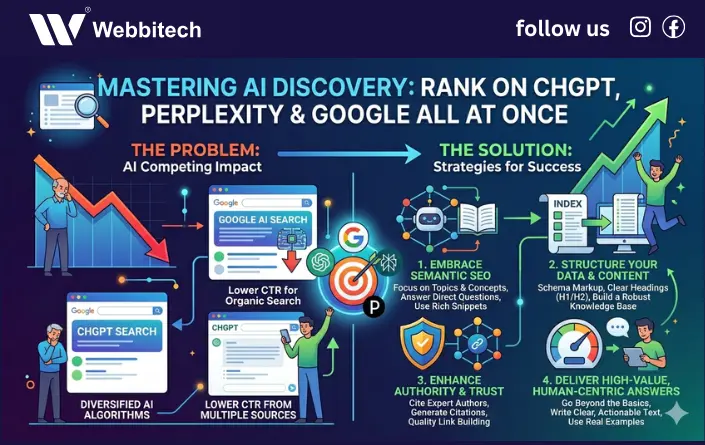
You cannot win all three by treating "AI search" as one channel. An analysis of 680 million citations found that only about 11% of domains are cited by both ChatGPT and Perplexity, so a page that dominates one engine can be invisible on another. The way to rank everywhere at once is to build a strong shared core, then add a small platform-specific tilt for each engine.
This guide breaks down how ChatGPT, Perplexity, and Google AI Overviews each pick their sources, the foundation that earns citations on all three, and a practical plan you can start this quarter. If your brand ranks well on Google but never shows up when buyers ask an AI assistant, this is why and how to fix it.
Treating ChatGPT, Perplexity, and Google as one target is like optimizing for "social media" without separating LinkedIn from TikTok. They run on different retrieval systems and reward different signals, so the same query can produce three completely different source lists.
The numbers make the gap concrete. Only 11% of domains are cited by both ChatGPT and Perplexity, which means each platform is closer to a separate ecosystem than a shared one. Brand citation rates diverge wildly too: one 2026 study of 34,234 AI responses found ChatGPT cited brands just 0.59% of the time while Perplexity sat around 13%.
So the goal is not one trick that wins everywhere. It is a portfolio: a core authority hub on your own site, plus the specific signals each engine trusts most.
Each engine has a "favorite kind" of source. Knowing it tells you where to put your effort.
ChatGPT leans encyclopedic and authority-driven. Wikipedia alone accounts for roughly 48% of its top citations. It only searches the live web on a minority of queries; the rest come from training data, so domain authority and being part of the trusted corpus matter. For provider or "best X" questions, ChatGPT checks authority signals like accreditation, awards, and recognized credentials before recommending.
Perplexity is real-time and community-driven. It retrieves live results on nearly every query, which makes it the fastest to reflect new content and the most influenced by discussion. Reddit makes up close to 47% of its top citations. It rewards pages with explicit, extractable facts and a recent date that matches the query's timeframe.
Google AI Overviews are the most diversified. They sit on Google's full index and keep meaningful overlap with traditional rankings, so your existing SEO carries over. They pull from publishers, forums, and notably multimodal content like YouTube. AI Overviews now appear on roughly half of all searches.
| ChatGPT | Perplexity | Google AI Overviews | |
|---|---|---|---|
| Retrieval | Mostly training data, web on some queries | Live web on nearly every query | Google's index, blended with rankings |
| Favors | Encyclopedic, authoritative, consensus sources | Community sources, Reddit, fresh pages | Diversified: publishers, forums, YouTube |
| Wins by | Domain authority, credentials, Wikipedia presence | Extractable facts, recency, Reddit discussion | Strong SEO, schema, multimodal content |
| Best for | High-authority, well-known brands | Newest, most specific, fact-dense content | Brands already ranking in organic search |
Despite the differences, a common foundation feeds every engine. Get this right and you become eligible everywhere before you tune for any single platform.
Answer-first, extractable structure. All three break pages into passages and judge each one alone. Open every page and section with a direct 40 to 60 word answer, use clean H2 and H3 headings, and add FAQ blocks. Self-contained answers are what get lifted into a response.
Specific, sourced facts. AI engines cite statements, not vibes. Concrete claims with a number, a date, and a named source are far more quotable than general prose. Aim for one supported statistic every 150 to 200 words.
Freshness. Recency is a strong signal, especially on Perplexity. One 2026 analysis found pages updated in the past three months averaged about 6 citations versus 3.6 for outdated pages. Add visible "updated" dates and refresh priority pages quarterly.
Entity authority and schema. Make your topic relationships explicit in copy and markup. Use Organization, Article, and FAQPage schema so engines understand who you are and what you cover.
Open the door to AI crawlers. Confirm robots.txt allows the major AI bots and consider an llms.txt file. If they cannot read you, nothing else matters.
Use this as a quick eligibility check on any priority page:
Once the core is solid, add the move each engine rewards most.
For ChatGPT, build authority and credentials. Strengthen your presence on consensus sources, keep a clean entity (a strong About page, consistent facts across the web, and ideally a Wikipedia-grade footprint in your niche). Surface your accreditation, awards, and proof points clearly, because ChatGPT checks for them on recommendation queries.
For Perplexity, publish fresh and get discussed. Keep priority pages current, lead with hard facts, and earn genuine mentions in relevant Reddit and community threads. Perplexity reflects new content fast, so a timely, fact-dense update can get cited within days.
For Google AI Overviews, double down on SEO and video. Because Overviews overlap heavily with rankings, traditional SEO is your foundation. Add YouTube content and multimodal assets, since Overviews favor them more than the other two engines.
Here is the trap. When an AI platform recommends a brand, it often cites a third party, not the brand's own site. Your competitor gets named in the answer (the mention), but a G2 page, a Reddit thread, or an industry publication gets the citation link.
That is why brand mentions across independent sources now matter more than backlinks for AI visibility. Distributing your content and presence across multiple trusted publications can lift AI citations substantially; one 2026 source reported increases of up to 325%. Think of it as the AI-era version of link building: instead of links, you are building a web of consistent mentions the models can triangulate into trust.
For most B2B brands, the third-party sources that carry weight include Reddit, G2, Capterra, and recognized industry publications. Showing up there is not optional vanity, it is citation infrastructure.
| Phase | Focus | What to do |
|---|---|---|
| Days 1 to 30 | Fix the core | Rewrite your top pages to be answer-first, add FAQ blocks and schema, confirm AI crawlers are allowed, and add updated dates. |
| Days 31 to 60 | Build authority and freshness | Publish one fact-dense, original piece worth citing. Tighten your entity (About page, consistent facts). Begin earning genuine mentions on Reddit, G2, or industry sites. |
| Days 61 to 90 | Tilt per platform and measure | Add YouTube for Google, keep refreshing for Perplexity, surface credentials for ChatGPT. Track citations and AI referral traffic, then repeat what earns mentions. |
Standard analytics will undercount this, because they count clicks and ignore citations. Build a simple measurement layer instead.
Create a dedicated AI traffic channel in GA4 by matching referrers from ChatGPT, Perplexity, Gemini, and Copilot, so those visits stop hiding inside direct or organic. Then track citation frequency on each engine for your key questions, alongside referral volume and conversion rate. The payoff justifies the effort: Perplexity visitors have been reported to convert at many times the rate of standard organic, so even small citation gains can move pipeline.
Have a project in mind? Let’s build something amazing together.
Webbitech — A Leading Web Design & Web Development Company with 15+ Years of SEO & Digital Marketing Expertise, Delivering Countless Success Stories
From idea to execution, we help businesses create high-performing websites and applications.
Start your journey today and take your brand to the next level.