Posted Date : 15 Sep 2026
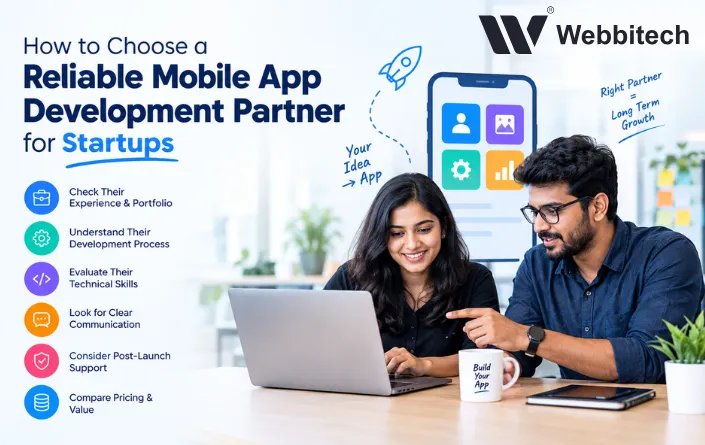
Every founder eventually hits the same wall: you have a brilliant idea, a rough wireframe, maybe a pitch deck—but you don't have an in-house engineering team to build it. So you go looking for a mobile app development partner, and within an hour of searching, you're staring at fifty agency websites that all promise the same thing: "innovative solutions," "cutting-edge technology," and "dedicated teams."
Here's the problem. Choosing the wrong partner doesn't just cost you money—it costs you runway, momentum, and sometimes the entire product. A mistimed launch or a buggy MVP can quietly kill a startup before it ever gets a fair shot at the market.
This guide walks you through exactly what to look for so you can move from "who do I even trust with this?" to a confident, informed decision.
A large enterprise can absorb a failed vendor relationship. They have budget cushions, internal QA teams, and time. Startups usually have none of these luxuries.
When you're working with limited funding and a tight go-to-market window, your app development company for startups essentially becomes an extension of your founding team. They influence your:
That's why this decision deserves the same scrutiny you'd give to hiring a co-founder—not just a vendor.
Plenty of agencies build apps. Far fewer understand the constraints startups actually operate under—shifting requirements, tight budgets, and the need to validate ideas fast rather than build the "perfect" product on day one.
Ask potential partners:
A partner used to working with startups will naturally suggest a phased roadmap instead of pushing you toward an expensive, feature-heavy build you don't need yet.
Not every app needs the same tech stack, and not every agency is equally strong across platforms. Before committing, check whether the team has hands-on depth in:
A reliable partner won't just say yes to everything—they'll recommend the stack that fits your product goals and budget, even if it's not the most "impressive" sounding technology.
A polished portfolio page means little without context. Dig deeper:
Founders often underestimate how much a project can derail simply due to poor communication. Before signing anything, clarify:
A trustworthy partner treats transparency as a default, not a favor. If you're chasing them for updates in week one, that pattern rarely improves later.
Reliable teams follow a structured, repeatable process rather than winging it project to project. At a minimum, expect:
If an agency can't clearly explain their process in a sentence or two, that's a warning sign—not a quirky sign of flexibility.
Most app development partners offer one of three pricing structures:
| Pricing Model | Best For | Watch Out For |
|---|---|---|
| Fixed price | Well-defined, small-scope projects | Scope creep charges |
| Time & materials | Evolving MVPs and iterative builds | Unclear cost ceilings |
| Dedicated team | Long-term, ongoing product development | Higher minimum commitment |
The cheapest quote is rarely the safest one. Founders who chase the lowest bid often end up paying twice—once for the original build and again to fix it with a different team.
This is a detail many first-time founders forget to confirm—and it can become a serious legal headache later. Before signing a contract, make sure it clearly states:
Launching the app isn't the finish line—it's the starting point. Ask potential partners:
A partner who disappears after deployment leaves you exposed exactly when user feedback starts rolling in and iteration matters most.
Choosing a mobile app development partner is one of the highest-leverage decisions a startup founder makes. The right team accelerates your product, protects your budget, and becomes a genuine ally in getting your idea into users' hands. The wrong one can quietly drain both your runway and your confidence.
Take your time, ask the harder questions, and prioritize transparency over flashy pitches.
At Webbitech, we've helped startups turn early-stage ideas into fully functioning, scalable mobile apps—with transparent pricing, dedicated teams, and full IP ownership from day one. If you're ready to build something real, get in touch with Webbitech for a free consultation on your app idea.
Costs vary widely based on complexity, but most startup MVPs range from a few thousand to tens of thousands of dollars depending on features, platforms, and the pricing model chosen.
A basic MVP typically takes 8–14 weeks, while more complex apps with custom backends and integrations can take 4–6 months.
Cross-platform frameworks like Flutter or React Native are often more budget-friendly for early-stage startups, while native development suits apps needing top-tier performance or deep device integration.
Ask about their startup experience, development process, communication style, pricing structure, IP ownership terms, and post-launch support options.
Most reliable agencies, including Webbitech, handle end-to-end app store submission for both the Apple App Store and Google Play as part of their deployment process.
Have a project in mind? Let’s build something amazing together.
Webbitech — A Leading Web Design & Web Development Company with 15+ Years of SEO & Digital Marketing Expertise, Delivering Countless Success Stories
From idea to execution, we help businesses create high-performing websites and applications.
Start your journey today and take your brand to the next level.