Posted Date : 22 Jun 2026
Search engines have evolved significantly over the years. Ranking a website is no longer just about keywords and backlinks. Today, search engines focus heavily on how users interact with a website. This is where page experience becomes an important part of SEO.
A website that loads quickly, works smoothly on mobile devices, and provides a secure browsing experience is more likely to keep visitors engaged. When users have a positive experience, search engines view the website as more valuable and trustworthy.
In this guide, we'll explore what page experience is, why it matters for SEO, and how you can improve it to boost your search visibility.
Page experience refers to how users perceive and interact with a webpage beyond its content. It measures whether visitors can access information quickly, navigate easily, and enjoy a smooth browsing experience.
Search engines use page experience signals to understand how user-friendly a website is. While high-quality content remains essential, a poor user experience can negatively impact engagement and search performance.
The primary goal of search engines is to deliver the best possible results to users. If two pages offer similar content quality, the page with a better user experience often has an advantage.
Improved page experience can lead to:
Higher user engagement
Lower bounce rates
Longer session durations
Better conversion rates
Increased customer trust
Improved search engine visibility
Although page experience alone won't guarantee top rankings, it can strengthen your overall SEO strategy and help you outperform competitors.
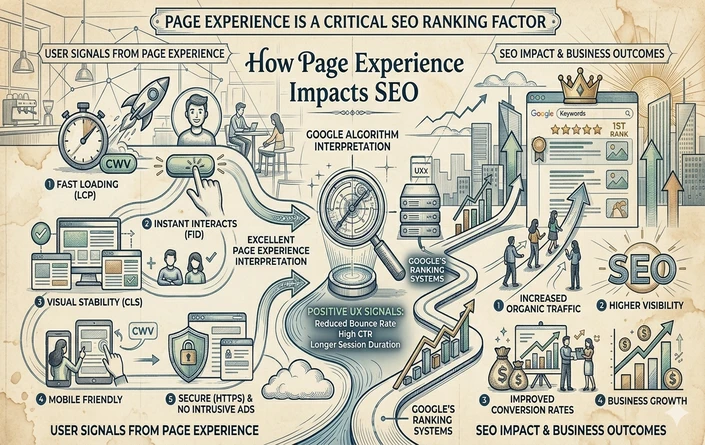
Core Web Vitals are a set of performance metrics that measure real-world user experience.
LCP measures how quickly the main content of a page loads.
Ideal Score: Less than 2.5 seconds
A slow-loading page can frustrate visitors and increase abandonment rates.
INP measures how responsive a website is when users interact with buttons, forms, or navigation elements.
Ideal Score: Less than 200 milliseconds
A responsive website improves user satisfaction and usability.
CLS measures visual stability. It evaluates whether page elements unexpectedly move while loading.
Ideal Score: Less than 0.1
Unexpected layout shifts can lead to accidental clicks and poor user experiences.
Most online searches now occur on mobile devices. Websites that are difficult to navigate on smartphones often experience higher bounce rates.
A mobile-friendly website should:
Adjust to different screen sizes
Display readable text without zooming
Offer easy navigation
Load quickly on mobile networks
Maintain consistent functionality across devices
Responsive design is no longer optional—it's a necessity for modern SEO.
Users expect websites to load almost instantly. Even a delay of a few seconds can significantly impact user engagement and conversions.
Fast-loading websites help:
Improve user satisfaction
Reduce bounce rates
Increase page views
Support stronger SEO performance
Common causes of slow websites include:
Large image files
Excessive JavaScript
Poor hosting services
Unoptimized code
Too many third-party scripts
Website security is an important trust signal.
HTTPS encrypts data exchanged between users and websites, helping protect sensitive information such as login credentials and payment details.
Benefits of HTTPS include:
Enhanced user trust
Better security
Improved credibility
Positive SEO impact
Visitors are less likely to engage with websites marked as "Not Secure."
Websites containing malware, deceptive content, or harmful downloads create poor user experiences and may be penalized by search engines.
To maintain a safe browsing environment:
Regularly update software and plugins
Use trusted hosting providers
Monitor website security
Remove malicious content immediately
A website should help visitors find information quickly and easily.
Good navigation improves the following:
User experience
Page discovery
Session duration
Conversion opportunities
Best practices include:
Clear menu structures
Logical page hierarchy
Internal linking
Easy-to-use navigation menus
Prominent call-to-action buttons
Even excellent content can fail if it's difficult to read.
Improve readability by:
Using short paragraphs
Adding descriptive headings
Including bullet points
Using simple language
Maintaining proper spacing
Readable content keeps users engaged and encourages them to spend more time on your website.
A poor user experience can negatively affect important engagement metrics, including:
Visitors often leave websites that load slowly or are difficult to navigate.
Users are less likely to explore additional pages if the browsing experience is frustrating.
Poor usability can discourage users from completing purchases, filling out forms, or contacting your business.
When users consistently have negative experiences, search engines may prioritize competing websites that offer better usability.
Compress images without sacrificing quality and use modern formats such as WebP.
Choose a high-performance hosting provider to improve loading speeds and uptime.
Remove unused CSS, JavaScript, and plugins that slow down your website.
Caching helps returning visitors load pages faster.
Ensure every page functions perfectly across mobile devices and tablets.
Regularly evaluate website performance and address any issues affecting user experience.
Internal links help users discover related content and improve website navigation.
Modern SEO is no longer solely about search engines. It is increasingly about serving users effectively.
A website that provides valuable content and an excellent browsing experience is more likely to attract visitors, generate engagement, and earn trust. These factors work together to support stronger search performance and long-term growth.
Businesses that invest in page experience often see benefits that extend beyond rankings, including improved lead generation, customer satisfaction, and revenue growth.
Page experience plays a crucial role in modern SEO. While content remains the foundation of search visibility, factors such as page speed, mobile-friendliness, Core Web Vitals, security, and usability significantly influence how users interact with your website.
By focusing on both content quality and user experience, businesses can create websites that not only rank well in search results but also convert visitors into loyal customers.
In today's competitive digital landscape, improving page experience is one of the most effective ways to strengthen your SEO strategy and achieve sustainable online growth.

Have a project in mind? Let’s build something amazing together.
Webbitech — A Leading Web Design & Web Development Company with 15+ Years of SEO & Digital Marketing Expertise, Delivering Countless Success Stories
From idea to execution, we help businesses create high-performing websites and applications.
Start your journey today and take your brand to the next level.