Posted Date : 08 Oct 2026
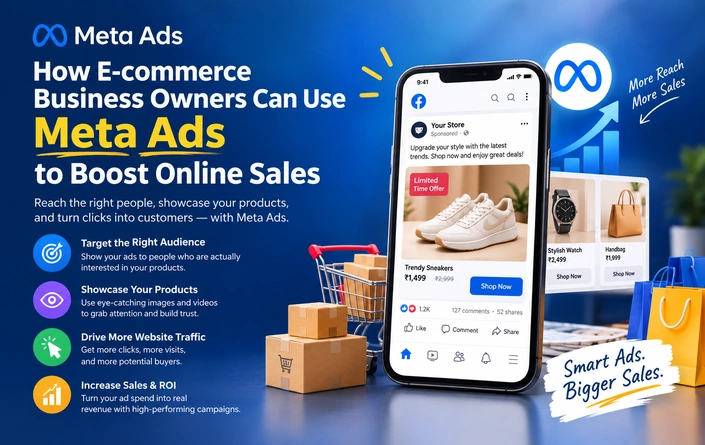
Running an e-commerce business is not just about having great products. You also need to reach the right customers, build trust, and turn website visitors into paying customers. Meta Ads can help e-commerce businesses reach potential buyers on Facebook and Instagram, generate product awareness, drive website traffic, and increase online sales.
For e-commerce business owners, Meta Ads can be used throughout the customer journey—from introducing your products to new audiences to retargeting people who viewed a product but did not purchase.
In this guide, we'll explain how Meta Ads help e-commerce businesses increase online sales, which campaign strategies to use, how retargeting works, and how to optimize your campaigns for better results.
Meta Ads are paid advertisements that businesses can run across platforms such as Facebook and Instagram.
For e-commerce brands, Meta Ads can promote:
Products and product collections
Special offers and discounts
New product launches
Catalog-based product ads
Seasonal sales
Retargeting campaigns
User-generated content
Product demonstration videos
Customer testimonials
The biggest advantage is that e-commerce businesses can reach people based on factors such as interests, online behavior, demographics, engagement, and previous interactions with the brand.
When combined with the Meta Pixel, Conversions API, product catalog, and conversion-focused landing pages, Meta Ads can become an important part of an e-commerce growth strategy.
One major advantage of Meta Ads is that businesses don't always have to wait for customers to search for their products.
Facebook and Instagram allow brands to introduce products to people who may be interested in them.
For example, an online fashion store can promote a new collection to relevant audiences and create demand before customers actively search for the products.
This makes Meta Ads particularly useful for:
Fashion brands
Beauty products
Home and lifestyle products
Jewellery
Electronics accessories
Food products
D2C brands
Local e-commerce businesses
A successful e-commerce advertising strategy should not treat every customer the same.
Meta Ads can be structured around different audience groups, such as:
New audiences: People who have not interacted with your brand.
Engaged audiences: People who watched your videos, interacted with Instagram or Facebook content, or visited your social profiles.
Website visitors: People who visited your website or product pages.
Product viewers: People who viewed specific products.
Previous customers: People who have already purchased from your business.
This segmentation allows businesses to show more relevant messages to different stages of the buying journey.
Not everyone purchases the first time they visit an e-commerce website.
A potential customer might:
View a product
Add it to the cart
Check the price
Leave the website
Compare other products
Return later
Retargeting allows e-commerce brands to reconnect with these users.
For example:
First interaction:
"Discover our latest collection."
Product viewer:
"Still thinking about it? Take another look."
Cart abandoner:
"Your cart is waiting. Complete your order today."
The message can become more specific as the customer moves closer to purchasing.
Meta's catalogue functionality allows e-commerce businesses to connect their product inventory with advertising campaigns.
This can help businesses promote relevant products dynamically based on user interactions.
For example, if someone views a particular pair of shoes, catalog-based advertising can help show that product again through retargeting.
For businesses with many products, catalog advertising can be more scalable than creating individual ads for every product manually.
The creative is one of the most important parts of an e-commerce Meta Ads campaign.
Your advertisement needs to stop the scroll quickly and communicate the product's value.
Effective e-commerce creatives can include:
Product demonstration videos
UGC-style videos
Before-and-after content
Customer testimonials
Product comparison videos
Unboxing videos
Lifestyle product photography
Problem-solution videos
Limited-time offers
Carousel product ads
Instead of simply showing a product, explain why the customer should buy it.
For example:
Weak:
"New skincare product available."
Stronger:
"Dry skin after every wash? Discover a simple daily skincare routine designed for hydration."
The second message focuses on a customer problem rather than only promoting the product.
User-generated content can make e-commerce advertisements feel more authentic.
An UGC-style advertisement may show:
The customer's problem
The product discovery
How the product is used
The experience/result
A clear call to action
For example:
"I wasn't sure whether this would actually work, but after using it for a few weeks, here's what I noticed..."
This format can feel more like a recommendation than a traditional advertisement.
For e-commerce businesses, UGC can be especially useful for products where customers need confidence before purchasing.
Getting clicks is not enough.
If your Meta Ads generate traffic but your product page doesn't convert, increasing the advertising budget may simply increase wasted spend.
Your product page should clearly communicate:
Product benefits
Price
Product images
Videos where relevant
Reviews
Delivery information
Return/refund policy
Payment options
Frequently asked questions
Clear Add to Cart button
Trust signals
The advertisement creates interest. The product page needs to convert that interest into a purchase.
E-commerce business owners should look beyond likes, comments, and impressions.
Important Meta Ads metrics include:
CTR helps you understand how effectively your ad encourages people to click.
CPC shows how much you're paying, on average, for a click.
This measures how effectively your website turns visitors into customers.
CPA shows how much it costs to generate a purchase or customer.
ROAS compares the revenue attributed to advertising with the amount spent.
For example:
If you spend ₹10,000 on advertising and generate ₹40,000 in attributed revenue:
ROAS = 4X
However, a good ROAS target depends on your product margin, average order value, operating costs, repeat purchases, and business model.
One creative rarely works forever.
E-commerce businesses should continuously test:
Hooks
Headlines
Videos
Images
UGC
Offers
Product angles
Audiences
Landing pages
Calls to action
For example, the same product could be promoted using different angles:
Problem-based:
"Suffering from dry skin?"
Benefit-based:
"Get long-lasting hydration."
Social proof:
"Why thousands of customers are choosing this."
Offer-based:
"Get 20% off this week."
Testing helps identify which message resonates most strongly with your target audience.
A strong e-commerce Meta Ads strategy usually needs both customer acquisition and retargeting.
Target people who have not purchased from your business.
The goal is to introduce your product and generate new customers.
Reach people who have already interacted with your brand.
Examples include:
Website visitors
Product viewers
Instagram engagers
Facebook engagers
Add-to-cart users
Previous customers
This creates a full-funnel advertising approach instead of relying on a single audience.
A simple e-commerce Meta Ads funnel can look like this:
Awareness → Interest → Product View → Add to Cart → Purchase → Repeat Purchase
Each stage can use different messaging.
Introduce the brand and product.
Explain the problem, product benefits, and differentiators.
Use reviews, demonstrations, testimonials, and comparisons.
Use strong product benefits, offers, urgency, and trust signals.
Promote related products, repeat purchases, bundles, and new launches to existing customers.
There is no single advertising budget that works for every e-commerce business.
Your budget depends on:
Product price
Gross margin
Average order value
Conversion rate
Customer acquisition cost
Competition
Target market
Website conversion rate
Repeat purchase rate
A better approach is to start with a controlled budget, collect enough conversion data, identify winning creatives and audiences, and then scale gradually.
Instead of asking only:
"How much should I spend?"
ask:
"How much can I afford to spend to acquire one profitable customer?"
This gives you a much more useful framework for deciding your Meta Ads budget.
Without proper tracking, it becomes difficult to understand which campaigns generate purchases.
Engagement is useful, but e-commerce campaigns ultimately need to contribute to business outcomes such as purchases and revenue.
Ad fatigue can reduce performance over time. Refreshing creative concepts can help maintain engagement.
When possible, send customers to a relevant product or category page that matches the advertisement.
Most social media traffic is mobile. Your product pages, checkout experience, images, buttons, and forms should work smoothly on mobile devices.
Increasing budgets aggressively without understanding campaign performance can negatively affect efficiency.
Meta Ads and search marketing should not be treated as completely separate channels.
Meta Ads can generate awareness and traffic, while SEO, AEO and GEO help your brand become discoverable through search engines and AI-powered search experiences.
For example:
Meta Ads:
Introduce your product to potential customers.
SEO:
Help your website appear for relevant Google searches.
AEO:
Structure content so it can directly answer customer questions.
GEO:
Improve your brand's visibility and relevance across generative AI and answer-based search experiences.
Together, these channels can create a broader digital marketing ecosystem for an e-commerce business.
Webbitech helps businesses plan and manage performance-focused digital marketing campaigns designed around business goals.
Our e-commerce marketing approach can include:
Meta Ads strategy
Facebook & Instagram advertising
Conversion campaigns
Product catalog campaigns
Retargeting
UGC ad concepts
Creative strategy
Landing page optimization
Conversion tracking
Performance analysis
SEO
AEO
GEO
Google Ads
The objective is not simply to generate clicks. The focus should be on building a measurable path from ad impression → website visit → product interaction → purchase → customer value.
Meta Ads can be a powerful customer acquisition channel for e-commerce businesses when the right audience, creative, offer, tracking, landing page, and optimization strategy work together.
The best approach is not to simply spend more on advertising. Instead, e-commerce business owners should continuously test creatives, understand customer behavior, improve conversion rates, measure profitability, and scale campaigns based on real business data.
If your e-commerce business wants to generate more online sales, Meta Ads can be an important part of a broader SEO, Google Ads, Meta Ads, AEO and GEO strategy.
Meta Ads help e-commerce businesses reach potential customers on Facebook and Instagram, promote products, retarget website visitors, and drive qualified traffic to product pages. With proper conversion tracking and optimization, campaigns can be optimized toward purchases and revenue.
Yes. Meta Ads can be effective for e-commerce businesses because they support visual advertising, audience targeting, retargeting, product catalogs, and conversion-focused campaigns. Results depend on the product, offer, creative, website, audience, and campaign strategy.
There is no fixed budget. The appropriate budget depends on product margin, average order value, conversion rate, customer acquisition cost, competition, and business goals. Start with a controlled test budget and scale campaigns based on profitable performance.
Product demonstrations, UGC-style videos, testimonials, lifestyle creatives, carousels, product catalog ads, problem-solution videos, and offer-focused creatives can all work. The best format depends on the product and audience.
ROAS, or Return on Ad Spend, measures revenue generated in relation to advertising spend. For example, ₹10,000 in ad spend generating ₹40,000 in attributed revenue represents a 4X ROAS.
Yes. Retargeting can help businesses reconnect with people who have previously interacted with their brand, such as website visitors, product viewers, add-to-cart users, and previous customers.
Improve the complete conversion funnel rather than focusing only on the ad. Test different creatives and offers, improve audience targeting, strengthen product pages, optimize checkout, improve tracking, and continuously analyze purchase data.
Yes. Meta Ads can generate awareness and traffic while SEO can capture people actively searching for relevant products or information. Using both channels can create a more comprehensive customer acquisition strategy.
Meta Ads are particularly useful for discovering and influencing potential customers through Facebook and Instagram, while Google Ads can capture users who are actively searching for products or solutions. Many e-commerce businesses can benefit from using both channels.
Webbitech can help e-commerce businesses with Meta Ads strategy, campaign setup, creative planning, retargeting, conversion tracking, performance analysis, and broader digital marketing services including SEO, AEO and GEO.
For e-commerce business owners, Meta Ads should be viewed as more than a way to generate clicks. With the right strategy, they can help build awareness, reach new customers, bring back interested visitors, and generate measurable online sales.
The key is to connect creative, targeting, tracking, website conversion, and continuous optimization into one complete growth strategy.
Have a project in mind? Let’s build something amazing together.
Webbitech — A Leading Web Design & Web Development Company with 15+ Years of SEO & Digital Marketing Expertise, Delivering Countless Success Stories
From idea to execution, we help businesses create high-performing websites and applications.
Start your journey today and take your brand to the next level.