Posted Date : 07 Sep 2026
Digital marketing has changed more in the last three years than it did in the previous decade—and artificial intelligence is the reason why. What used to take a team of analysts, copywriters, and media buyers weeks to plan can now be tested, optimized, and scaled in hours.
In 2026, AI is no longer a "nice-to-have" add-on for marketing teams. It's the infrastructure behind ad targeting, content creation, customer service, and campaign optimization. Businesses that understand how to use it are pulling ahead of competitors who are still relying on manual, guesswork-driven strategies.
This guide breaks down exactly how AI is transforming digital marketing in 2026, the tools driving that change, and what marketers need to do to keep up.
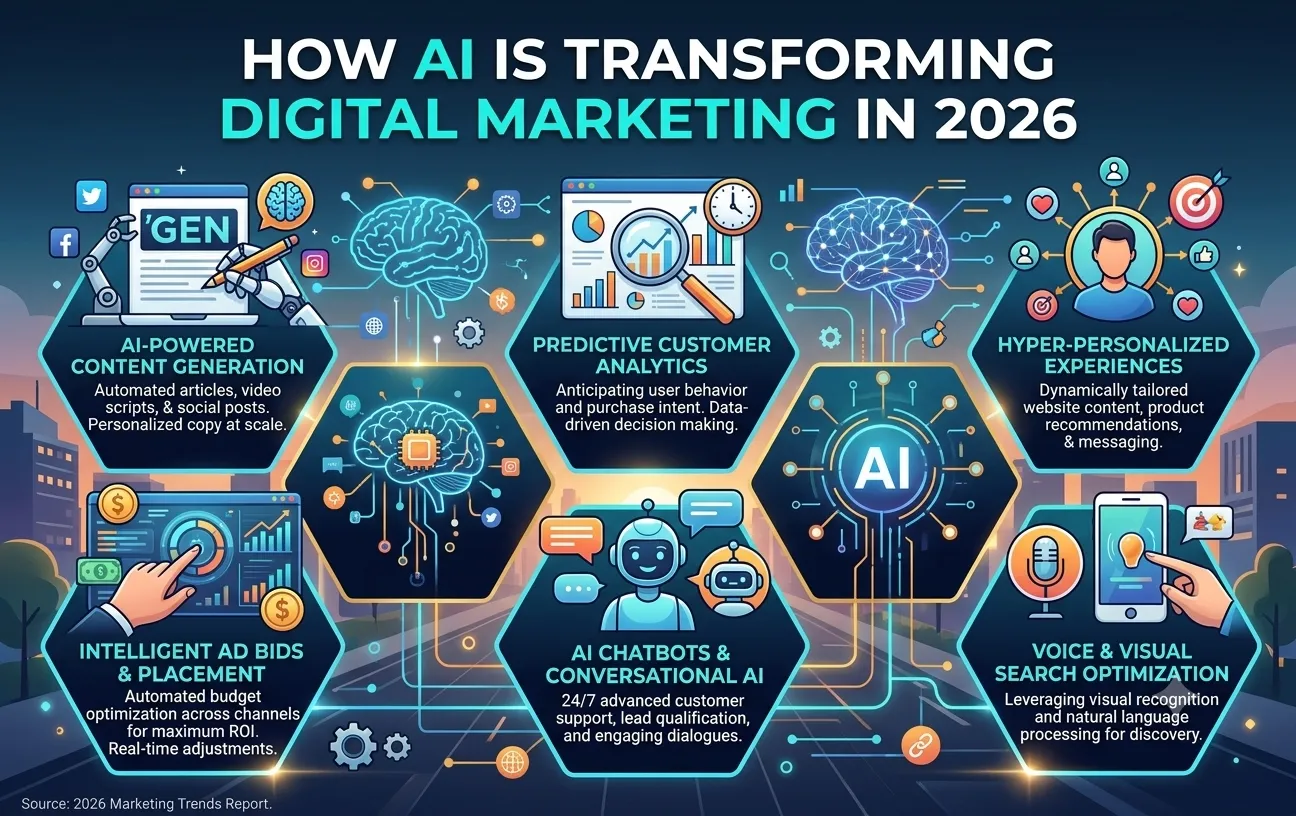
1. AI-Powered Ad Targeting and Optimization
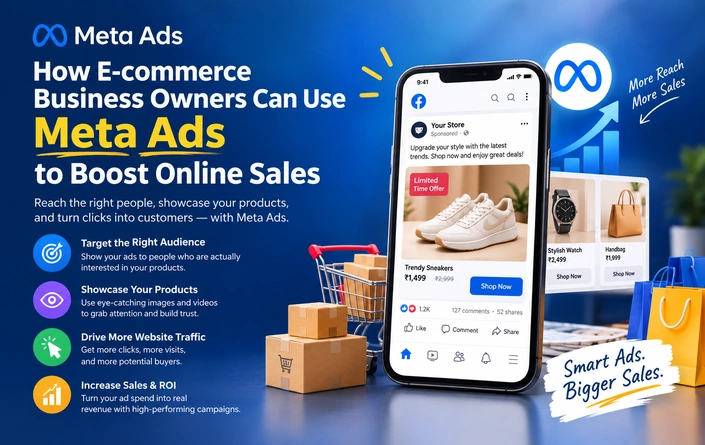
The biggest shift in digital marketing is happening inside ad platforms themselves. Meta, Google, and TikTok have all moved toward AI-driven campaign types — Advantage+ on Meta, Performance Max on Google—that let machine learning handle targeting, bidding, and creative rotation automatically.
Instead of manually selecting interests and demographics, marketers now feed these systems a handful of creative assets and a conversion goal, and the AI tests thousands of audience and placement combinations in real time.
What this means for marketers:
Less time spent on manual audience research, more time on creative strategy
Better performance from first-party data fed into AI systems (customer lists, pixel data, CRM integrations)
A shift in skill set from "targeting expert" to "AI campaign strategist"—knowing what inputs to give the algorithm matters more than manually picking interests
2. Generative AI in Content Creation
Content production has been completely reshaped by generative AI tools. Blog posts, ad copy, product descriptions, and even video scripts can now be drafted in seconds using large language models.
But the real shift in 2026 isn't just "AI writes the content"—it"'s AI-assisted content at scale with human strategic oversight. The most successful marketing teams use AI to:
Generate multiple headline and hook variations for A/B testing (similar to the multi-variant ad copy approach used in performance marketing)
Repurpose one long-form piece of content into social posts, email copy, and video scripts
Localize content into multiple languages instantly, while a human editor reviews tone and cultural accuracy
The teams getting the best results aren't fully automating content—they're using AI as a first-draft engine and spending their saved time on strategy, positioning, and quality control.
3. Predictive Analytics and Customer Insights
AI has made it possible to predict customer behavior before it happens, not just report on it after the fact. Predictive analytics tools now forecast:
Which customers are likely to churn
What products a customer is likely to buy next
The optimal time and channel to reach a specific customer segment
This has turned marketing from a reactive function into a proactive one. Instead of running a campaign and waiting to see results, marketers can model likely outcomes before spending a single rupee or dollar on media.
4. Hyper-Personalization at Scale
Personalization used to mean inserting a customer's first name into an email subject line. In 2026, AI enables true 1:1 personalization — dynamically changing website content, product recommendations, ad creative, and email offers based on real-time behavior.
Personalization Type How AI Powers It
Website content Dynamically adjusts based on visitor's traffic source, past behavior, and location
Ad creative Dynamic Creative Optimization (DCO) auto-generates and tests creative combinations per user
Email marketing AI predicts optimal send time and subject line per individual subscriber
Product recommendations Machine learning models suggest products based on browsing and purchase patterns
This level of personalization was previously only available to enterprise brands with large data science teams. AI tools have made it accessible to small and mid-sized businesses too.
5. Conversational AI and Chatbots
AI-powered chatbots have moved far beyond simple FAQ bots. In 2026, conversational AI handles:
Qualifying leads before they reach a sales team
Answering product questions with context from a company's actual knowledge base
Booking appointments and following up automatically via WhatsApp, Instagram DMs, and website chat
For local and B2B businesses especially, this means faster response times to inbound leads — which directly impacts conversion rates, since speed-to-lead is one of the strongest predictors of whether a prospect converts.
6. AI and the Changing Face of SEO
Search itself is being reshaped by AI. With AI Overviews and generative answer engines now appearing directly in search results, SEO in 2026 isn't just about ranking on a results page — it's about being cited as a source inside AI-generated answers.
This emerging discipline, often called Generative Engine Optimization (GEO) or AI visibility, requires:
Clear, well-structured content that directly answers specific questions
Strong topical authority (comprehensive coverage of a subject, not just single keyword-targeted pages)
Structured data (schema markup) that helps AI systems understand and extract your content accurately
Marketers who treat AI search visibility as a separate discipline from traditional SEO are already seeing an edge in organic visibility.
7. Marketing Automation and Agentic Workflows
Perhaps the most significant shift in 2026 is the rise of agentic AI — AI systems that don't just generate content or insights, but actually execute multi-step marketing workflows with minimal human input. Examples include:
AI agents that monitor campaign performance and automatically reallocate budget toward top-performing ad sets
Automated reporting agents that compile weekly performance summaries and flag anomalies
AI-driven customer segmentation that continuously updates audience lists based on new behavioral data
This doesn't eliminate the need for marketers — it changes their role from "doing the manual work" to "supervising and directing AI systems," similar to how a marketing manager oversees a team.
What This Means for Your Business in 2026
AI isn't replacing marketers—it's replacing the manual, repetitive parts of marketing work. The businesses winning right now are the ones that:
Feed AI systems clean, accurate first-party data
Use AI for speed and scale, but keep human oversight on strategy and brand voice
Test AI-generated creative and copy variations systematically, rather than assuming AI output is final
Invest in AI visibility (GEO) alongside traditional SEO
Treat AI tools as a force multiplier for a lean team, not a replacement for strategic thinking

Have a project in mind? Let’s build something amazing together.
Webbitech — A Leading Web Design & Web Development Company with 15+ Years of SEO & Digital Marketing Expertise, Delivering Countless Success Stories
From idea to execution, we help businesses create high-performing websites and applications.
Start your journey today and take your brand to the next level.