Posted Date : 22 Sep 2026
Mobile app development in 2026 no longer looks like a relay race between designers, developers, and QA teams passing a baton. It looks more like a fleet of AI agents working in parallel—planning features, writing code, testing edge cases, and flagging their own mistakes before a human ever opens a pull request.
This isn't incremental automation. It's a structural shift in how mobile products get built, and it's happening at a pace most engineering leaders underestimated a year ago. This guide breaks down exactly what's changing across the pipeline, which tools are driving it, what the real risks are, and how to start adopting agentic AI without breaking your existing workflow.
Agentic AI refers to AI systems that plan, execute, and self-correct multi-step tasks with minimal human intervention — as opposed to earlier "copilot" tools that only suggested the next line of code. In a mobile development context, an agentic system can read an entire codebase, decompose a feature request into subtasks, write and test the code, catch its own errors, and only surface a result once the app actually works.
The distinction matters for search and answer engines alike: a copilot suggests, and an agent acts. That single difference is why 2026 is being called the "agent-first" era of software development rather than just another AI-assisted one.
| Capability | Traditional / Copilot Tools | Agentic AI Pipeline |
|---|---|---|
| Input handling | Waits for explicit prompts or taps | Interprets goals, context, and voice/image input |
| Code generation | Suggests one function or line at a time | Plans and builds multi-screen flows end-to-end |
| Error handling | The developer manually finds and fixes bugs. | The agent detects, diagnoses, and patches its own errors. |
| Testing | Manual or scripted test cases | Autonomous QA agents generate and run test suites. |
| Deployment | Human-triggered CI/CD steps | Agent-managed pipelines with human approval gates |
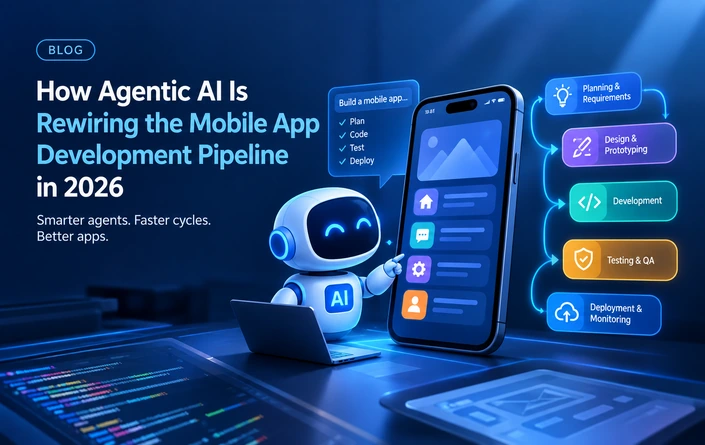
Product requirement documents, sketches, and even screenshots can now be fed directly to an agent, which turns them into a scoped technical plan and a working prototype—compressing what used to be a multi-day discovery phase into hours.
Developers describe a feature in plain language, and agents generate the UI, backend logic, and API integrations together as one continuous unit rather than as disconnected outputs from separate tools.
Coding agents in 2026 are active contributors rather than passive suggestion engines: they can fix bugs on their own, manage cross-project dependencies, and recommend improvements based on the existing codebase. By 2026, teams manage a fleet of AI agents that write, debug, and deploy code rather than writing every line themselves, and Google's internal agent research shows that breaking complex problems into specialized sub-agents managed by a supervisor agent can significantly cut processing time.
This is where agentic AI delivers the fastest ROI. Agents generate test cases from user stories, run them across device farms, and self-repair generation errors instead of stopping and waiting for a developer to re-prompt them—turning QA from a bottleneck into a continuous background process.
The gap that's finally closing in 2026 is between "an AI generated this app" and "this app is actually shippable." That gap includes App Store review compliance, in-app purchase integration, push notifications, crash reporting, and privacy manifests — all of which leading agentic platforms are now pre-integrating rather than leaving as manual homework.
Post-launch, agentic AI doesn't stop at the build. On-device agents now monitor user behavior and take proactive action — for example, travel apps that watch flight prices, check calendar conflicts, and rebook automatically without a user prompt.
If you're deciding how much to invest in agentic tooling this year, the data makes the urgency concrete:
That last stat is the one engineering leaders should sit with. Adoption has outpaced governance — which is exactly where the risk lives.
Agentic AI's biggest failure mode isn't bad output — it's ungoverned output. 88% of organizations have confirmed or suspected an AI agent security incident in the past year, yet only 14.4% of teams deploy agents with full security approval. On top of that, Gartner research shows organizations will abandon 60% of AI projects through 2026 because their underlying data isn't AI-ready.
Agentic AI is AI that autonomously plans, executes, and corrects multi-step development tasks — such as writing code, running tests, and fixing bugs — rather than only responding to individual prompts.
Coding assistants suggest code line-by-line and wait for developer approval at each step. Agentic AI plans an entire task, executes multiple steps autonomously, checks its own work, and only stops for approval at meaningful checkpoints.
No. Agentic AI removes repetitive work like boilerplate coding, dependency management, and routine testing, but it still requires human oversight for architecture decisions, security approval, and judgment calls—especially given that most organizations still lack centralized control over their agents.
Ungoverned agent access. Security incidents linked to AI agents are already common industry-wide, and most teams have not yet deployed agents under full security review, so scoped permissions and human approval gates matter more than raw capability.
Testing and quality assurance, because agentic QA tools can generate test cases, run them, and self-repair errors with low risk if something goes wrong—making it the safest and fastest place to start.
Agentic AI isn't a feature you bolt onto your existing mobile pipeline—it's a different way of organizing the work itself, from planning through deployment and beyond. The teams pulling ahead in 2026 aren't the ones with the flashiest AI demo; they're the ones who paired agentic tooling with real governance, starting with low-risk stages like QA before expanding trust outward.
If you're evaluating where to start, begin with a shadow-mode pilot on your testing pipeline this quarter—it's the lowest-risk, highest-signal way to see what agentic AI can actually do inside your codebase.

Have a project in mind? Let’s build something amazing together.
Webbitech — A Leading Web Design & Web Development Company with 15+ Years of SEO & Digital Marketing Expertise, Delivering Countless Success Stories
From idea to execution, we help businesses create high-performing websites and applications.
Start your journey today and take your brand to the next level.