Posted Date : 05 Aug 2026
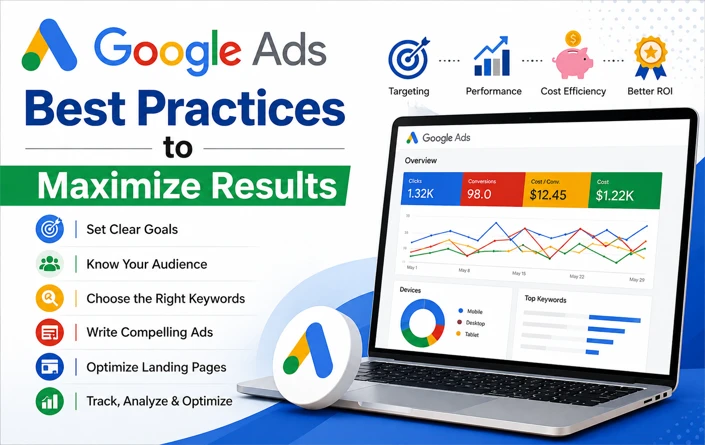
Google Ads remains one of the most powerful digital advertising platforms for businesses of every size. Whether your objective is generating leads, increasing online sales, driving website traffic, or building brand awareness, Google Ads offers unmatched targeting capabilities. Success, however, depends on strategy rather than budget alone.
Modern advertising requires continuous optimization, data-driven decisions, and an understanding of customer intent. Businesses that embrace these principles consistently outperform competitors.
Google processes billions of searches every day, connecting businesses with customers actively looking for products and services.
Unlike traditional advertising, Google Ads reaches people precisely when they express intent. This means advertisers can focus their budgets on users most likely to convert, resulting in stronger return on investment.
Additional advantages include the following:
Every successful campaign begins with a clearly defined objective.
Without measurable goals, optimization becomes guesswork.
If visibility is the objective, prioritize impressions, reach, and brand recall rather than immediate conversions.
Businesses offering services should optimize for qualified leads through contact forms, phone calls, and consultation requests.
Online retailers should focus on purchases, revenue, and return on ad spend (ROAS).
Effective campaigns begin with understanding who your customers are.
Demographics alone are insufficient. Successful advertisers analyze behaviors, interests, purchasing habits, and search intent.
Segment audiences based on:
Segmentation allows personalized messaging that resonates more effectively.
Google categorizes search intent into several types:
The highest-converting keywords typically align with transactional intent.
Keyword research remains the cornerstone of successful Google Ads campaigns.
Choosing the right search terms determines who sees your advertisements.
Broad keywords generate larger search volumes but often produce stronger competition and higher costs.
Example:
Long-tail keywords attract highly qualified traffic.
Example:
These keywords generally convert better because searchers have clearer intent.
Negative keywords prevent ads from appearing in irrelevant searches.
Examples include:
A well-maintained negative keyword list reduces wasted ad spend significantly.
Campaign organization directly influences optimization.
Avoid placing unrelated keywords within the same campaign.
Separate campaigns based on:
This approach enables more accurate bidding and reporting.
Each ad group should contain closely related keywords.
Highly relevant ad groups improve Quality Score and click-through rates.
Your advertisement has only seconds to capture attention.
Every word should communicate value.
Effective headlines:
Descriptions should explain:
Avoid generic statements.
Examples include:
Strong CTAs increase engagement and conversions.
Clicks alone do not generate revenue.
Landing pages should align perfectly with advertisement messaging.
Important elements include:
Consistency between ads and landing pages improves conversion rates.
Quality Score directly affects both cost per click and ad positioning.
Google evaluates:
Higher quality scores often reduce advertising costs while increasing visibility.
Google's AI-powered bidding strategies simplify optimization.
Popular strategies include:
Select bidding strategies based on campaign objectives rather than trends.
Ad extensions improve visibility and provide additional information.
Useful extensions include:
Extensions frequently improve click-through rates.
Audience targeting extends beyond keywords.
Google enables advertisers to reach users based on:
Combining audiences with keyword targeting often improves campaign efficiency.
Many visitors do not convert during their first visit.
Remarketing allows businesses to reconnect with previous visitors.
Effective remarketing strategies include:
Returning visitors often convert at higher rates.
Most Google searches now occur on mobile devices.
Ensure that:
Mobile optimization directly influences conversions.
Continuous experimentation leads to incremental improvements.
Test:
Small improvements accumulate into significant performance gains.
Regular analysis ensures campaigns remain profitable.
Essential metrics include the following:
Use these metrics to guide optimization decisions.
Many campaigns underperform due to avoidable errors.
Common mistakes include:
Routine audits help identify and correct these issues.
Artificial intelligence has become an integral part of Google Ads.
AI can assist with:
Automation should complement human expertise, not replace strategic oversight.
The advertising landscape evolves continuously.
Key trends shaping Google Ads include the following:
Businesses that adapt quickly maintain a competitive advantage.
Maximizing Google Ads results requires more than increasing budgets. Success comes from combining strategic planning, precise audience targeting, high-quality creative, optimized landing pages, intelligent bidding, and continuous performance analysis. By following these best practices, businesses can improve visibility, generate higher-quality leads, reduce wasted ad spend, and achieve sustainable growth.
The most successful advertisers treat Google Ads as an ongoing optimization process rather than a one-time campaign. Regular testing, thoughtful refinement, and a commitment to data-driven decision-making ensure campaigns remain effective in an increasingly competitive digital marketplace.
Have a project in mind? Let’s build something amazing together.
Webbitech — A Leading Web Design & Web Development Company with 15+ Years of SEO & Digital Marketing Expertise, Delivering Countless Success Stories
From idea to execution, we help businesses create high-performing websites and applications.
Start your journey today and take your brand to the next level.