For Business Enquiry: +91 97892 39293
WEBBITECH

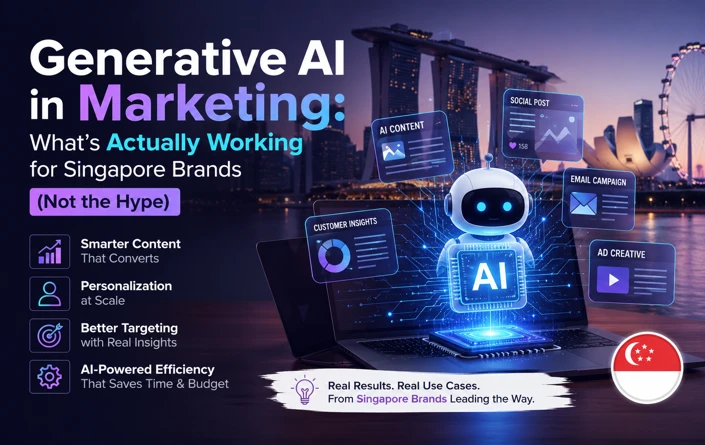
Generative AI in Marketing: What's Actually Working for Singapore Brands (Not the Hype)

Generative AI in Marketing: What's Actually Working for Singapore Brands (Not the Hype)

Generative AI in Marketing: What's Actually Working for Singapore Brands (Not the Hype)

Every marketing deck in Singapore right now has a slide about AI. Fewer have a number attached to it.

Walk into any agency pitch this year, and you'll hear the same buzzwords—"AI-powered," "hyper-personalized," "next-gen automation." Most of it is noise. But underneath the noise, a smaller set of AI use cases are quietly producing real results for Singapore brands: faster production, better-targeted spend, and content that actually gets found by the AI tools people now search through.

Here's what's genuinely working, what's still mostly hype, and how to tell the difference for your own business.

1. AI as a production engine, not a creative director

The brands seeing real gains aren't asking AI to "be creative." They're using it to multiply the output of a creative idea a human already approved.

In practice, that looks like:

  • Generating five or six variations of the same ad creative for A/B testing, instead of running one version for two weeks and hoping.
  • Localising a single campaign concept across English, Mandarin, Malay, and Tamil copy in hours rather than days — important in a market where genuinely multilingual marketing is a real differentiator, not a nice-to-have.
  • Drafting first passes of product descriptions, social captions, and email subject lines that a human editor then tightens and fact-checks.

The pattern across brands that are getting value from this: a human still owns the strategy and does final review. AI handles volume, not judgement. Teams that skip the human oversight step tend to end up with content that reads fine individually but feels generic and interchangeable across the brand's channels—which actually hurts trust in a market as discerning as Singapore's.

2. Getting found inside AI answers (this is the real shift)

This is the trend most Singapore marketers are underestimating. A large and growing share of Google searches in Singapore now end without a click because the answer appears directly in an AI overview. On top of that, tools like ChatGPT and Perplexity are increasingly where people go to ask "What's the best digital marketing agency in Singapore?" or "Which clinic is best for X"—and brands that don't show up inside those answers simply don't exist for that customer.

What's actually working here isn't an AI tool—it's a content discipline shift:

  • Writing pages that state the answer clearly near the top, in plain language a model can lift and cite, rather than burying it under three paragraphs of brand storytelling.
  • Structuring content with clear headers, defined terms, and specific numbers—AI systems favor content that's easy to parse and quote.
  • Building topic clusters around one core service or product line, instead of scattering one-off blog posts that never build authority on a subject.

Generative AI tools can help draft this structured content faster, but the win comes from the structure and clarity, not from the AI itself.

3. First-party data feeding personalisation that doesn't feel creepy

Third-party tracking keeps getting harder, so the Singapore brands ahead of the curve are using AI to make more out of the data they already own—email lists, account behavior, past purchases—rather than chasing better ad targeting.

This looks like:

  • AI-assisted segmentation that flags which existing customers are likely to churn or buy again, instead of treating every contact the same.
  • Dynamic website content that changes based on what a visitor has already shown interest in (a returning customer sees different homepage modules than a first-time visitor).
  • Personalized follow-up sequences after a form fill or cart abandonment, tuned to the specific product or service the person looked at.

The honest caveat: this only works if you've already built a half-decent first-party data foundation—email capture, a usable CRM, and basic tracking. AI personalization layered on top of messy or missing data just produces confident-sounding nonsense.

4. A consistent short-form video pipeline, not one viral swing

Singapore audiences are watching a lot of short-form video daily, across TikTok, Reels, and Shorts. The brands winning here aren't the ones chasing a single viral hit—they're the ones treating video as a repeatable production line: AI tools speed up captioning, rough-cut editing, and generating variations of the same video for different platforms, while a person still decides the hook, the message, and whether it's actually good.

What's still mostly hype

To be fair to the skepticism: a few things marketed hard as "AI marketing wins" in Singapore right now don't hold up well in practice.

  • Fully automated ad campaigns with no human review. Automated bidding tools work best with clean, abundant conversion data — most SMEs don't have enough volume for this to outperform a well-run manual campaign.
  • Generic AI-written blog content at scale. Search engines and AI answer engines are both getting better at recognizing shallow, interchangeable content. Volume without distinct expertise tends to underperform.
  • AI chatbots as a customer service replacement rather than a first filter. They're useful for routing and FAQs; they frustrate customers fast when used as the only support channel for anything non-trivial.

The practical takeaway

If you're a Singapore brand deciding where to actually spend time and budget on AI this year, the brands seeing real results are doing roughly the same three things:

  1. Using AI to multiply approved creative work, not to generate strategy from scratch.
  2. Restructuring content to be quotable inside AI search answers, not just ranked in classic search.
  3. Feeding AI personalization with first-party data they've deliberately built, not data they hope they have.

Everything else — the flashy AI demos, the "fully autonomous marketing" pitches — is worth watching, but it's not where the ROI is right now. Start with the three things above, and you're already ahead of most of the market.

About the Author

Webbitech is a leading website design and web development company in Coimbatore,

🚀 Get Your Project Started

Have a project in mind? Let’s build something amazing together.

🏆#1 Website Design & Web Development Company - Trusted by 500+ Business Owners

Webbitech — A Leading Web Design & Web Development Company with 15+ Years of SEO & Digital Marketing Expertise, Delivering Countless Success Stories

🚀Let’s Build Something Amazing Together

From idea to execution, we help businesses create high-performing websites and applications.
Start your journey today and take your brand to the next level.
Related Articles

Top 10 Mobile App Development Companies and App Developers in Bangalore (2026)

Top 10 Mobile App Development Companies and App Developers in Bangalore (2026)

Task-Specific AI Agents Are Coming to 40% of Enterprise Apps by 2026 — Is Your App Ready?

Task-Specific AI Agents Are Coming to 40% of Enterprise Apps by 2026 — Is Your App Ready?

MCP Apps Explained: How Claude Now Renders Interactive UIs Inside Chat

MCP Apps Explained: How Claude Now Renders Interactive UIs Inside Chat

Claude + MCP in 2026: From Anthropic Side Project to Linux Foundation Standard

Claude + MCP in 2026: From Anthropic Side Project to Linux Foundation Standard

MCP's Biggest Update Yet: What the July 2026 Spec Release Means for Developers

MCP's Biggest Update Yet: What the July 2026 Spec Release Means for Developers

WhatsApp Webbitech Get Free Consulting Get In Touch