Posted Date : 23 Jun 2026
Artificial intelligence is rapidly transforming digital advertising. What once required hours of campaign setup, audience research, bid adjustments, creative testing, and performance monitoring can now be automated in minutes. Platforms like Google Ads, Meta Ads, TikTok Ads, and LinkedIn Ads are increasingly shifting toward AI-driven campaign management, where algorithms handle much of the decision-making process.
For marketers, this raises an important question:
If advertising platforms can automate everything, what role will marketers play?
The answer is simple: automation can execute tactics, but it cannot replace strategy, creativity, brand understanding, or business objectives.
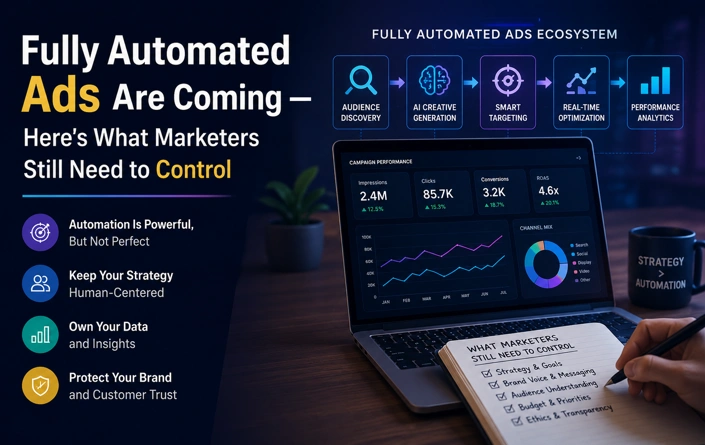
Fully automated advertising is coming, and in many ways, it's already here. However, successful marketers will continue to play a critical role in guiding, monitoring, and controlling the elements that AI cannot fully understand.
Let's explore what advertising automation means for the future and what marketers must continue to manage.
Over the past decade, advertising platforms have steadily introduced automation features.
Examples include:
Automated bidding
Dynamic creative optimization
AI-generated ad copy
Predictive audience targeting
Automated budget allocation
Performance Max campaigns
Advantage+ shopping campaigns
Today's advertising systems analyze thousands of signals in real time, making optimization decisions faster than any human team could.
The goal is simple:
Deliver better results with less manual intervention.
For businesses, this means improved efficiency and potentially higher returns on advertising spend.
However, efficiency doesn't eliminate the need for human oversight.
Modern advertising algorithms excel at handling large-scale data analysis.
They can:
AI evaluates millions of user interactions across devices, locations, demographics, and behaviors.
Algorithms adjust bids in real time based on conversion probability.
Machine learning detects trends and audience behaviors that marketers may never notice manually.
AI can simultaneously test multiple creatives, headlines, audiences, and placements.
Automation enables campaigns to expand across channels without increasing management complexity.
These capabilities make automation an incredibly powerful tool.
But powerful tools still need direction.
While AI can automate execution, it cannot fully understand business context, customer emotions, or brand identity.
Here are the areas where marketers remain essential.
Advertising platforms optimize for the goals they are given.
If the objective is flawed, automation simply accelerates the wrong outcome.
For example:
More leads don't always mean better leads.
More traffic doesn't always mean more revenue.
More conversions don't always mean higher profitability.
Marketers must define the following:
Revenue targets
Customer acquisition goals
Market expansion plans
Brand positioning strategies
Long-term growth objectives
AI can optimize campaigns, but humans must decide where the business is going.
One of the biggest limitations of automation is its inability to fully understand brand personality.
Your brand is more than words.
It represents:
Values
Trust
Reputation
Customer expectations
Emotional connection
AI-generated content may be technically correct but lack authenticity.
Marketers must ensure that every advertisement reflects:
Brand tone
Unique selling propositions
Company values
Customer expectations
The strongest brands are built through consistent messaging, not algorithmic efficiency.
AI can identify who converts.
Marketers understand why they convert.
This distinction is critical.
Customer motivations often involve:
Emotions
Pain points
Aspirations
Personal experiences
Cultural influences
Understanding these factors requires human insight.
Marketers should continue conducting the following:
Customer interviews
Market research
Competitor analysis
Customer journey mapping
The better the audience understanding, the better the automation performs.
Advertising success increasingly depends on creative quality.
Automation can test creative assets, but it cannot consistently generate breakthrough ideas.
Human creativity drives the following:
Campaign concepts
Storytelling
Emotional engagement
Visual identity
Brand differentiation
The most memorable advertisements are often built around insights, humor, emotion, or cultural relevance—areas where humans still excel.
AI may create content, but marketers create meaning.
Automation is only as good as the data it receives.
Poor tracking leads to poor decisions.
Marketers must ensure:
Accurate conversion tracking
Proper attribution setup
CRM integration
First-party data collection
Clean analytics reporting
Without reliable data, even the most advanced AI systems will optimize incorrectly.
The phrase "garbage in, garbage out" remains true in automated advertising.
While AI can distribute budgets within campaigns, marketers must determine overall investment priorities.
Important decisions include:
Channel selection
Market expansion budgets
Seasonal spending
Product launch allocations
Brand versus performance spending
Business priorities change constantly.
Humans are still needed to make strategic investment decisions.
As automation becomes more powerful, ethical considerations become increasingly important.
Marketers must monitor the following:
Ad placements
Brand safety concerns
Data privacy compliance
Consumer trust issues
AI-generated content accuracy
A single automated mistake can damage years of brand building.
Human oversight remains essential for protecting reputation and maintaining customer trust.
As privacy regulations evolve and third-party cookies disappear, first-party data is becoming one of the most valuable marketing assets.
Businesses should focus on building the following:
Email subscriber lists
Customer databases
Loyalty programs
CRM systems
Customer communities
The companies that own high-quality customer data will gain a significant competitive advantage in the AI-driven advertising landscape.
Automation performs best when powered by proprietary customer insights.
The role of marketers is changing.
In the past, success often depended on mastering platform settings, bid adjustments, and manual optimization techniques.
Tomorrow's marketers will focus more on:
Strategic planning
Creative leadership
Customer psychology
Data interpretation
Business growth initiatives
Technical campaign management will increasingly be handled by automation.
Strategic decision-making will remain firmly in human hands.
The marketers who adapt to this shift will become more valuable, not less.
To stay competitive, marketers should invest in skills that AI struggles to replicate.
Focus on developing:
Strategic thinking
Brand building
Consumer psychology
Storytelling
Creative leadership
Market analysis
Customer experience optimization
These capabilities will become the true differentiators in an automated advertising environment.
Fully automated advertising is no longer a future prediction—it is rapidly becoming the industry standard.
AI can optimize campaigns faster, analyze more data, and execute decisions at a scale that humans cannot match. Yet automation is not a replacement for marketers. Instead, it shifts their focus toward higher-value responsibilities.
Successful marketers will continue to control strategy, messaging, creativity, audience understanding, data quality, and brand protection.
The future belongs to businesses that combine the efficiency of automation with the insight and creativity of human expertise.
Because while AI can run ads, it still takes people to build brands.
Have a project in mind? Let’s build something amazing together.
Webbitech — A Leading Web Design & Web Development Company with 15+ Years of SEO & Digital Marketing Expertise, Delivering Countless Success Stories
From idea to execution, we help businesses create high-performing websites and applications.
Start your journey today and take your brand to the next level.