Posted Date : 11 Aug 2026
Content strategy is undergoing a quiet upheaval. For nearly two decades, brands optimized primarily to climb ranked lists of blue links. That paradigm is fracturing. Generative answer engines now synthesize responses directly, often bypassing the click entirely. Marketers who cling exclusively to legacy SEO playbooks risk irrelevance, not because their fundamentals were wrong, but because the destination has moved. Adapting requires more than bolting a few tactics onto an existing plan. It demands a recalibration of how content gets conceived, structured, and measured.
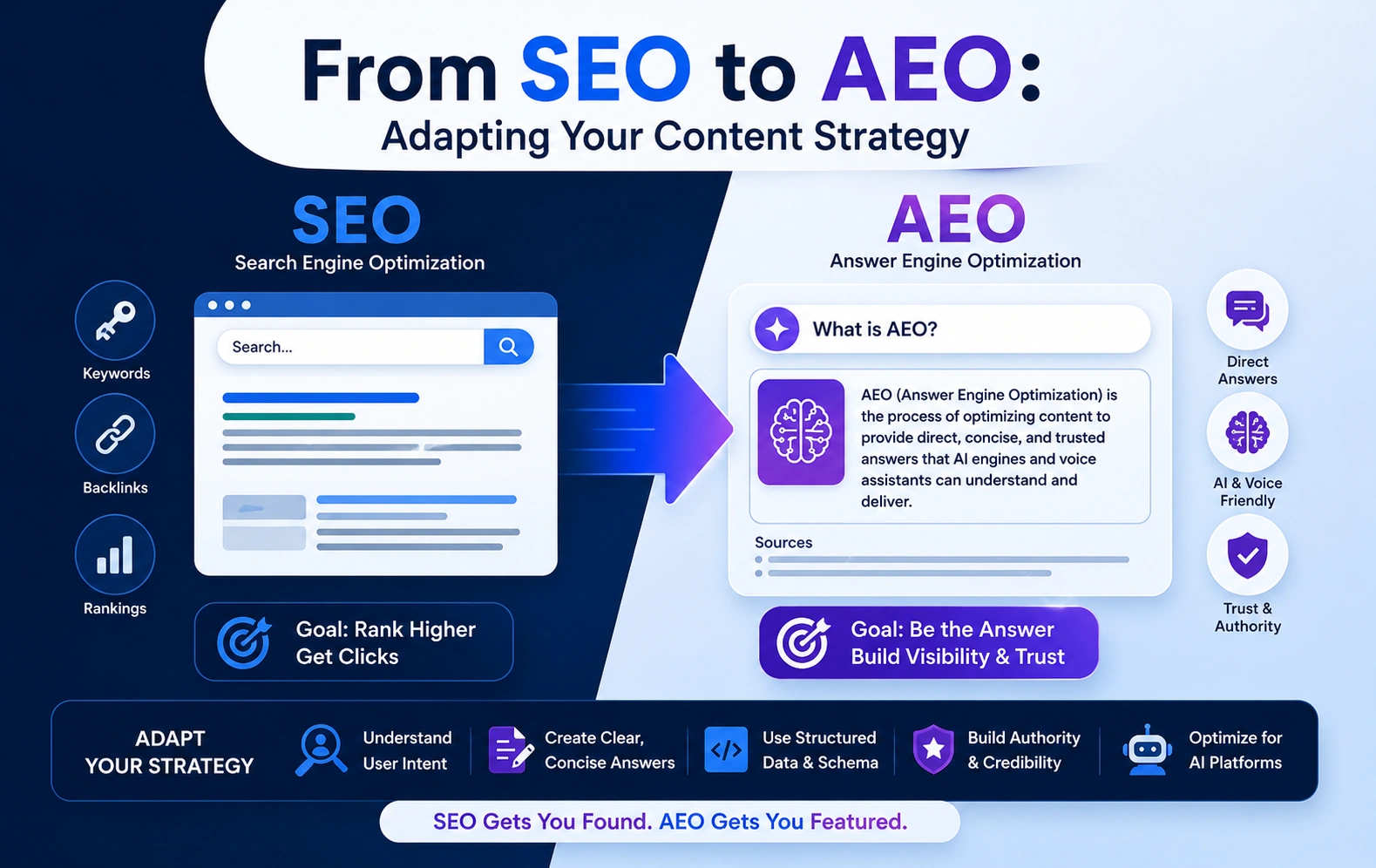
Search Engine Optimization has long centered on visibility within a ranked results page. Its toolkit, keyword targeting, backlink acquisition, on-page metadata, evolved around the premise that users would click through to a source. Success was quantified by position, click-through rate, and organic traffic volume. This model rewarded comprehensive pages that satisfied Google's ranking algorithm, even if the actual answer sat several paragraphs deep.
Answer Engine Optimization inverts the priority. Rather than earning a spot in a list, content competes to become the synthesized answer itself, or a cited fragment within one. This requires clarity, extractability, and semantic precision that traditional SEO never strictly demanded. AEO does not discard SEO's foundations; it layers new requirements atop them, emphasizing structure and machine comprehension alongside human readability.
Large language models embedded within search interfaces now parse vast corpora of content and generate consolidated responses on demand. These systems prioritize precision and coherence over sheer volume of backlinks. Their growing adoption signals a durable shift, not a passing novelty, and content strategies built solely around legacy ranking factors will increasingly underperform.
Users have grown accustomed to instant, synthesized answers. Zero-click searches, queries resolved without a single website visit, continue to climb. This behavioral shift means that even flawless SEO execution cannot guarantee traffic if an answer engine satisfies the query beforehand. Brands must now compete for citation and mention, not merely for the click.
SEO success is binary in a sense: you either rank or you do not, and position matters enormously. AEO success is more probabilistic, hinging on whether an answer engine deems your content sufficiently authoritative, clear, and relevant to extract from. There is no fixed "position one" to chase; instead, there is a constant negotiation for inclusion.
Where SEO historically rewarded keyword density and variation, AEO rewards conceptual clarity. Answer engines interpret meaning holistically, connecting entities and intent rather than matching strings. This shift renders old-school keyword stuffing not just ineffective but actively counterproductive, as it muddies the semantic signal these systems rely on.
Begin by evaluating whether existing pages state their core answer plainly and early. Content that meanders before arriving at its point is far less likely to be excerpted. Flagging pages that bury their value proposition beneath excessive preamble is a critical first diagnostic step.
Beyond phrasing, structural elements matter. Pages lacking clear headings, bullet-driven summaries, or logical hierarchy create friction for parsing systems. An audit should catalog these weaknesses systematically, ranking pages by both traffic potential and ease of remediation.
Search volume alone is an increasingly insufficient metric. Mapping content to specific intent categories, informational, comparative, transactional, navigational, ensures alignment with how answer engines classify and route queries. This reframing shifts research from a numbers game to an intent-diagnosis exercise.
Voice interfaces and chat-based search have normalized full-sentence queries. Content strategies must accommodate phrasing like "how do I switch from SEO to AEO strategy" rather than relying solely on clipped keyword fragments. Long-tail, conversational variants deserve dedicated research effort, not an afterthought bolted onto existing keyword lists.
Every section should ideally open with a concise, self-contained answer before elaborating. This "inverted pyramid" approach, borrowed loosely from journalism, aligns naturally with how extraction algorithms identify citable fragments. Burying the answer beneath throat-clearing context undermines this effort.
Schema markup, FAQ tags, HowTo formatting, and Article metadata function as an explicit translation layer for machines. Without it, answer engines must infer structure probabilistically, introducing risk of misinterpretation. Treating schema implementation as core infrastructure, not an optional add-on, materially improves eligibility for citation.
Isolated articles rarely establish sufficient depth to be treated as authoritative. Building interconnected clusters, a pillar page supported by satellite articles addressing adjacent subtopics, signals comprehensive expertise. This clustering approach benefits both traditional rankings and AEO citation likelihood simultaneously.
Explicitly naming and connecting entities, people, products, organizations, concepts, strengthens the semantic web underlying your content. Vague pronouns and unlinked references weaken this web, making it harder for answer engines to validate context and credibility.
Bylines, credentials, and transparent citation of primary sources bolster the Experience, Expertise, Authoritativeness, and Trustworthiness signals that answer engines weigh heavily. Anonymous or uncredited content increasingly struggles for inclusion, regardless of factual accuracy.
Answer engines cross-reference brand mentions across multiple domains to gauge reliability. Contradictory claims or outdated data scattered across different platforms erode this trust calculus. Maintaining a unified, consistent narrative across owned and earned media reinforces credibility at scale.
Neither discipline can succeed atop a fragile technical foundation. Slow load times, blocked resources, and poor Core Web Vitals scores hinder both ranking and extraction eligibility. Regular technical audits remain a non-negotiable baseline requirement.
With mobile and voice interactions comprising a growing share of queries, responsive design and accessibility compliance are no longer peripheral concerns. Screen-reader-friendly markup and mobile-optimized layouts improve both user experience and machine parsing simultaneously.
Traditional rank tracking no longer tells the full story. Brand visibility within AI-generated answers, citation frequency, and share of voice within synthesized responses represent emerging metrics that deserve a place in regular reporting dashboards.
Emerging monitoring tools now track how often a brand's content is cited or referenced within AI answer boxes. Incorporating these tools into a measurement stack, alongside conventional analytics, provides a fuller picture of content performance across the evolving search ecosystem.
Rather than running SEO and AEO as parallel, siloed efforts, the most efficient strategy integrates them into a single workflow. Structural improvements, schema implementation, and intent mapping benefit both disciplines concurrently, eliminating redundant effort.
Given finite resources, prioritization matters. High-traffic, high-authority pages should receive AEO restructuring first, followed by broader content cluster expansion. This phased approach ensures measurable gains without overwhelming existing content operations.
The migration from SEO to AEO is not a wholesale abandonment of established practice; it is an evolution that layers new demands atop a familiar foundation. Brands that audit rigorously, restructure deliberately, and measure holistically position themselves to remain visible regardless of how search interfaces continue to transform. Those still optimizing exclusively for yesterday's ranking factors will find their content increasingly invisible in a landscape now defined by synthesized answers.
Have a project in mind? Let’s build something amazing together.
Webbitech — A Leading Web Design & Web Development Company with 15+ Years of SEO & Digital Marketing Expertise, Delivering Countless Success Stories
From idea to execution, we help businesses create high-performing websites and applications.
Start your journey today and take your brand to the next level.