Posted Date : 04 Jul 2026
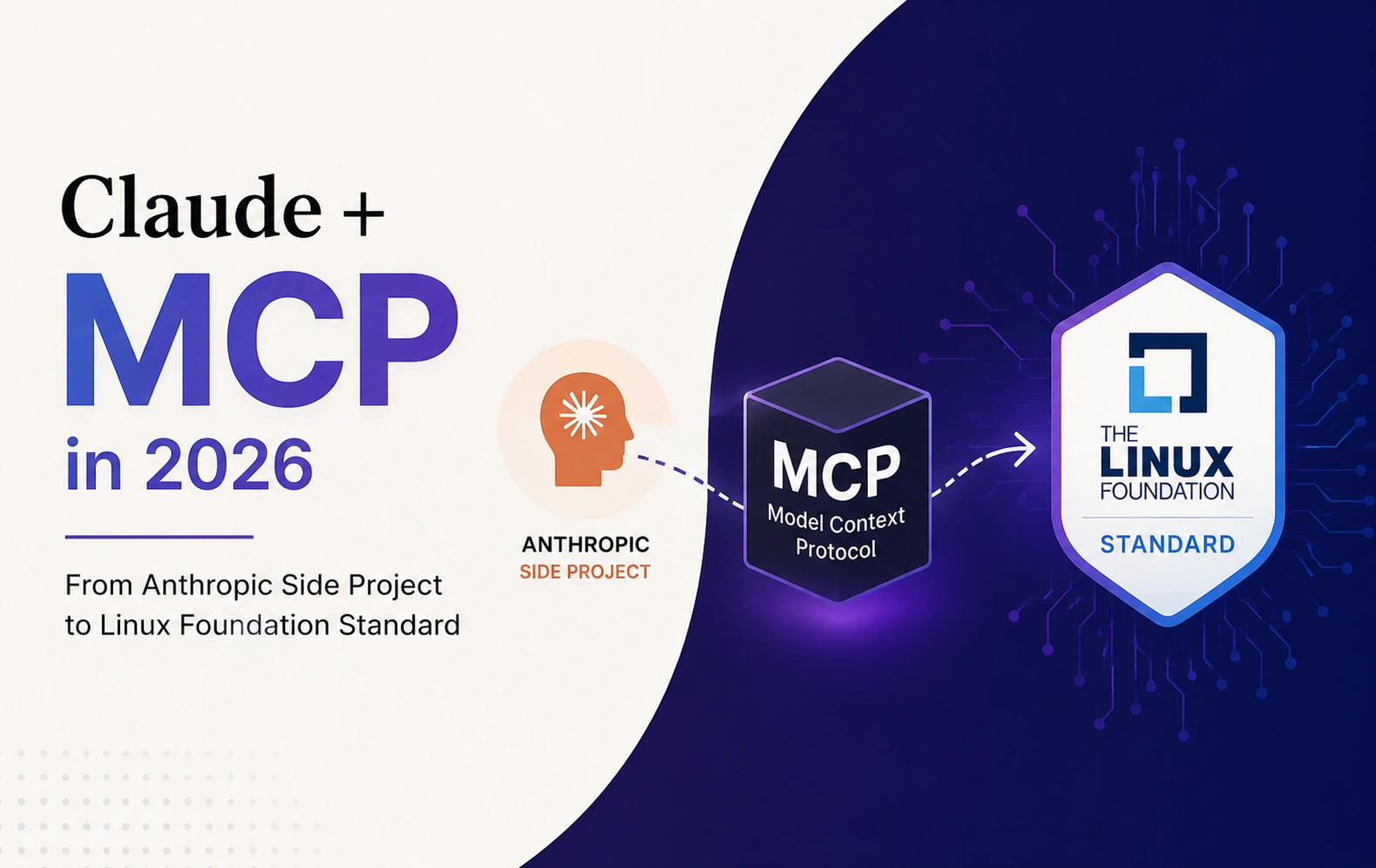
In November 2024, the Model Context Protocol shipped as an open-source project out of Anthropic—a way to standardize patterns their own engineers kept reinventing every time they connected Claude to an external tool or data source. A little over a year later, it's the governance foundation underneath one of the fastest-adopted standards in the history of open source, stewarded not by Anthropic but by the Linux Foundation.
That trajectory is worth understanding in full because it explains why MCP looks the way it does today—and why the answer to "What happens if Anthropic's priorities change?" no longer matters the way it once did.
MCP's creator, lead maintainer David Soria Parra, has described its origin simply: it was a way to distill patterns Anthropic engineers were already reinventing a single protocol governing how models and systems talk to each other, request context, and execute tools. Anthropic released it publicly in November 2024 alongside a set of reference servers, and the reception inside the developer community was immediate—the kind of adoption curve you rarely see for a brand-new protocol.
Within weeks, contributors from Microsoft, GitHub, OpenAI, and independent developers were expanding and hardening the specification. Over the following months, the community layered on the features that took MCP from "a clever internal tool" to genuine infrastructure: sampling semantics for predictable model behavior across clients; long-running task APIs for builds and deployments that take longer than a single request-response cycle; and—critically—OAuth support that unlocked remote MCP servers instead of confining the protocol to local-only use.
That last piece mattered more than it might sound. Before OAuth support landed, most MCP servers ran locally, which limited enterprise usage and created real installation friction. Once servers could run remotely and securely, MCP became viable for the compliance-conscious deployments that large organizations actually need.
By the numbers, MCP's growth is genuinely unusual for a protocol this young. It launched with roughly 2 million monthly SDK downloads; by March 2026, that figure had crossed 97 million. For comparison, Kubernetes — now considered foundational cloud infrastructure — took nearly four years to reach a comparable deployment density. MCP got there in about sixteen months.
The protocol now underpins more than 10,000 published MCP servers and has first-class client support across Claude, ChatGPT, Cursor, Gemini, Microsoft Copilot, Visual Studio Code, and most of the major coding-agent tooling in use today. A March 2025 milestone — OpenAI's decision to adopt MCP rather than continue building out its own proprietary tool-connection interfaces — was widely read as a signal that the protocol had already won the argument on openness versus walled gardens.
The turning point came on December 9, 2025, when Anthropic donated MCP to the newly formed Agentic AI Foundation (AAIF), a directed fund under the Linux Foundation. MCP joined two other founding projects—Block's Goose, an open-source local-first agent framework, and OpenAI's AGENTS.md, a now-widely-adopted convention for giving coding agents repo-specific instructions.
The framing from Anthropic's leadership was direct. Mike Krieger, Anthropic's Chief Product Officer, put it this way: MCP started as an internal project to solve a problem Anthropic's own teams faced, and a year after open-sourcing it, it had become the industry standard for connecting AI systems to data and tools. Donating it to the Linux Foundation, in his words, was about ensuring it stayed open, neutral, and community-driven as it became critical infrastructure for the industry.
What makes this donation notable isn't just that it happened—it's who signed on alongside Anthropic. The AAIF was co-founded by Anthropic, Block, and OpenAI, direct competitors placing core projects under the same neutral governance. Platinum membership, each with a governing board seat, includes Amazon Web Services, Anthropic, Block, Bloomberg, Cloudflare, Google, Microsoft, and OpenAI. Gold members include Cisco, IBM, Oracle, SAP, Snowflake, Salesforce, Datadog, Docker, JetBrains, Okta, and more than a dozen others. Getting that list of companies to agree on shared plumbing is not something the AI industry does often.
The Linux Foundation's executive director, Jim Zemlin, framed the goal explicitly: avoiding a future where tool connections and agent orchestration are locked behind a handful of proprietary platforms—drawing a deliberate parallel to how open protocols like HTTP and TCP/IP became the foundation the entire web was built on, rather than staying under the control of any single company.
For developers already building on MCP, the practical governance answer is reassuring: very little changed operationally on day one. The project's technical direction and day-to-day maintenance remain with MCP's existing maintainers, who retain full autonomy over the spec's evolution. The AAIF Governing Board handles strategic investment, budget allocation, member recruitment, and approval of new projects joining the foundation—it doesn't dictate what goes into the next MCP spec release.
What did change is the answer to a question every enterprise architecture team eventually asks about a vendor-created standard: What happens if the company behind it changes course, gets acquired, or simply loses interest? Before the AAIF donation, that question about MCP didn't have a fully satisfying answer. Now it does, backed by the same governance model that has stewarded Linux, Kubernetes, Node.js, and PyTorch for decades. For regulated industries in particular—Bloomberg's CTO specifically cited this when discussing MCP's fit for financial services compliance requirements—vendor-neutral governance isn't a nice-to-have; it's often a prerequisite for adoption at all.
Anthropic's relationship to MCP didn't end with the donation—the company continues to invest in the project's development, maintain core infrastructure, and participate actively in the community, the same as it did before December 2025. Claude's own connector ecosystem has grown to more than 75 MCP-powered integrations, and Anthropic has continued shipping API-level capabilities like Tool Search and Programmatic Tool Calling specifically to help production deployments handle large numbers of tools efficiently. The difference now is that these contributions sit alongside comparable investment from Microsoft, Google, AWS, and others, rather than MCP's roadmap depending on any single company's priorities.
The governance shift set up everything that's followed. With neutral stewardship in place, the MCP community shipped its November 2025 spec release—which introduced asynchronous operations, statelessness groundwork, server identity, and the official extensions framework—and is now finalizing an even larger revision, the 2026-07-28 specification, expected to publish later this month. That release completes the move to a fully stateless protocol core, formalizes extensions like MCP Apps and Tasks, and tightens authorization around OAuth 2.1 and OpenID Connect. None of that would carry the same weight if it were still one company's unilateral decision about its own protocol—it matters specifically because it's the product of a community process with real skin in the game from across the industry.
MCP's first year was about proving the idea worked. Its move to the Linux Foundation was about proving it would last. The next chapter — playing out in real time as the 2026-07-28 spec finalizes — is about proving it can keep evolving without fracturing the ecosystem that's formed around it.

Have a project in mind? Let’s build something amazing together.
Webbitech — A Leading Web Design & Web Development Company with 15+ Years of SEO & Digital Marketing Expertise, Delivering Countless Success Stories
From idea to execution, we help businesses create high-performing websites and applications.
Start your journey today and take your brand to the next level.