Posted Date : 03 Sep 2026
For two decades, "digital advertising" has been almost synonymous with Google Ads. That's no longer a given. OpenAI's ChatGPT Ads platform has gone from a small pilot to a advertising channel with real scale in under a year, and marketers everywhere are asking the same question: should new budget go toward the AI-native platform, or stay with the search giant that built the playbook?
This guide breaks down how ChatGPT Ads and Google Ads actually compare — on cost, targeting, reach, and measurable ROI — so you can make a data-informed call on where your 2026 ad dollars belong.
Understanding the comparison starts with understanding how new ChatGPT Ads really is. OpenAI began testing ads with U.S. users on Free and ChatGPT Go tiers in February 2026. Self-serve access followed a few months later, and OpenAI removed its earlier six-figure minimum spend requirement, opening the platform to small and mid-sized advertisers rather than only large brands.
Since then, growth has been fast. By mid-August 2026, the platform had expanded to the United Kingdom, Mexico, Brazil, Japan, and South Korea, and by late August it reached 31 European markets, including Germany, France, Spain, Italy, and the Netherlands. On August 31, 2026, OpenAI announced that ChatGPT Ads reached $1 billion in annualized revenue run rate in less than 200 days after launch, with tens of thousands of advertisers now using the platform.
Google Ads, by contrast, needs no introduction — a mature, global platform with decades of optimization data, an enormous partner ecosystem, and a proven ROI track record across nearly every industry.
ChatGPT Ads don't look or behave like traditional search ads. According to OpenAI, sponsored listings are clearly labeled and appear separately from ChatGPT's actual answer, and the model's response is never shaped by advertiser payments. Targeting relies on contextual signals from the current conversation — and, when a user enables personalization, relevant past chats — rather than the keyword-bidding model search marketers are used to.
Key mechanics worth knowing:
Google Ads runs on decades of refined intent-based targeting: keyword bidding, Performance Max campaigns, remarketing audiences, and a real-time auction system tuned across billions of daily queries. Its strengths are well documented — mature analytics, cross-device tracking, a vast publisher network through the Google Display Network and YouTube, and support for virtually every campaign objective from lead generation to app installs.
| Factor | ChatGPT Ads | Google Ads |
|---|---|---|
| Launch maturity | Live since Feb 2026; still scaling | Established, highly mature |
| Targeting basis | Conversational context + intent | Keywords, audiences, remarketing |
| Reach (as of Aug 2026) | US, UK, Canada, Australia, NZ, Mexico, Brazil, Japan, South Korea, 31 European markets, India, MEA | Global, virtually every market |
| Entry cost | ~$3–$5 CPC, $25–$60 CPM (early reports) | Highly variable by industry and keyword competition |
| Minimum spend | None (self-serve since May 2026) | None |
| Audience served | Free and Go tier users only | All users across Search, Display, YouTube |
| Measurement stack | Still developing (per industry reviews) | Extensive, mature reporting and attribution tools |
| Best suited for | Early movers, brand discovery, testing new intent signals | Proven direct-response performance at scale |
1. First-mover advantage is real, but shrinking. Early ChatGPT Ads adopters — reportedly including Best Buy, Lowe's, and VistaPrint — got in before the auction became competitive. As more advertisers join, costs typically rise, so testing now can mean cheaper learning later.
2. Conversational intent is different from search intent. Users don't type a query and scan ten blue links — they describe a need in natural language and expect a direct answer. Brands that adapt their messaging to this format may see engagement patterns Google Ads simply doesn't capture.
3. No minimum spend barrier. Since the self-serve Ads Manager removed its six-figure pilot requirement, small and mid-market brands can test the platform with modest budgets.
4. Explosive platform growth signals demand. Reaching $1 billion in annualized revenue within roughly 200 days suggests genuine advertiser appetite, not just a novelty.
1. Measurement maturity still matters. Industry reviewers have noted that ChatGPT Ads' buying and measurement tools have improved quickly, but the audience and attribution ecosystem hasn't caught up to what performance marketers expect from Google. If your team relies on granular attribution, Google Ads remains the safer bet today.
2. Reach beyond the free tier. ChatGPT Ads currently exclude paying ChatGPT Plus subscribers, meaning a meaningful slice of the most engaged AI users aren't reachable yet through ads. Google Ads has no equivalent gap.
3. Track record and predictability. Years of historical data let Google Ads advertisers forecast performance with more confidence than a channel still finding its benchmarks.
4. Broader campaign objectives. Google's ecosystem — Search, Display, YouTube, Shopping, Performance Max — supports a fuller marketing funnel than a single conversational placement can right now.
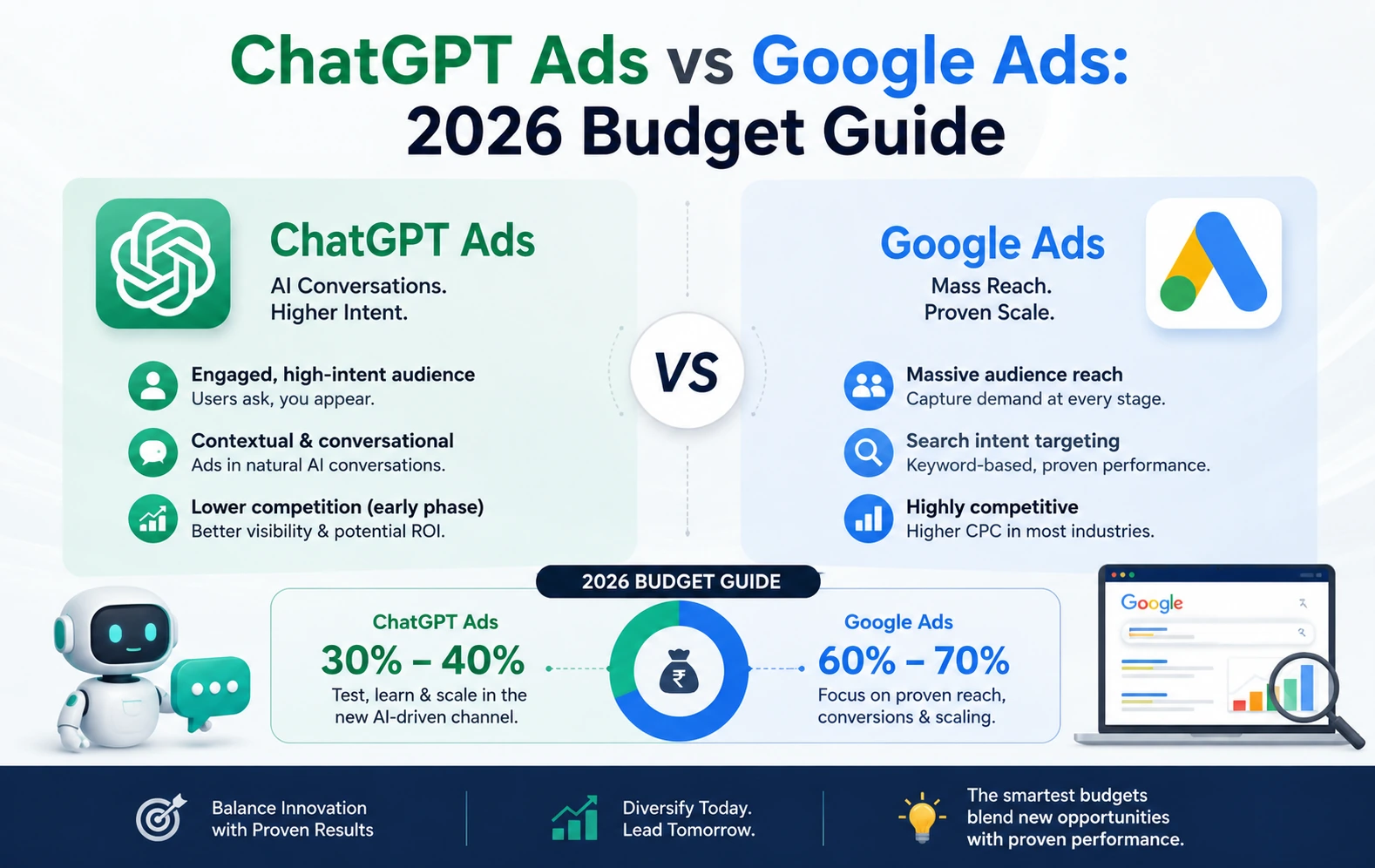
The honest answer for most marketers in 2026: both, but in different proportions depending on your goals.
Treat 2026 as a transition year: run controlled tests, track cost-per-acquisition on both platforms side by side, and shift budget based on what your own data shows — not just industry hype.
Early reports put ChatGPT Ads CPCs around $3–$5 and CPMs around $25–$60, but Google Ads costs vary enormously by industry and keyword competition. Neither platform is universally cheaper — run a small test to compare costs for your specific niche.
No. As of August 2026, ChatGPT Ads are shown only to users on the Free and ChatGPT Go tiers, not to paying Plus subscribers.
OpenAI states that ad matching happens on its own infrastructure using aggregated signals, and advertisers never receive a user's raw chat history or personal details.
As of late August 2026, ChatGPT Ads are available in the US, UK, Canada, Australia, New Zealand, Mexico, Brazil, Japan, South Korea, 31 European markets, and — as of August 31 — India, and parts of the Middle East and North Africa.
Since the six-figure minimum spend requirement was removed in May 2026, small businesses can test the self-serve Ads Manager with modest budgets, making it a reasonable low-risk test alongside an existing Google Ads program.
Have a project in mind? Let’s build something amazing together.
Webbitech — A Leading Web Design & Web Development Company with 15+ Years of SEO & Digital Marketing Expertise, Delivering Countless Success Stories
From idea to execution, we help businesses create high-performing websites and applications.
Start your journey today and take your brand to the next level.