Posted Date : 21 Jul 2026
There was a time when managing a paid media account meant logging in every morning, checking yesterday's numbers, and manually nudging bids up or down based on gut feel and a few spreadsheet formulas. That era is over. In 2026, AI-driven bidding isn't a nice-to-have optimization layer — it's the backbone of how performance marketing actually runs.
The shift isn't just about automation replacing manual tasks. It's about marketing budgets moving in real time, across channels, based on signals no human team could realistically track and act on fast enough by hand.
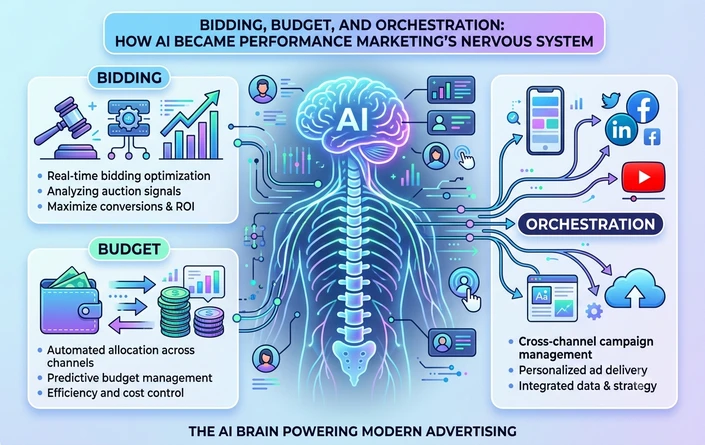
Every ad auction is a moment of decision: how much is this specific impression, for this specific person, in this specific context, actually worth? AI-driven bidding systems now evaluate device, location, behavior, and time-of-day signals to set the optimal bid for each individual auction—not a flat bid applied across an entire campaign, but a dynamically calculated value for every single opportunity.
This matters because the old model—set a bid, check performance weekly, and adjust—simply can't keep pace with how fast auction dynamics shift throughout a single day, let alone a campaign's full run. AI systems process these signals continuously, adjusting in the moment rather than after the fact.
Bidding is only half the story. The other half is budget allocation, and this is where the shift from static to dynamic is most visible. Budgets are increasingly reallocated automatically toward higher-converting segments, with underperforming ads or audiences paused without requiring manual intervention.
Instead of a marketer deciding at the start of the month how much goes to which campaign, channel, or audience, AI systems continuously watch performance and shift spend toward what's actually working—in near real time. A campaign that starts strong on Monday and fades by Thursday doesn't have to wait for a weekly review to get corrected; the system reallocates as soon as the data signals a shift.
Here's where the real transformation is happening: this optimization is increasingly unified across search, social, display, and programmatic rather than managed separately by channel. That's a meaningful departure from how performance marketing teams have traditionally operated—with a search specialist, a social specialist, and a programmatic buyer each optimizing their own slice of the budget somewhat independently.
Cross-channel orchestration means the AI isn't just optimizing search bids in isolation from social spend. It's looking at the full picture—where is this budget working hardest right now, regardless of channel—and shifting resources accordingly. For marketing teams, this changes both the tooling and the org chart: the value increasingly sits with people who can interpret and direct the system across channels, not just execute within one.
This shift doesn't eliminate the need for skilled marketers—it changes what skill actually matters. A few practical implications:
AI-driven bidding and cross-channel orchestration represent one of the clearest cases of AI actually delivering on performance marketing's oldest promise: put the budget where it works, the moment it starts working there. The brands seeing the biggest gains aren't the ones that adopted the technology first — they're the ones that paired it with clear strategic direction and enough oversight to keep it pointed at the right goals.
Curious whether your current setup is still running on manual, siloed logic? Start by mapping out how spending actually moves across your channels today—if it takes a person to move it, that's your next automation opportunity.
Have a project in mind? Let’s build something amazing together.
Webbitech — A Leading Web Design & Web Development Company with 15+ Years of SEO & Digital Marketing Expertise, Delivering Countless Success Stories
From idea to execution, we help businesses create high-performing websites and applications.
Start your journey today and take your brand to the next level.