Posted Date : 21 Jul 2026
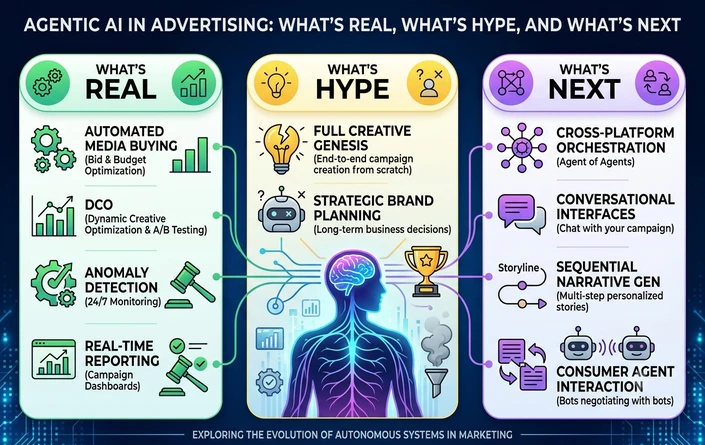
For the last couple of years, "agentic AI" has been one of those phrases that shows up in every marketing keynote and half the vendor pitch decks in your inbox. In 2026, something notable happened: the phrase stopped being mostly aspirational. Agentic AI in advertising is now shipping in production, at scale, across major platforms — even as the industry pushes back hard on the idea that it's already running the show autonomously.
Understanding the real state of this technology — not the hype version — matters for any performance marketer deciding where to invest time and trust right now.
If you wanted a single moment that captured this shift, it happened in June 2026. Within a single week, at least eight major ad-tech platforms—DoubleVerify, LiveRamp, Pixalate, Mediaocean, Magnite, Yahoo, Stagwell, and Fox—all shipped agentic buying, coordination, or measurement infrastructure. That's not a slow rollout of a speculative feature; that's an entire industry infrastructure layer moving at once.
This activity spans three distinct layers worth understanding separately:
Here's where it's worth slowing down. Despite the flurry of product launches, informed voices in the industry are actively correcting the narrative that AI is already running media buying end-to-end without human involvement. The IAB Media Center's VP has pushed back specifically on the idea that agentic AI is fully autonomously managing media today—the more accurate description of where things stand is meaningful workflow improvement, not full autonomy.
That distinction matters. Workflow improvement means AI is doing real work—reducing manual tasks, speeding up decisions, and catching things humans would miss—without meaning nobody's driving anymore. Full autonomy implies you can walk away entirely. The industry is very clearly telling us we're not there, even as the underlying technology accelerates.
The pattern showing the most traction isn't "hand everything to the "AI"—it's a layered structure that keeps humans in the loop at the right level:
This two-layer approach gives marketers the speed benefits of automation without fully surrendering control—a middle ground that looks a lot more sustainable than either extreme.
If you're evaluating agentic AI tools for your marketing stack, a few practical takeaways from where the industry actually stands:
Agentic AI in advertising has crossed a real threshold—this is infrastructure now, not a proof of concept. But the more useful mental model isn't "AI is running my campaigns for me." It's "AI is handling more of the tactical grind, faster than any team could by hand, while a clear-eyed monitoring layer keeps it honest. " Marketers who adopt that framing—rather than chasing the fully autonomous fantasy—are the ones positioned to actually benefit as the technology keeps maturing.
Wondering where your own campaigns sit on the autonomy spectrum? Start by listing which decisions in your current workflow are purely tactical versus genuinely strategic—that split is your roadmap for what to automate first.
Have a project in mind? Let’s build something amazing together.
Webbitech — A Leading Web Design & Web Development Company with 15+ Years of SEO & Digital Marketing Expertise, Delivering Countless Success Stories
From idea to execution, we help businesses create high-performing websites and applications.
Start your journey today and take your brand to the next level.