Posted Date : 12 Aug 2026
A quiet recalibration is underway in the metrics that matter. For years, success meant occupying position one on a results page. Now, success increasingly means being the sentence an AI system chooses to surface, verbatim or paraphrased, inside its own answer. This is a fundamentally different game, governed by different rules, rewarding a different kind of content craftsmanship.
This guide walks through the mechanics of how answer engines select and quote content, the structural and technical adjustments required to become quotable, and the measurement frameworks needed to know whether the effort is working.
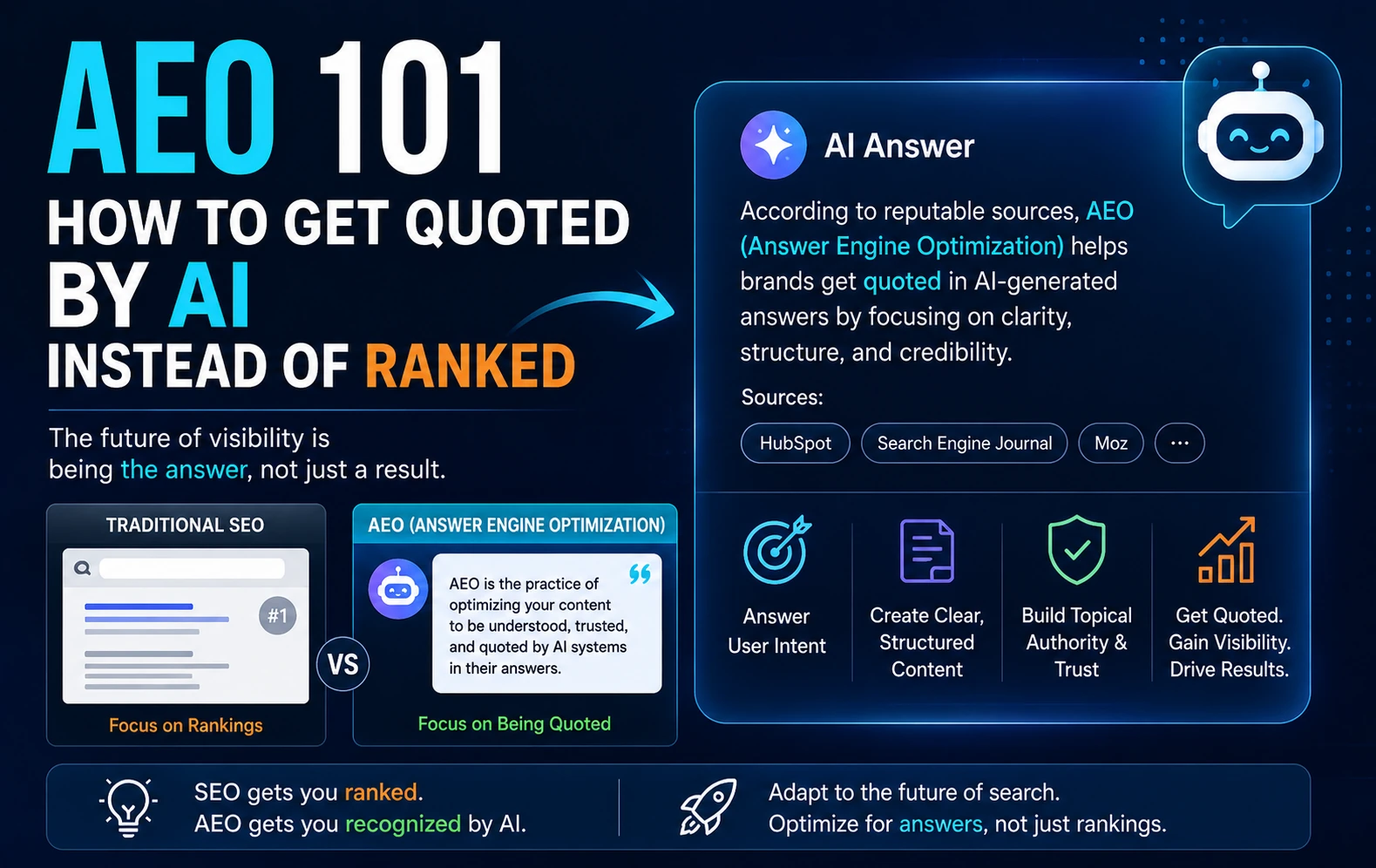
Answer Engine Optimization is the discipline of shaping content so that generative AI systems can accurately extract, synthesize, and attribute it within their own responses. It sits adjacent to SEO but pursues a distinct outcome: inclusion inside an answer, rather than a listing beside one.
Search engines index and rank. Answer engines comprehend and synthesize. The former returns a curated list; the latter returns a singular, distilled response often assembled from multiple sources. This distinction changes everything about how content should be built — the goal shifts from earning a click to earning a mention.
Where marketers once obsessed over pixel position on a results page, the new battleground is inclusion probability within a generated answer. There is no scroll depth to game, no ad placement to outbid — only the underlying quality and clarity of the content itself.
Large language models ingest content in chunks, evaluating each segment for coherence, relevance, and standalone comprehensibility. A paragraph that requires surrounding context to make sense is far less likely to survive this extraction process intact.
Content that is naturally divisible into discrete, meaning-complete units — a definition here, a step-by-step process there — aligns well with how models segment and retrieve information. Sprawling, interdependent prose resists this chunking and often gets passed over.
Hedging language, vague qualifiers, and circuitous phrasing introduce uncertainty that models are reluctant to propagate. Declarative, unambiguous statements are inherently more citable because they carry lower risk of misrepresentation.
Beyond phrasing, models weigh contextual signals of reliability: consistency with other reputable sources, author transparency, and freedom from contradictory claims elsewhere on the same domain. Trust, in this context, is cumulative and cross-referenced.
Lead with the conclusion. State the answer in the opening sentence of a section, then elaborate afterward. This inverted-pyramid approach mirrors journalistic convention and happens to be exactly what extraction algorithms favor.
Framing subheadings as direct questions — "What causes X?" "How does Y work?" — creates a natural query-to-answer mapping that mirrors how users phrase prompts to AI systems, increasing the likelihood of a direct match.
Bullet points, numbered lists, and short paragraphs are not merely stylistic choices; they are structural cues that help parsing systems isolate discrete, extractable units of information.
A single, well-constructed sentence that fully answers a question — without requiring the reader to consult adjacent sentences — is the atomic unit of AEO success. Brevity, deployed deliberately, becomes a competitive advantage.
Implementing FAQPage, HowTo, and Article schema gives machines an unambiguous map of your content's purpose and structure, reducing the interpretive burden placed on the extraction model.
Accurate, descriptive meta titles and descriptions still matter — not for ranking alone, but as a first-pass signal that helps AI crawlers determine relevance before deeper content parsing occurs.
A logically nested site structure, with clear topical hierarchies and internal linking, helps models understand how individual pages relate to a broader body of expertise, reinforcing topical credibility.
Rather than publishing isolated articles, structure content into interlinked clusters around a core theme. This density of coverage signals depth of expertise, which models tend to favor when selecting a source to quote.
Unique statistics, survey findings, or proprietary benchmarks are exceptionally valuable in the AEO landscape because they cannot be sourced elsewhere. Models gravitate toward original data precisely because it is irreplaceable.
Visible author expertise — bylines, credentials, demonstrable experience — continues to function as a trust multiplier, reinforcing to both search and answer engines that the content originates from a credible, accountable source.
Regularly querying AI platforms with relevant prompts and logging whether your brand or content appears provides a rough but useful proxy for AEO performance, absent more formalized analytics.
A new category of monitoring tools is beginning to formalize this tracking process, offering dashboards that quantify citation frequency and share-of-voice across major answer engines.
When certain pages or phrasings consistently get pulled into AI answers and others don't, that pattern is a diagnostic tool in itself — a feedback loop for refining structure, clarity, and framing across the rest of the content library.
The ambition is no longer to be found; it is to be spoken through. Content engineered for extraction, clarity, and verifiable authority stands the best chance of becoming the voice an AI system borrows when it answers a question — and that borrowed voice, repeated across thousands of queries, is quietly becoming the most valuable real estate on the internet.
Have a project in mind? Let’s build something amazing together.
Webbitech — A Leading Web Design & Web Development Company with 15+ Years of SEO & Digital Marketing Expertise, Delivering Countless Success Stories
From idea to execution, we help businesses create high-performing websites and applications.
Start your journey today and take your brand to the next level.