Posted Date : 23 Jul 2026
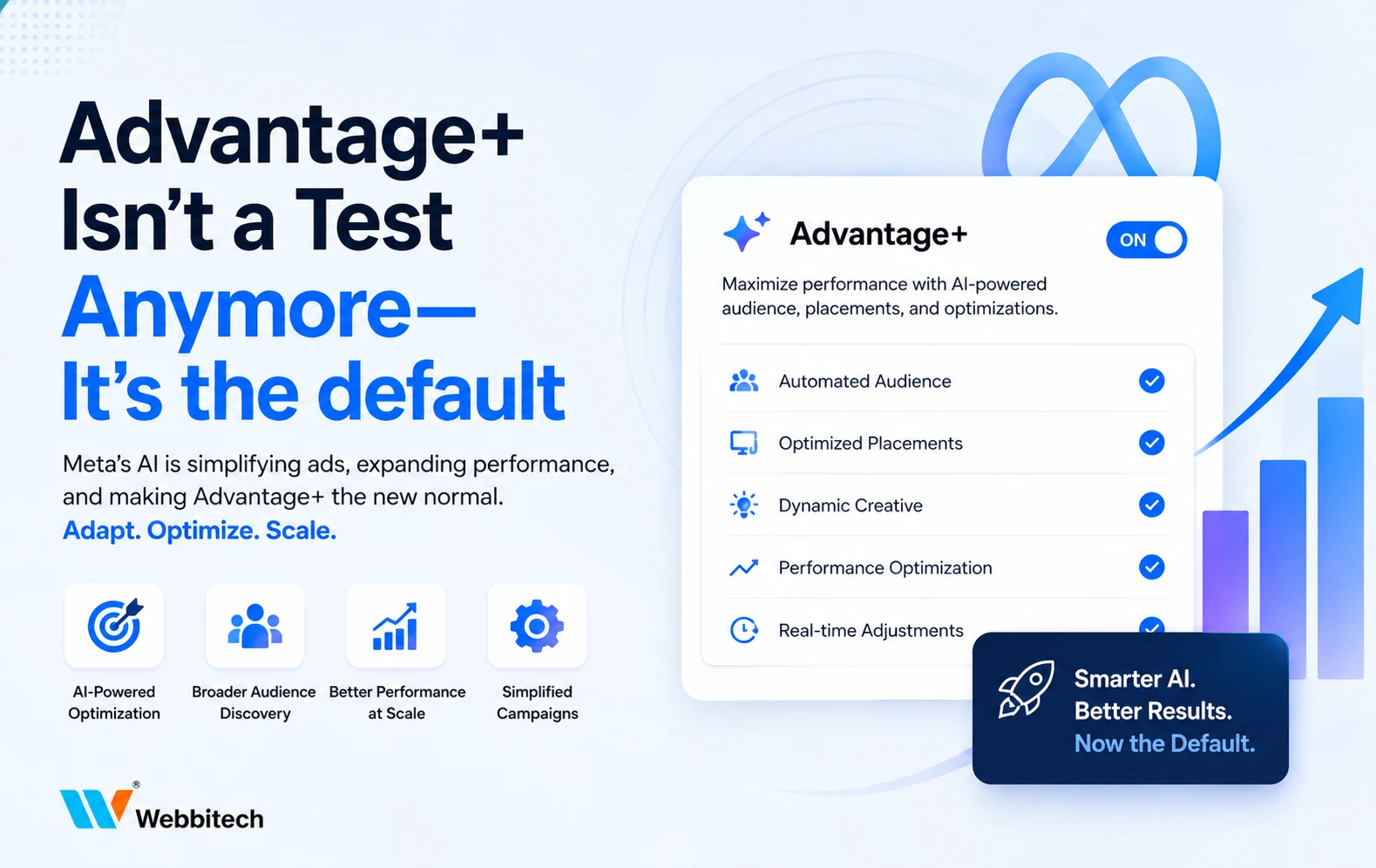
A year ago, running Advantage+ campaigns felt like an experiment. You'd carve out 10-20% of budget, see what the automation could do, and keep your "real" campaigns on manual controls just in case. That era is over.
Walk into almost any well-run Meta Ads account today and Advantage+ isn't sitting in a testing folder—it's the account. Manual campaign structures, once the default for serious advertisers, are now the exception reserved for edge cases and niche use cases. If you're still treating Advantage+ as optional, you're not being cautious. You're falling behind.
Meta's push toward automation didn't happen overnight, but 2026 is the year it crossed a threshold. Two things pushed it there.
First, the algorithm got dramatically better. Meta's newer retrieval infrastructure processes far more ad variants in parallel and matches audiences to creative with a speed and precision that manual bid strategies simply can't compete with. When the machine outperforms a media buyer's best guess on where to allocate budget, the case for manual control weakens fast.
Second, Advantage+ expanded past its original use case. It launched as an e-commerce tool, tightly built around catalog-driven shopping campaigns. That's no longer where it stops. Advantage+ is now being adopted by service businesses, SaaS companies, and subscription brands—categories that had little reason to touch it even a year ago. Once a tool works for lead gen and subscription funnels, not just product catalogs, it stops being a niche play and starts being infrastructure.
The hesitation around Advantage+ was never really about performance—it was about control. Media buyers built careers on precise audience segmentation, layered interest stacks, and granular budget allocation. Handing that over to a black-box algorithm felt like giving up the craft.
But that craft has been eroding for years anyway. Signal loss since iOS 14.5, the death of granular interest targeting, and increasingly automated bid strategies have already stripped away most of the manual levers advertisers used to pull. Advantage+ isn't taking away control that advertisers still meaningfully had—it's formalizing a shift that was already happening.
The advertisers still resisting tend to fall into one of two camps: those running highly regulated or niche categories where automation genuinely underperforms and those who haven't updated their mental model of what "good targeting" even means anymore.
If Advantage+ is now the foundation rather than the experiment, three things change about how you should operate.
1. Creativity becomes your primary lever. With targeting increasingly automated, creative is what the algorithm uses to figure out who to show your ads to. Weak creativity doesn't just underperform—it actively confuses the system about your audience. Budget and time that used to go into audience research should now go into creative testing and variation.
2. Tracking quality matters more, not less. Advantage+ is only as good as the signals feeding it. Clean conversion tracking, accurate event data, and well-defined optimization events aren't nice-to-haves anymore—they're the primary input the algorithm uses to learn. Weak tracking doesn't crash an account; it just quietly makes it more expensive.
3. "Set and monitor" replaces "set and forget. "Advantage+" doesn't mean walking away. It means shifting your attention from manual bid adjustments to feeding the system better inputs—creative variety, accurate signals, and clear optimization goals—and monitoring outcomes rather than micromanaging inputs.
Not necessarily all at once, but the direction is clear. If you're still running the majority of budget through manual campaign structures in 2026, it's worth asking what that choice is actually protecting you from. In most categories, the honest answer is "not much."
Start by moving your highest-volume, most stable campaigns to Advantage+ first—these give the algorithm the most data to learn from and typically show the clearest gains. Keep a small manual holdout if you want a benchmark, but expect the gap to keep widening in Advantage+'s favor as Meta continues to invest in the underlying automation.
Advantage+ stopped being a test the moment it stopped needing to prove itself. In 2026, it's simply how Meta Ads works for most advertisers, across most verticals. The advertisers who win from here won't be the ones with the cleverest manual audience stack—they'll be the ones who've gotten the best at feeding the machine great creative and clean data.

Have a project in mind? Let’s build something amazing together.
Webbitech — A Leading Web Design & Web Development Company with 15+ Years of SEO & Digital Marketing Expertise, Delivering Countless Success Stories
From idea to execution, we help businesses create high-performing websites and applications.
Start your journey today and take your brand to the next level.