Posted Date : 04 Aug 2026
The discipline of building for the web has never held still for long. Each cycle of hardware advancement, browser capability, and user expectation forces a corresponding shift in how sites and applications get built. What distinguishes the current wave is convergence: artificial intelligence, distributed infrastructure, and sustainability concerns are colliding simultaneously, rather than arriving as isolated trends. The result is a landscape where yesterday's best practice risks becoming this year's technical debt.
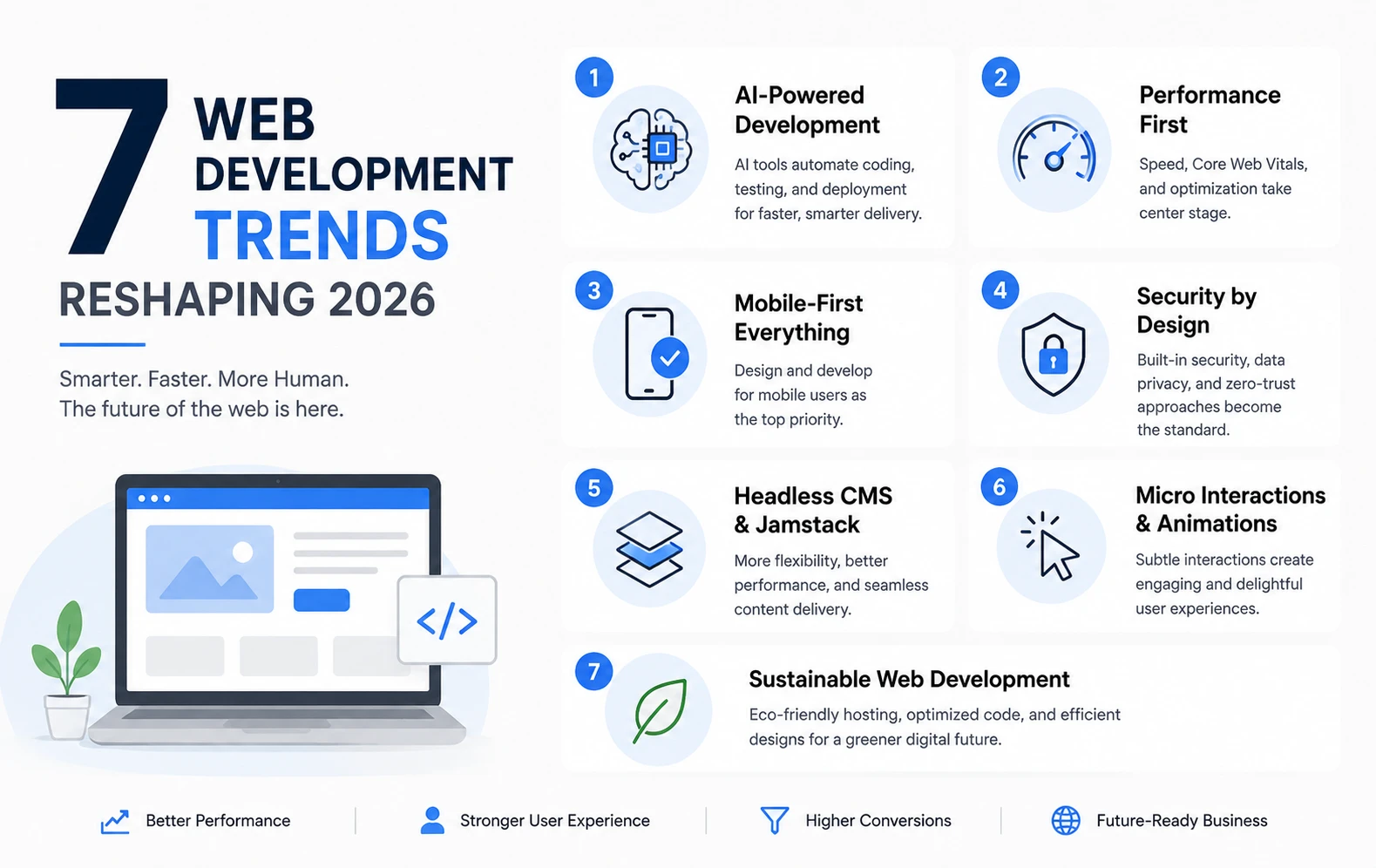
Early iterations of AI coding assistants offered little more than glorified autocomplete. The current generation has moved considerably beyond that, capable of scaffolding entire component structures, reasoning about architectural tradeoffs, and flagging logical inconsistencies before a human reviewer even opens the file. Developers increasingly function as orchestrators and reviewers of machine-generated output rather than sole authors of every line, a shift that compresses production timelines without necessarily eliminating the need for seasoned engineering judgment.
Quality assurance has traditionally been the most labor-intensive, and often the most neglected, phase of a build cycle. Machine learning models trained on historical bug patterns now generate test cases autonomously, identify edge conditions human testers routinely overlook, and predict which code changes carry the highest regression risk. This predictive layer doesn't replace human QA judgment, but it does redirect scarce human attention toward the areas most likely to matter.
Centralized server architecture, long the default, is steadily ceding ground to distributed edge computing. Logic once confined to a single regional data center now executes at points of presence scattered across the globe, physically closer to the end user. This isn't merely an infrastructural curiosity; it fundamentally reshapes how developers reason about state, caching, and request routing.
Applications with tight latency budgets—real-time collaboration tools, live commerce experiences, and interactive dashboards—see the most pronounced gains from edge deployment. Shaving even a few hundred milliseconds off round-trip time can materially alter conversion rates and perceived responsiveness, particularly for users situated far from traditional data center hubs.
WebAssembly, once a niche curiosity favored by a small cohort of systems programmers, has found genuine mainstream traction in 2026. Computationally intensive tasks — image and video processing, cryptographic operations, complex simulations — now run inside the browser at speeds approaching native execution, sidestepping the historical performance ceiling of interpreted JavaScript.
Perhaps the more consequential shift is linguistic. Teams are no longer constrained to a single language for browser-executable code. Rust, C++, and Go modules now compile directly to WebAssembly targets, allowing organizations to reuse existing codebases and specialized talent pools that were previously locked out of frontend development entirely.
The headless paradigm, which separates content and business logic from presentation, has transitioned from an advanced pattern reserved for large enterprises into something approaching a default assumption for new builds. Teams gain the latitude to swap frontend frameworks, redesign interfaces, or launch entirely new channels without disturbing the underlying data layer.
Underpinning this shift is an API-first mentality: systems are designed around well-documented, versioned interfaces from the outset, rather than having APIs bolted on as an afterthought. This philosophical reordering tends to produce more resilient, more interoperable systems capable of supporting use cases the original architects never explicitly anticipated.
Digital infrastructure carries a real, measurable energy cost, and awareness of that fact has finally begun influencing engineering decisions. Leaner codebases, reduced payload sizes, and more efficient rendering pipelines are increasingly framed not merely as performance optimizations but as environmental ones — smaller data transfers translate directly into reduced energy draw across the delivery chain.
Hosting providers powered by renewable energy sources have moved from a marketing footnote to a genuine selection criterion during vendor evaluation. Procurement teams now routinely request carbon disclosure data alongside uptime guarantees, treating environmental impact as a legitimate line item in infrastructure decision-making rather than an afterthought.
Static, one-size-fits-all interfaces are giving way to experiences that reshape themselves in near real time based on observed user behavior. This requires substantially more sophisticated data pipelines than earlier personalization efforts, capable of ingesting, processing, and acting on behavioral signals within milliseconds rather than batch-processing them overnight.
Content management systems now routinely support conditional rendering logic tied directly to these behavioral pipelines, serving distinct layouts, copy, or product recommendations to different visitor segments without requiring separate page builds. The practical effect is a web experience that feels increasingly bespoke, even at substantial scale.
Security review, once relegated to a final gate before deployment, has migrated earlier into the development lifecycle. Static analysis tools now flag vulnerabilities at the moment code is written, and threat modeling has become a standard component of initial architecture discussions rather than a retrospective exercise performed after an incident.
Traditional password-based authentication, long recognized as a persistent weak point, is being steadily displaced by passkeys and biometric-backed standards. This shift reduces the attack surface tied to credential theft while, somewhat counterintuitively, improving the user experience by eliminating friction-laden password entry altogether.
No single trend outlined here operates in isolation; each intersects with and amplifies the others. AI-augmented workflows accelerate the adoption of edge and WebAssembly architectures by lowering the implementation barrier. Composable, API-first systems make hyper-personalization technically feasible at scale. Security-by-design and sustainability considerations increasingly function as constraints that shape how all the other trends get implemented, rather than as separate concerns bolted on afterward. Organizations that treat 2026's shifts as a connected system, rather than a checklist of isolated technologies to adopt, will be the ones best positioned to build web experiences that remain resilient as the next cycle of change inevitably arrives.

Have a project in mind? Let’s build something amazing together.
Webbitech — A Leading Web Design & Web Development Company with 15+ Years of SEO & Digital Marketing Expertise, Delivering Countless Success Stories
From idea to execution, we help businesses create high-performing websites and applications.
Start your journey today and take your brand to the next level.