Posted Date : 02 Jul 2026
Most "AI for marketing" content still talks about prompting a chatbot for blog ideas. That's useful, but it's not where the time savings are anymore. The bigger shift is connector-driven: Claude reading live data from the tools your team already runs on, and chaining steps across them without a person manually relaying information from one app to another.
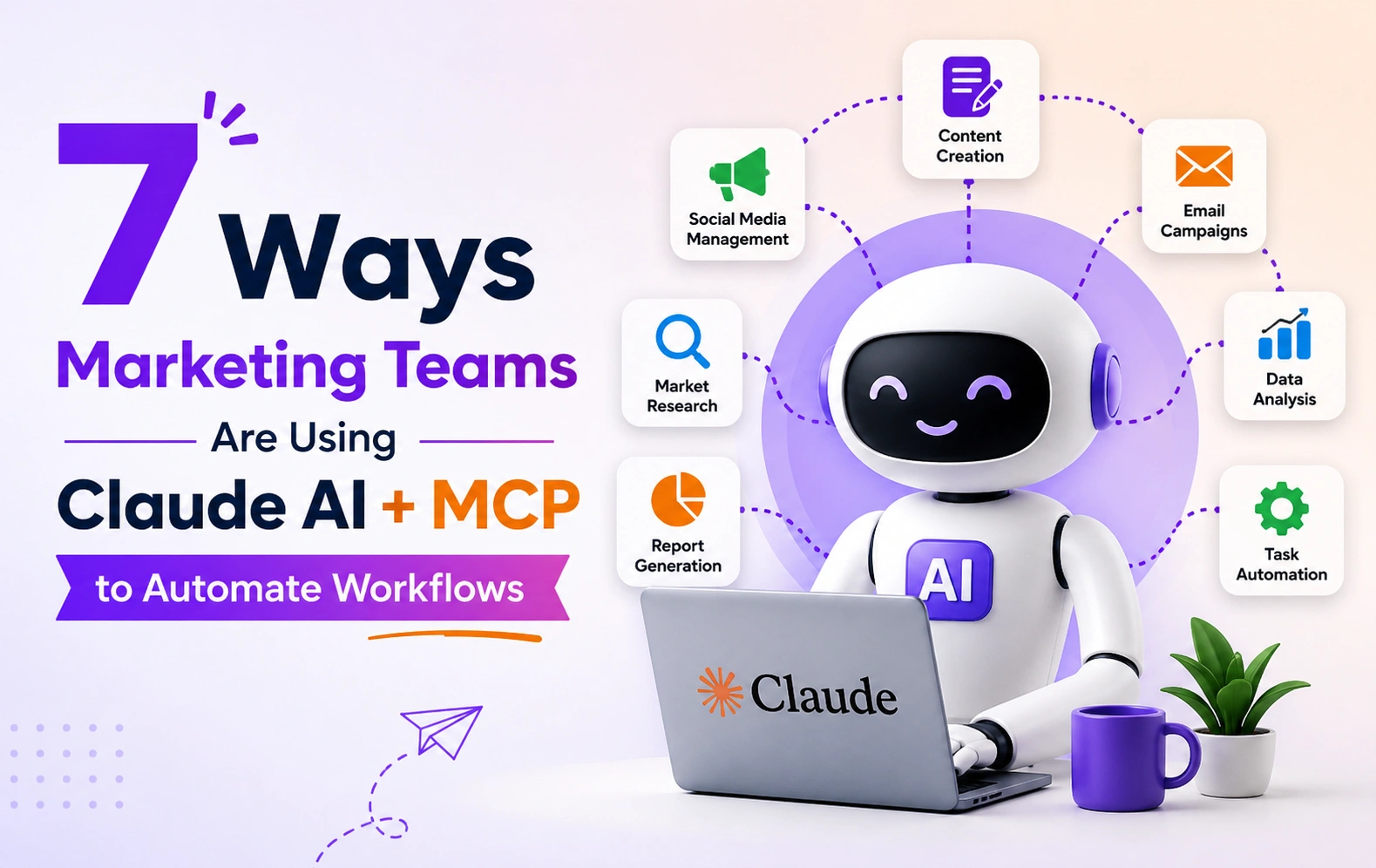
Here are seven workflows marketing teams are actually running today, not hypothetical use cases — each one built on MCP connectors doing real work between systems.
The old way: someone logs into three or four platforms, exports numbers, builds a comparison table, and writes up a summary — usually the same hour every week, usually the least favorite task on someone's calendar.
The automated version: with ad platform and email/CRM connectors active, a team asks Claude to pull last week's campaign and flow performance, compare it to the prior week, and write a plain-English summary of wins, underperformers, and recommended next steps — saved as a formatted document. Some teams take this a step further with a scheduled task, so the digest is waiting for them every Monday morning without anyone prompting for it.
Why it works: this is a read-only workflow end to end, which makes it one of the safest places to automate aggressively.
Auditing every active email flow or ad campaign for underperformance is exactly the kind of task that's important but perpetually deprioritized — it takes real time and doesn't feel urgent until something's clearly broken. Teams with a connected email or CRM platform are asking Claude to audit every active flow, flag anything underperforming or showing deliverability issues, and rank the fixes by estimated impact.
The honest caveat: the output is only as good as your ability to sanity-check it. Teams that get value here treat the audit as a prioritized list to investigate, not a set of conclusions to act on blindly.
A campaign gets discussed across a dozen Slack messages, half-decided in a meeting, and never quite makes it into a proper brief before the deadline creeps up. With Slack and a documentation tool (Notion, Google Drive) both connected, a marketer can ask Claude to pull the relevant discussion, summarize what was decided, and draft it into a structured brief in the team's usual format — instead of someone reconstructing the conversation from memory the next morning.
Why it works: it turns unstructured conversation into structured documentation without anyone manually re-typing decisions that were already made.
For marketers juggling client work or multiple campaigns, the first fifteen minutes of the day often go to piecing together what's urgent across email, a task tracker, and Slack. Teams with those three connected are asking Claude for a single prioritized briefing each morning — what's overdue, what's urgent in the inbox, and what needs a response before lunch — turning a multi-app scan into one conversation.
Why it works: none of the individual pieces are hard to check manually. The value is entirely in not having to switch apps five times to assemble the full picture.
Instead of writing a campaign brief in the abstract and hoping it resonates, teams are asking Claude to pull real customer or contact data first — who hasn't purchased recently but is still engaging with email, which accounts have gone quiet in the CRM — and use that to inform who a new campaign should target and what angle it should take. The campaign copy itself still goes through normal review, but the targeting logic is grounded in live data instead of a guess.
Why it works: it removes the export-a-list-then-brainstorm-separately step, so the targeting and the creative get built with the same information in front of them.
Paid media and analytics data rarely agree perfectly — different attribution windows, different status filters, different refresh timing. Instead of manually reconciling an ads dashboard against GA4 every time a number looks off, teams with both connected are asking Claude to pull both data sets in the same conversation and explain the discrepancy, or compare cost-per-acquisition across channels to inform where budget should shift next.
Why it works: the reconciliation logic (mismatched date ranges, attribution windows, entity status) is exactly the kind of pattern-matching Claude is well suited to, and it's tedious enough that most people were skipping the double-check before.
The most advanced version of this isn't a single question — it's a chain of steps run without someone watching each one happen. A marketer describes an outcome ("audit my flows, draft a re-engagement campaign for lapsed customers, and save everything for review"), steps away, and comes back to finished work: pulled data, a drafted campaign, and files saved in the right place. This kind of unattended, multi-step execution is a newer capability, generally available through desktop-based agentic environments rather than a standard chat window, and it's worth treating as the next step up once single-step workflows are already working well for your team.
The honest caveat: unattended workflows still need a review step before anything ships or spends money. The value is in the work being done and waiting for you, not in removing the human checkpoint entirely.
None of them are about replacing marketing judgment. Every example above ends with a human reviewing, approving, or deciding what to do with what Claude produced — the automation is in the assembly, not the decision. The pattern across all seven is the same: connect the tools where your real data already lives, start with read-only workflows, and only extend into write actions (drafting, staging, creating) once you trust what the read-only version has been telling you.
If you're only automating one thing this month, the performance digest (#1) and the flow or campaign audit (#2) are the easiest wins — pure read-only, immediately useful, and a good way to learn what your specific connectors are actually good at before you build anything more ambitious on top.
Sources referenced: Klaviyo and Anthropic's 2026 reporting on agentic marketing workflows in Claude, Anthropic's documentation on connectors and scheduled tasks, and independent case-style reporting on marketing MCP workflows from 2026.

Have a project in mind? Let’s build something amazing together.
Webbitech — A Leading Web Design & Web Development Company with 15+ Years of SEO & Digital Marketing Expertise, Delivering Countless Success Stories
From idea to execution, we help businesses create high-performing websites and applications.
Start your journey today and take your brand to the next level.