Posted Date : 02 Jul 2026
If you've used Claude for marketing work, you've experienced its main limitation firsthand: it's only as good as what you tell it. Ask it to analyze your ad performance, and you first have to export the data and paste it in. Ask it to draft a campaign for your most engaged customers, and it has no idea who those customers actually are until you tell it. MCP is the piece that removes that limitation. Here's what it actually is, in plain language.
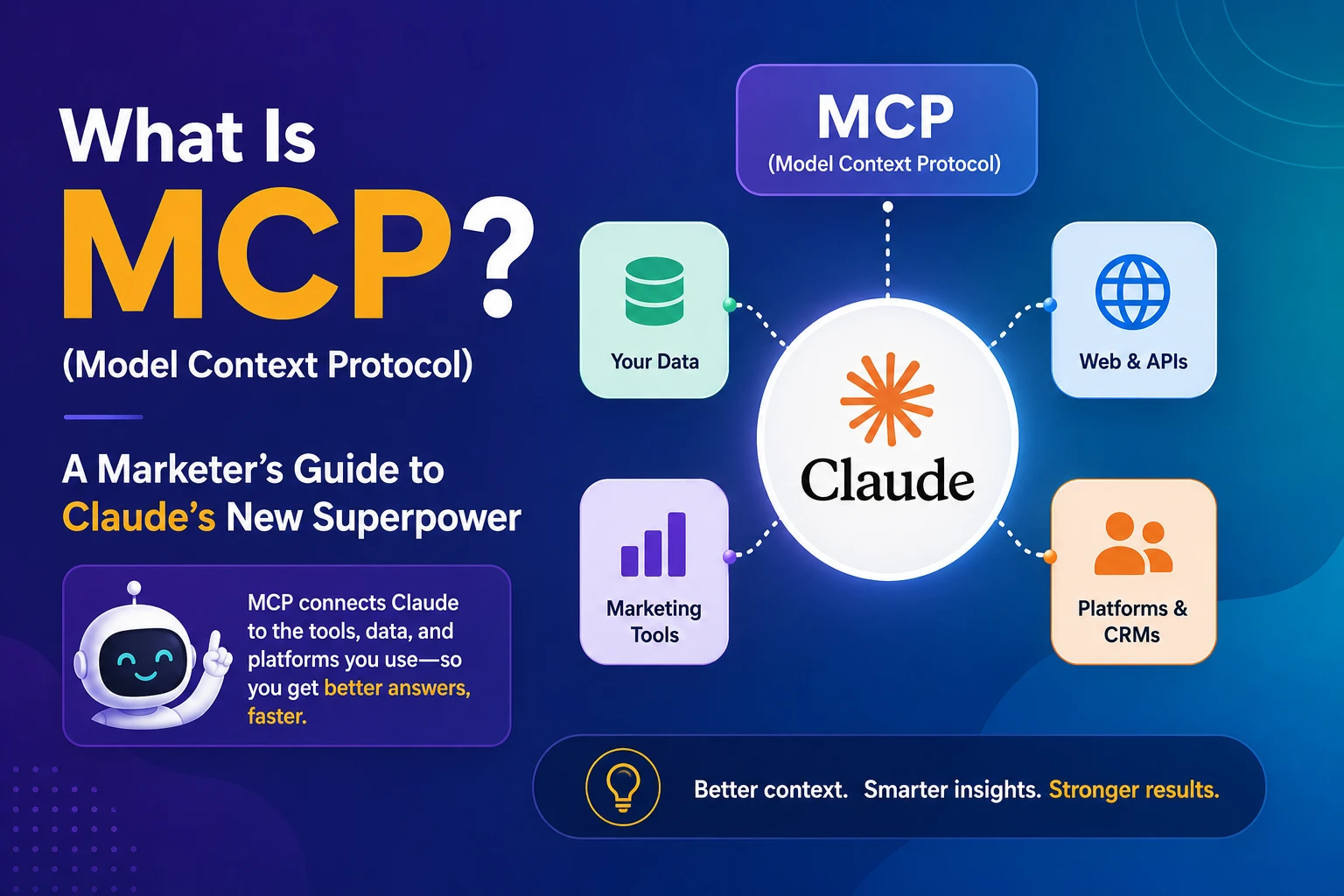
MCP stands for Model Context Protocol. It's an open standard, created by Anthropic, that lets AI applications like Claude connect directly to external tools and data sources — your CRM, an ad platform, an analytics tool, a project tracker — instead of relying only on whatever you type or paste into the chat window.
Once a tool is connected through MCP, Claude can read live information from it (and in some cases, take action in it) as a normal part of your conversation. You ask a question in plain English; Claude does the work of pulling the relevant data, rather than you doing that work first and handing Claude the result.
Think about the difference between describing a photo to a friend over the phone and just handing them the photo.
Without MCP, using Claude for marketing work is a lot like the phone call. You have to describe your situation — paste in numbers, summarize what a campaign looked like, explain who a customer segment is — before Claude can help. Claude only knows what's in the conversation.
With MCP, it's closer to handing over the photo. Claude can look directly at the connected source (within whatever permissions you've granted) and work from the real thing, not your secondhand description of it.
Before MCP, connecting an AI model to an external tool meant a custom integration — a one-off build, specific to that model and that tool, that someone had to write and maintain. MCP changes that by giving developers a shared protocol. A company building, say, a CRM or an ad platform can build one MCP server, and it works with any MCP-compatible AI application, not just Claude.
That's why the number of marketing tools with an MCP connector has grown quickly — CRMs, email platforms, ad platforms, and SEO tools have all shipped official connectors, because building one now unlocks compatibility broadly rather than requiring a separate integration per AI vendor.
Broken down simply, a working MCP connection gives Claude two kinds of capability:
Not every connector offers both. Some are deliberately read-only. Whether a specific tool supports write actions, and what those actions are, varies by connector — worth checking before you assume Claude can do more than report back to you.
A few things worth being clear-eyed about, since the term gets used loosely:
Before MCP-style connections became common, "AI in marketing" mostly meant content generation: drafting copy, brainstorming ideas, summarizing a document you pasted in. Useful, but bounded. The moment Claude can read your actual campaign data, CRM records, or keyword rankings, the category of task expands — reporting, auditing, cross-platform analysis, and campaign prep all become things Claude can meaningfully help with, because it's no longer working from a description of your business. It's working from the business itself.
That's also why the setup for most of these connectors doesn't require a developer. Connecting a tool through MCP is generally a login flow — the same kind of "Sign in with Google" button you use everywhere else — not a coding project. The protocol does the technical work; you're just authorizing the connection.
MCP is the standard that lets Claude connect to the tools where your actual marketing data lives, so you're asking it questions about your real campaigns and customers instead of describing them from memory.
If you're ready to see it in action, the natural next step is connecting one tool — your CRM or your most-used ad platform is a reasonable place to start — and running a single read-only question through it before deciding what else is worth connecting.
Sources referenced: Anthropic's documentation on MCP and remote connectors, and independent 2026 reporting on the growth of the MCP connector ecosystem across marketing platforms.

Have a project in mind? Let’s build something amazing together.
Webbitech — A Leading Web Design & Web Development Company with 15+ Years of SEO & Digital Marketing Expertise, Delivering Countless Success Stories
From idea to execution, we help businesses create high-performing websites and applications.
Start your journey today and take your brand to the next level.