Posted Date : 13 Aug 2026
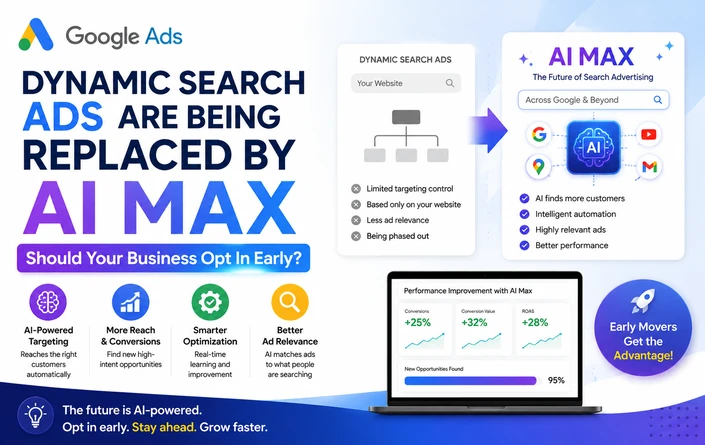
If you've been running Dynamic Search Ads (DSA) for your small business or online store, here's something you need on your radar: Google is retiring DSA entirely and replacing it with a new AI-powered system called AI Max for Search.
This isn't a minor feature update. It's a full changeover of a campaign type that many small businesses and e-commerce brands have quietly relied on for over a decade. And unlike some Google Ads changes that arrive with barely a notice, this one comes with a real decision to make: do you wait for Google to migrate your account automatically, or do you move now, on your own terms?
Let's walk through exactly what's changing, why it matters, and what the smart move is for a small business budget.
If you've never dug into how DSA works, here's the short version: instead of you building keyword lists, DSA crawls your website content and automatically generates ads that match what people are searching for. It's been especially useful for e-commerce stores with large product catalogs — filling in the gaps where you didn't have time or bandwidth to create a keyword for every single product page.
It's a "set it and let Google figure out the rest" tool. For over a decade, that's made it a popular, low-maintenance option for small businesses that don't have a dedicated PPC team constantly building out keyword lists.
Google confirmed the shift back in April 2026: Dynamic Search Ads are being phased out in favor of AI Max for Search. Here's the timeline that matters:
In other words, this isn't an optional feature you can ignore. If you're currently running DSA, your account is moving to AI Max one way or another. The only real choice is whether you're the one driving that move or whether Google's automated system does it for you.
AI Max isn't just DSA with a new name. It's a meaningfully different system, built on Google's Gemini AI models.
Where DSA worked by crawling your website and matching queries to your page content, AI Max combines that same page-content signal with much broader real-time intent signals—things like current search trends, your existing keywords, your ad creative, and landing page data — to figure out what a searcher actually wants, even when their query doesn't closely match your site's wording.
A few concrete differences worth knowing:
According to Google's own internal data, campaigns using the full AI Max feature suite saw an average of 7% more conversions or conversion value at a similar cost per acquisition or ROAS, compared to using standard search term matching alone. That's a meaningful number if it holds true for your account, though as with any platform-reported figure, real results will vary by industry, catalog size, and account history.
This is the real question for a small business owner, and the honest answer is migrating early is very likely the smarter move, for a few concrete reasons.
1. You keep control over the transition. If you migrate voluntarily, you can review and adjust settings, structure, and targeting before the change goes live. If you wait for the automatic upgrade, Google will port your existing settings over to "mirror" your legacy setup as closely as possible — but you won't have had a hand in fine-tuning anything before it happens.
2. You get testing time. Moving early gives you weeks to actually watch how AI Max performs for your specific business before it becomes mandatory anyway. That's valuable data you simply don't get if you wait until September and get force-migrated along with everyone else scrambling at the same time.
3. Your historical performance data carries over more cleanly. Several agencies working through early migrations have noted that a proactive move lets you port historical data more smoothly versus a bulk automated migration happening to hundreds of thousands of accounts at once.
4. You avoid the "everyone moves at once" performance dip. When a huge volume of accounts all shift bidding/targeting systems simultaneously in September, there's a reasonable chance of temporary volatility across the board as Smart Bidding systems recalibrate. Moving earlier, on a quieter schedule, generally means a smoother adjustment period for your specific account.
That said, early migration isn't entirely without effort. It's not a "flip a switch and forget it" change—it does require reviewing your setup rather than assuming everything will behave identically.
If your account has never used dynamic search ads, this update might not seem relevant — but check twice before assuming that. This change also affects:
If either of those applies to your account, you're affected by this transition too, even if you never consciously turned on DSA.
Log into Google Ads and look for any DSA campaigns, automatically created assets settings, or campaign-level broad match. If you're not sure, this is worth a five-minute audit rather than a guess.
Before making any changes, pull your top search queries, landing pages, and budget/performance figures for your DSA campaigns over the last few months. You'll want this as a baseline to compare against once AI Max is live.
Since AI Max leans heavily on your website content and smart URL selection to match searchers to the right page, this is a good moment to make sure your product pages and landing pages are clear, current, and easy for both users and AI to understand.
Given the advantages of controlling your own timeline, moving proactively — even a few weeks before the September deadline — puts you in a stronger position than waiting to be auto-upgraded.
AI Max doesn't eliminate the value of keywords; it uses them as a signal. Don't assume you can abandon keyword strategy entirely just because the system is more automated.
Whether you move early or get auto-upgraded, budget time to watch performance closely right after the switch. Smart Bidding systems typically need a short adjustment window to recalibrate to any structural change.
Even if you decide to wait, don't let the deadline sneak up on you. Put a calendar reminder now so you're not caught off guard when new DSA campaign creation stops being possible.
This update isn't happening in isolation. It's part of the same direction Google has been moving in all year—folding more of its advertising stack into AI-driven systems built on Gemini, from bidding to reporting to now, search targeting itself. Dynamic Search Ads were already one of Google's more automated tools; AI Max is simply the next, more capable version of that same idea.
For small business owners, the practical takeaway isn't to resist this shift—it's arriving whether you opt in or not. The real opportunity is in being one of the businesses that migrate deliberately, test early, and understand the new system, rather than one of the businesses that get swept into it in September without having looked at their account in months.
Migrating a search campaign type isn't something you want to get wrong, especially if search has been a reliable, low-maintenance channel for your business. The difference between a smooth transition and a rocky one often comes down to how the account is set up before the switch happens.
At Webbitech, we've been managing performance marketing and Google Ads for small businesses and e-commerce brands for over 15 years, and we're already helping clients migrate from DSA to AI Max ahead of the September deadline.
Book a free consultation call with Webbitech →
We'll review your account, tell you honestly whether early migration makes sense for your business, and handle the transition so your search performance doesn't skip a beat.
Have a project in mind? Let’s build something amazing together.
Webbitech — A Leading Web Design & Web Development Company with 15+ Years of SEO & Digital Marketing Expertise, Delivering Countless Success Stories
From idea to execution, we help businesses create high-performing websites and applications.
Start your journey today and take your brand to the next level.