Posted Date : 08 Jun 2026
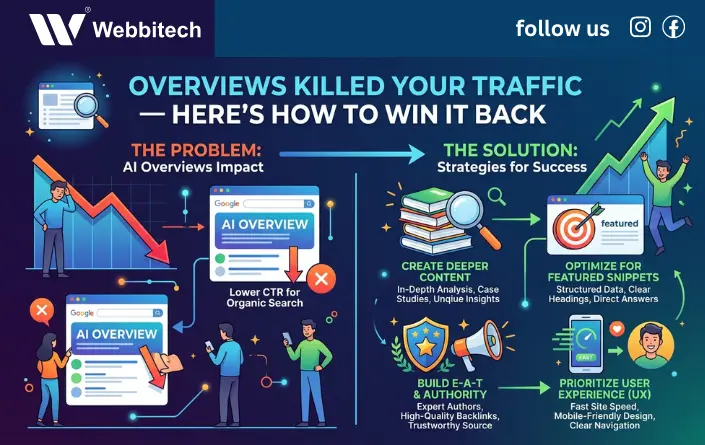
AI Overviews did not kill search. They changed who gets the click. Google now answers the question on the results page, so users stop scrolling, and the page that "ranks #1" often never gets visited. The way to win traffic back in 2026 is to stop optimizing only to rank and start optimizing to become the source AI cites.
If your organic traffic dropped this year and nobody can explain why, this is almost certainly the cause. Below is what the data actually shows, why high rankings stopped protecting you, and a practical plan to recover the visits, leads, and revenue you lost.
AI Overviews absorb the clicks that used to flow to your site. A randomized field study published in early 2026 found they cut outbound organic clicks by 38% on the queries where they appear, while zero-click searches rose from 54% to 72% (Search Engine Journal, 2026). The summary answers the question, so the user never leaves Google.
The hardest-hit pages are informational ones. Definitions, explanations, and "how to" content have seen organic traffic fall roughly 30 to 40%, because those are exactly the questions AI can answer confidently in a paragraph. Pew Research found users click through just 8% of the time when an AI Overview is present, versus 15% without one.
It is worth being precise, because the headlines oversell the collapse. U.S. organic search traffic was down about 2.5% year over year by early 2026, a real decline but not an apocalypse. The clicks did not vanish. They got redistributed, and the redistribution is what you need to plan for.
Here is the uncomfortable shift: a top ranking and an AI citation are now two different things. The overlap between the top 10 Google results and the pages cited inside AI Overviews collapsed from around 75% in mid-2025 to somewhere between 17 and 38% by early 2026. In plain terms, you can rank beautifully and still be invisible in the AI answer sitting above you.
Seer Interactive's large query study captured the scale of it: when an AI Overview appears, organic click-through rate fell from a pre-AI baseline of 1.76% to 0.61%, a 61% drop. Ahrefs reported a similar 58% CTR decline for top-ranking pages when an Overview is present.
The table below is the mental model to internalize.
| Search before AI Overviews | Search in 2026 | |
|---|---|---|
| Goal | Rank in the 10 blue links | Get cited as a source in the AI answer |
| User behavior | Scans results, clicks 2 to 3 | Reads the summary, clicks 0 to 1 |
| What wins | Keywords, backlinks, page authority | Clear extractable answers, brand mentions, entity trust |
| Who gets the click | The #1 ranked page | The page the AI chose to cite |
This is the half of the story most "SEO is dead" posts skip. The traffic that still arrives is higher quality, and being cited pays off directly.
Pages cited inside an AI Overview earn roughly 120% more clicks per impression than uncited pages on the same query (Seer Interactive, 2026). Visitors who do click after reading a summary convert better too, because they arrive already informed. Several 2026 analyses put AI-referred conversion rates at 2.4 to 4.4 times standard organic search.
So the objective is no longer "rank and wait for clicks." It is "become citable, capture the smaller but warmer stream of visitors, and let AI do part of your qualifying for free."
Generative Engine Optimization (GEO) is the practice of structuring your content so AI engines like Google AI Overviews, ChatGPT, Perplexity, and Gemini cite it. It sits on top of solid SEO, it does not replace it. Google's AI Overviews still favor content that already performs in organic search, so your technical foundation has to stay healthy.
Here is what actually moves the needle.
Write answer-first, not intro-first. Open every page and every major section with a direct, 40 to 60 word answer to the question. AI engines break pages into passages and score each one for whether it stands alone as an answer. Bury the answer under three paragraphs of warm-up and you will not be extracted.
Make specific, citable claims backed by data. Vague, fluffy content gets skipped. Concrete claims with a number, a date, and a source are what AI quotes. One supported statistic every 150 to 200 words is a good density to aim for.
Add FAQ and Q&A structure. AI systems lean heavily on clear question-and-answer pairs. Self-contained FAQ answers of 40 to 60 words give engines clean passages to lift.
Build your brand entity off your own site. This is the surprising one: brand mentions now correlate with AI citation more strongly than backlinks do. AI engines pull heavily from Reddit, YouTube, LinkedIn, and review platforms like G2 and Trustpilot. Being discussed across those sources teaches the model that you are an authority worth citing.
Open the door technically. Make sure your robots.txt allows AI crawlers, add structured data (FAQ, Article, Organization schema), and consider an llms.txt file. If AI crawlers cannot read you, none of the content work matters.
Use this checklist as a quick audit of any important page:
You do not need to rebuild everything. Triage first, then expand.
| Phase | Focus | What to do |
|---|---|---|
| Days 1 to 30 | Stop the bleeding | Identify your highest-traffic pages that lost the most clicks. Rewrite their openings to be answer-first and add FAQ blocks. Confirm AI crawlers are allowed. |
| Days 31 to 60 | Build citability | Add sourced statistics and schema across priority pages. Publish one piece of original data or research AI will want to cite. Start showing up in relevant Reddit, LinkedIn, or YouTube discussions. |
| Days 61 to 90 | Measure and expand | Track which pages get cited and where AI referral traffic lands. Double down on the formats that earn citations. Build out a small cluster of authority content. |
Your old dashboards will mislead you here, because they count clicks and ignore citations. Set up a separate measurement layer.
Create an "AI traffic" channel in GA4 by matching referrers from ChatGPT, Perplexity, Gemini, and Copilot, so AI-referred visits stop hiding inside "direct" or "organic." Then track three things over time: how often your brand is cited across the major AI engines for your key questions, how much referral traffic those engines send, and how that traffic converts compared to classic organic. Rising citations with flat clicks is still a win, because it builds the brand recall that drives the next visit.
Did AI Overviews really kill organic traffic? No, but they reshaped it. AI Overviews reduced clicks on informational queries by 30 to 40% and pushed zero-click search above 64%. Traffic was redistributed toward cited sources and AI referrals rather than eliminated, so the goal shifts from ranking to being cited.
What is GEO and how is it different from SEO? GEO, or Generative Engine Optimization, structures content so AI engines cite it in their answers. SEO aims to rank pages in search results. GEO aims to get statements quoted by AI. You need both, because AI Overviews still favor pages that already rank well.
Why does ranking #1 no longer guarantee traffic? Because AI Overviews use a separate retrieval system that extracts passages and chooses citations independently of the blue-link rankings. The overlap between top-ranked pages and AI-cited pages has dropped to between 17 and 38%, so a high ranking can sit beneath an answer that never mentions you.
How do I get my content cited by AI Overviews? Write answer-first passages of 40 to 60 words, back claims with sourced statistics, add FAQ and Article schema, allow AI crawlers in robots.txt, and build brand mentions on third-party platforms. AI engines favor clear, extractable, verifiable answers over keyword-heavy prose.
Is AI search traffic actually worth pursuing? Yes. Visitors referred by AI engines convert at 2.4 to 4.4 times the rate of standard organic search because they arrive already informed. The volume is smaller, but the intent is higher, which is why citability matters more than raw click count.
How long until GEO recovers my traffic? Most teams see early movement within 60 to 90 days on priority pages once they fix answer structure, schema, and crawler access. Brand-entity signals build more slowly, so treat citations and AI referrals as compounding assets rather than instant wins.
How do I measure AI search performance? Create a dedicated AI traffic channel in GA4 using referrer matching, then track citation frequency across ChatGPT, Perplexity, and Gemini alongside referral volume and conversion rate. Standard organic dashboards undercount AI impact because they only measure clicks, not citations.
Should small businesses bother with AI Overviews optimization? Yes, and early movers gain the most. Because citation overlap with rankings is low, smaller sites with sharp, well-structured answers can be cited even when they do not rank first. That levels a field where large brands once dominated through backlinks alone.
AI Overviews did not end search, they raised the bar. The brands recovering traffic in 2026 are the ones that treat being cited as the new ranking and rebuild their best pages to be the clearest, most quotable answer on the topic. Do that consistently and you stop losing visits to the AI summary and start being the reason it exists.
Have a project in mind? Let’s build something amazing together.
Webbitech — A Leading Web Design & Web Development Company with 15+ Years of SEO & Digital Marketing Expertise, Delivering Countless Success Stories
From idea to execution, we help businesses create high-performing websites and applications.
Start your journey today and take your brand to the next level.