Posted Date : 23 Jul 2026
Most Meta Ads budgets are still built around a targeting-era logic: a line item for audience testing, a line item for placements, and a line item for bid strategy experiments. That structure made sense when advertisers controlled those levers. Increasingly, they don't.
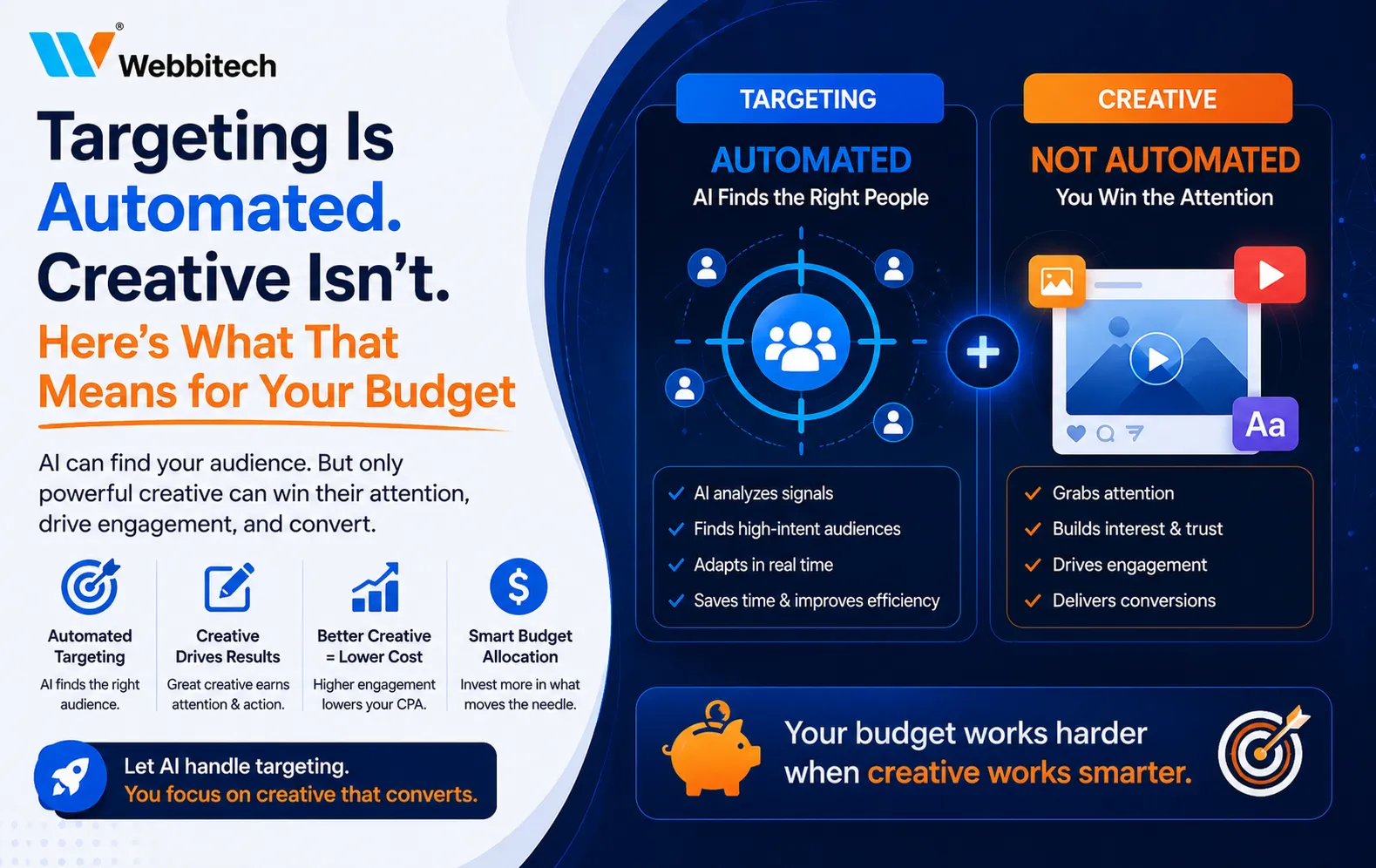
Meta's delivery systems now handle targeting, placement, and bidding with minimal input. What hasn't been automated is creative. That means the budget conversation has to change too—not just how much you spend, but where inside the account that spend actually goes to work.
It's easy to treat "creative is the new targeting" as a mindset shift and leave it at that. But mindset shifts that don't show up in the budget don't actually change outcomes.
If your media buying team still spends the bulk of their time on audience research, bid adjustments, and placement testing, that's time and headcount pointed at a part of the account that the algorithm is already optimizing better than a human can. Meanwhile, if creative production is still treated as a fixed monthly deliverable—a batch of assets handed off once and left to run—it's underfunded relative to the role it now plays.
The mismatch is simple: the lever that drives performance is creative, but the budget still often reflects a targeting-first account structure.
From audience testing to creative testing. Dollars and hours once spent building and testing audience segments are largely wasted on accounts running Advantage+ or broad targeting. Redirect that budget toward producing and testing more creative variants instead. This isn't a philosophical swap—it's a literal reallocation of ad spend and team hours.
From one polished asset to many rough ones. A budget built around a handful of highly produced ads no longer matches how the algorithm learns. It needs volume and variety to find what resonates. Splitting a production budget across more, faster, lower-cost creative iterations typically outperforms concentrating it in fewer high-polish pieces.
From external creative as a cost center to creative as a growth investment. Treating creative as a line item you minimize (a set number of ads per month from an agency or freelancer) undersells its role. Accounts that treat creative production as a growth investment—with an ongoing budget tied to testing velocity rather than a fixed monthly cap—tend to see compounding gains as the algorithm has more to learn from.
From bid strategy experimentation to tracking infrastructure. Some of the budget freed up from manual bid testing should go toward better conversion tracking and signal quality (clean pixel/CAPI setup, accurate event definitions). Creative can only do its job if the algorithm is learning from accurate data.
For an account previously split something like 40% audience/targeting work, 30% creative, 20% bid testing, and 10% tracking, a creative-led restructure might look closer to 10% targeting oversight, 55% creative production and testing, 10% bid monitoring, and 25% tracking and measurement infrastructure. The exact split depends on account size and maturity, but the direction is consistent: less time and budget on levers the algorithm already owns, more on the one it doesn't.
This also changes hiring and vendor decisions. An account that used to need a strong media buyer now needs a media buyer who can brief, test, and iterate creative fast—or a tighter partnership between media buying and creative production than most teams currently have.
Accounts that keep budget structured around manual targeting aren't just missing an opportunity—they're often paying for redundant work. Time spent fine-tuning an audience the algorithm will override anyway is time (and often agency or salary cost) that isn't producing incremental performance. The real cost isn't visible on a single invoice; it shows up as flat or declining performance while competitors reallocating toward creative pull ahead.
Budgets tend to lag behind strategy shifts by six to twelve months, and that lag is expensive in a fast-moving channel. If targeting is automated and creative is what's left to control, your budget should already reflect that—not "eventually," but now.
If you're not sure whether your current spend matches where performance is actually coming from, a creative and budget audit is the fastest way to find out.
Have a project in mind? Let’s build something amazing together.
Webbitech — A Leading Web Design & Web Development Company with 15+ Years of SEO & Digital Marketing Expertise, Delivering Countless Success Stories
From idea to execution, we help businesses create high-performing websites and applications.
Start your journey today and take your brand to the next level.