Posted Date : 04 Aug 2026
Outline
Creative fatigue is the slow, almost imperceptible erosion of an advertisement's persuasive power. It sets in when the same audience encounters an identical visual or message so often that novelty gives way to indifference. The eye stops registering it; the thumb keeps scrolling. This isn't a glitch in Meta's delivery system—it's a predictable behavioral pattern, rooted in habituation, the same psychological mechanism that makes a ticking clock disappear from conscious awareness after a few minutes in the room.
On Meta's advertising platform, this manifests quantitatively. Engagement curves that once sloped upward begin to plateau, then dip. What was a compelling scroll-stopper in week one becomes wallpaper by week four. The ad hasn't changed. The audience's relationship to it has.
Return on ad spend is not a static number; it's a function of attention, and attention is a depleting resource within any fixed audience pool. When fatigue sets in, cost per acquisition climbs even as targeting, bidding, and budget remain untouched. Advertisers frequently misdiagnose this as an audience problem or a landing page issue when the root cause is sitting in plain sight: the creative itself has simply worn out its welcome.
Left unaddressed, fatigue compounds. Frequency rises, relevance diminishes, and Meta's own delivery algorithm—which rewards engagement—begins throttling impressions for the tired asset, creating a vicious cycle of declining efficiency.
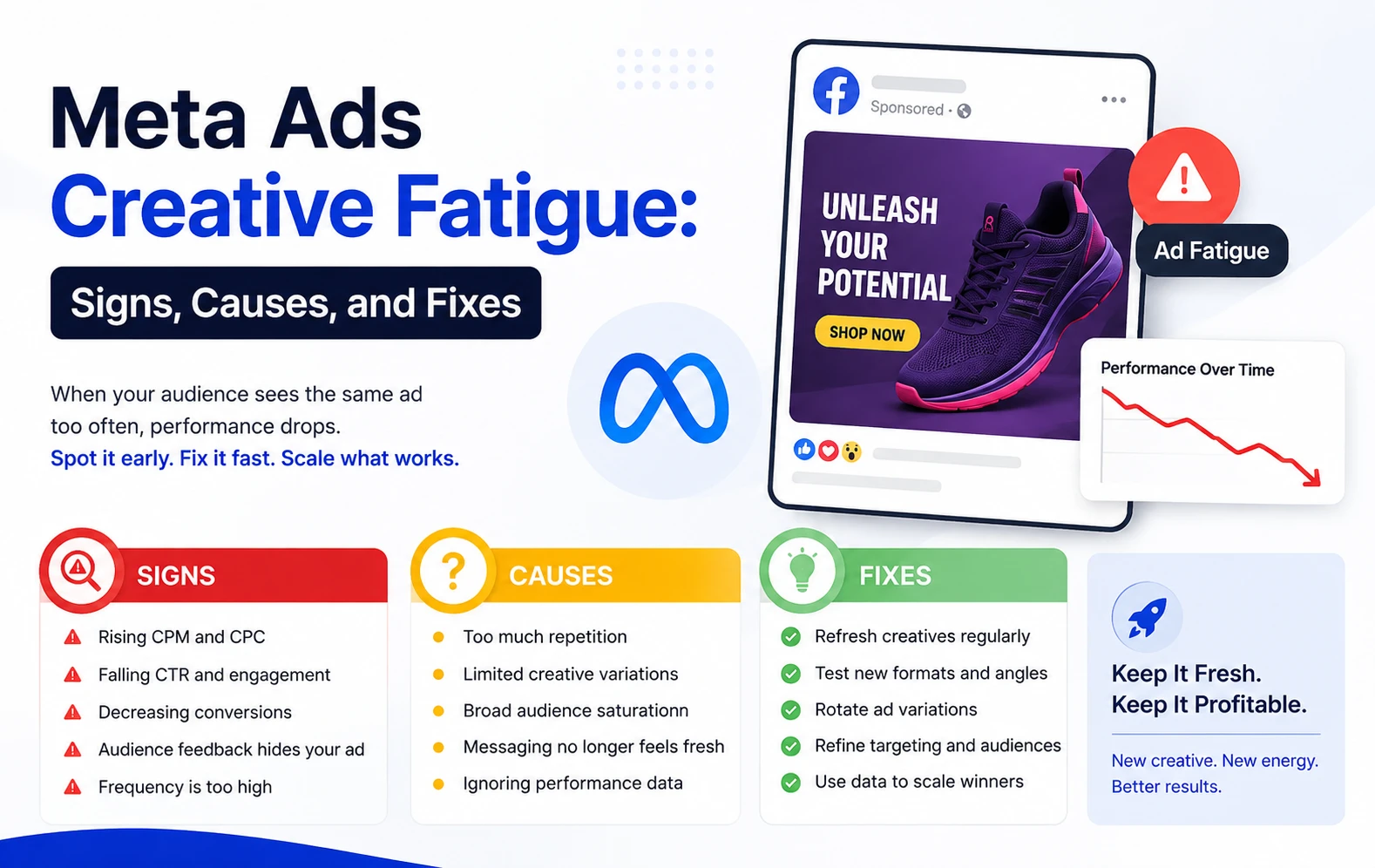
A downward trajectory in click-through rate, sustained over multiple consecutive reporting periods rather than a single noisy day, is often the earliest quantifiable symptom. A single dip might be statistical noise. A steady, multi-week decline against a stable audience is a diagnostic red flag.
As engagement wanes, Meta's auction mechanics respond by demanding more spend to achieve the same outcome. Cost per click, cost per lead, or cost per purchase—whichever north-star metric governs the campaign—begins to inflate. This is the financial fingerprint of fatigue, and it's usually the metric that first triggers alarm among stakeholders.
Frequency, the average number of times a unique user has seen an ad, is perhaps the single most reliable leading indicator. Industry practitioners generally regard a frequency exceeding 3 to 4 within a short attribution window as a threshold worth scrutinizing, though the precise tipping point varies by vertical, funnel stage, and creative format.
Beyond the numbers, qualitative signals matter too. A rise in "hide ad" clicks, negative comments, or a drop in positive engagement ratio all suggest the audience isn't merely ignoring the creative—they're actively rejecting it. This is a more acute stage of fatigue and typically demands immediate creative rotation rather than gradual adjustment.
Every audience segment has a finite capacity to absorb repeated exposure before diminishing returns set in. Smaller, more niche audiences saturate faster, simply because the same finite pool of eyeballs is being asked to look at the same asset repeatedly within a compressed timeframe.
Overly granular targeting — stacking multiple interest layers, narrow lookalike percentages, or hyper-specific demographic filters — shrinks the available audience to the point where Meta's delivery system has little choice but to serve the same users the same creative on a near-daily cadence.
When multiple ad sets within an account target overlapping audiences, they effectively compete against one another in the same auction, accelerating cumulative frequency without the advertiser necessarily realizing it. This audience cannibalization is a frequently overlooked contributor to premature fatigue.
Reliance on a single format — say, one static image carousel — without variation in motion, copy angle, or visual hierarchy accelerates habituation. Human perception is tuned to notice change; sameness, by contrast, gets filtered out as background noise.
Many advertisers allocate the bulk of budget toward media spend and treat creative production as an afterthought. Without a standing pipeline of fresh assets, the same handful of creatives are forced to carry the campaign far longer than their natural effective lifespan allows.
Configuring custom alerts within Meta Ads Manager to flag when frequency crosses a predetermined threshold allows for proactive intervention rather than reactive damage control. Automated monitoring removes the guesswork and the lag time inherent in manual weekly reviews.
Aggregate campaign-level reporting can mask fatigue occurring at the individual ad level. A granular, ad-by-ad review — cross-referencing click-through rate, frequency, and cost per result on a rolling weekly basis — surfaces fatigue earlier, before it drags down blended account performance.
Establishing a predictable cadence—refreshing primary creative assets every two to four weeks, depending on audience size and spend velocity—pre-empts fatigue rather than merely reacting to it once metrics have already deteriorated.
Broadening targeting parameters, layering in additional lookalike percentages, or activating Meta's Advantage+ audience expansion features increases the pool of unique users available, diluting frequency and extending the effective runway of existing creative.
Meta's dynamic creative tools allow multiple headlines, images, and calls to action to be tested in combination, with the algorithm automatically favoring the best-performing permutations. This built-in variability inherently slows the onset of fatigue compared to a single fixed creative.
Alternating between static images, carousel formats, short-form video, and Reels-native content introduces structural variation that resets audience attention, even when the underlying message remains consistent.
A systematized, ongoing pipeline—where new creative concepts are continuously ideated, produced, and queued for rotation — transforms creative refresh from a reactive scramble into a predictable operational rhythm, insulating campaigns from sudden performance cliffs.
Mapping creative production against campaign flight dates, seasonal shifts, and promotional windows ensures fresh assets are ready before fatigue symptoms emerge, rather than being produced under duress once performance has already declined.
User-generated content and authentic, less polished formats tend to exhibit slower fatigue curves than highly produced brand content, largely because they read as native to the platform rather than as interruptive advertising and because a broader library of source content is typically available to draw from.
Creative fatigue is not a flaw in Meta's advertising ecosystem; it's an inevitable consequence of finite attention meeting repeated exposure. The advertisers who sustain performance over the long term are rarely the ones with the single best-performing ad—they're the ones with the most disciplined system for noticing decline early and refreshing creative before the numbers force their hand. Treating creative production as an ongoing operational function, rather than a one-time asset, is what separates campaigns that compound in efficiency from those that quietly erode.

Have a project in mind? Let’s build something amazing together.
Webbitech — A Leading Web Design & Web Development Company with 15+ Years of SEO & Digital Marketing Expertise, Delivering Countless Success Stories
From idea to execution, we help businesses create high-performing websites and applications.
Start your journey today and take your brand to the next level.