Posted Date : 14 Aug 2026
Our recent campaign at Webbitech shows that it can.
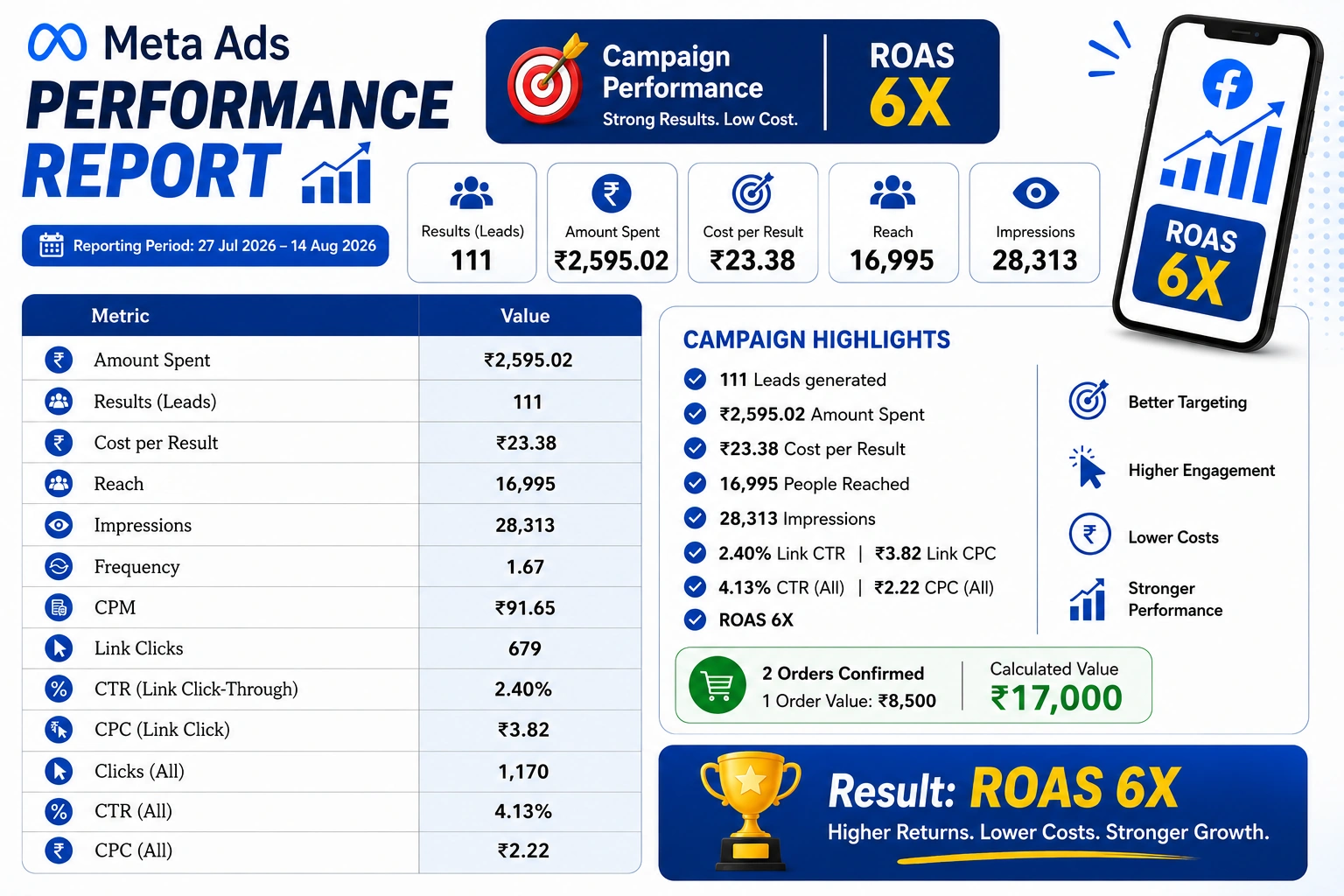
With just ₹2,595 in Meta Ads spend, the campaign generated 111 leads at an average cost of approximately ₹23.38 per lead. From those leads, 2 confirmed conversions were generated, with each conversion valued at ₹8,500.
That resulted in a total conversion value of ₹17,000 and a calculated 6.55x ROAS.
Let's look at how the campaign performed and the strategies behind the results.
| Metric | Result |
|---|---|
| Ad Spend | ₹2,595 |
| Leads Generated | 111 |
| Cost Per Lead | ₹23.38 |
| Confirmed Conversions | 2 |
| Value Per Conversion | ₹8,500 |
| Total Conversion Value | ₹17,000 |
| Lead-to-Conversion Rate | 1.80% |
| Calculated ROAS | 6.55x |
The ROAS is calculated as ₹17,000 ÷ ₹2,595 = 6.55x.
The campaign was designed around a simple performance marketing objective:
Generate a high volume of relevant inquiries while maintaining an efficient cost per lead.
Rather than relying on a large advertising budget, the campaign focused on getting more from every rupee spent.
The strategy centered around four key areas:
Audience targeting
High-impact creative
Conversion-focused messaging
Continuous campaign optimisation
Meta has access to a massive pool of users, but reaching everyone isn't the objective.
The campaign was structured to reach audiences that were more relevant to the offer. By focusing the advertising around potential customers instead of a broad audience, the campaign could use its limited budget more efficiently.
Effective targeting helps answer one of the most important questions in Meta Ads:
Who is most likely to become a customer?
Getting someone to stop scrolling is only the first step.
The creative and messaging were designed to communicate the offer quickly and give users a clear reason to inquire.
The campaign focused on:
Strong hooks
Clear benefits
Relevant messaging
Simple communication
Direct calls to action
The goal was not just engagement. The goal was lead generation.
One creative rarely remains the best performer forever.
That's why testing different creative concepts and messaging angles is an important part of performance marketing.
By analyzing how different ads performed, marketers can identify which combinations generate stronger engagement and more enquiries.
This creates a continuous optimisation cycle:
Test → Measure → Optimise → Scale
The campaign generated 111 leads from ₹2,595 in advertising spend.
The average cost per lead was:
₹2,595 ÷ 111 = ₹23.38
So, the campaign acquired each lead for approximately ₹23.38.
For a lead-generation campaign, maintaining an efficient CPL can help businesses generate a larger inquiry volume without immediately increasing their advertising budget.
Generating leads is important, but leads aren't the final business outcome.
In this campaign, 2 leads converted into confirmed conversions.
Each conversion was assigned a value of ₹8,500.
Therefore:
2 × ₹8,500 = ₹17,000
The campaign generated ₹17,000 in total conversion value.
The lead-to-conversion rate was:
2 ÷ 111 × 100 = 1.80%
This illustrates why businesses should track the complete funnel instead of evaluating Meta Ads purely on lead volume.
The campaign investment was:
₹2,595
The tracked conversion value was:
₹17,000
ROAS is calculated as:
₹17,000 ÷ ₹2,595 = 6.55x
That means the campaign generated approximately ₹6.55 in tracked conversion value for every ₹1 spent on advertising.
A common mistake businesses make is judging Meta Ads only by cost per lead.
For example, a campaign generating leads at ₹20 may initially appear better than one generating leads at ₹40.
But what happens if the ₹40 leads convert more frequently?
The second campaign could potentially generate more business value.
That's why performance marketers need to look beyond:
CPL
and evaluate:
Lead Quality → Conversion Rate → Conversion Value → ROAS
In this campaign, the ₹23.38 CPL was an important efficiency metric, while the 2 confirmed conversions and ₹17,000 conversion value provided the deeper business context.
Several elements contributed to the campaign's performance.
The campaign concentrated on audiences relevant to the offer rather than spending the entire budget indiscriminately.
The advertisements were built to encourage users to take action instead of simply generating impressions.
Campaign data provides insights into which ads and audiences are performing better. Using that information allows budgets to be managed more effectively.
Tracking confirmed conversions and assigning a value of ₹8,500 to each conversion made it possible to calculate the campaign's return more meaningfully.
The campaign began with just ₹2,595 in advertising spend.
That investment generated:
111 leads → 2 confirmed conversions → ₹17,000 conversion value
With a calculated 6.55x ROAS, the campaign demonstrates the importance of combining efficient lead generation with conversion tracking.
However, ROAS and conversion value should always be interpreted according to the business's actual revenue, margins, attribution model and other costs. A tracked conversion value is not automatically the same as net profit.
More leads are useful only when they have the potential to become customers.
A lead-generation campaign should ideally be connected to a CRM, sales process or other conversion tracking system so businesses can understand what happens after submission.
Different audiences respond to different messages. Regular creative testing can help identify stronger-performing concepts.
Instead of guessing which campaign, ad set or creative is working, use performance data to guide optimisation.
The real journey is:
Ad Impression → Click → Lead → Qualified Lead → Conversion → Business Value
Optimising every stage can create a much stronger performance marketing system.
At Webbitech, we believe Meta Ads should be measured by more than impressions, clicks and likes.
Our approach combines:
Audience research
Campaign strategy
Creative development
Conversion-focused ad copy
Lead generation
Conversion tracking
Performance analysis
Campaign optimisation
The objective is to help businesses turn advertising budgets into measurable enquiries and business outcomes.
The campaign delivered:
₹2,595 — Total Ad Spend
111 — Leads Generated
₹23.38 — Average Cost Per Lead
2 — Confirmed Conversions
₹8,500 — Value Per Conversion
₹17,000 — Total Conversion Value
1.80% — Lead-to-Conversion Rate
6.55x — Calculated ROAS
This Meta Ads case study demonstrates an important principle:
The goal isn't simply to generate cheap leads. The goal is to generate relevant leads and turn them into measurable business value.
With ₹2,595 spent, 111 leads generated and 2 confirmed conversions worth ₹17,000, this campaign shows how a focused, data-driven Meta Ads strategy can make a relatively small advertising budget work harder.
Webbitech combines performance marketing strategy, creative testing and conversion tracking to help businesses build Meta Ads campaigns focused on measurable growth.

Have a project in mind? Let’s build something amazing together.
Webbitech — A Leading Web Design & Web Development Company with 15+ Years of SEO & Digital Marketing Expertise, Delivering Countless Success Stories
From idea to execution, we help businesses create high-performing websites and applications.
Start your journey today and take your brand to the next level.