Posted Date : 10 Aug 2026
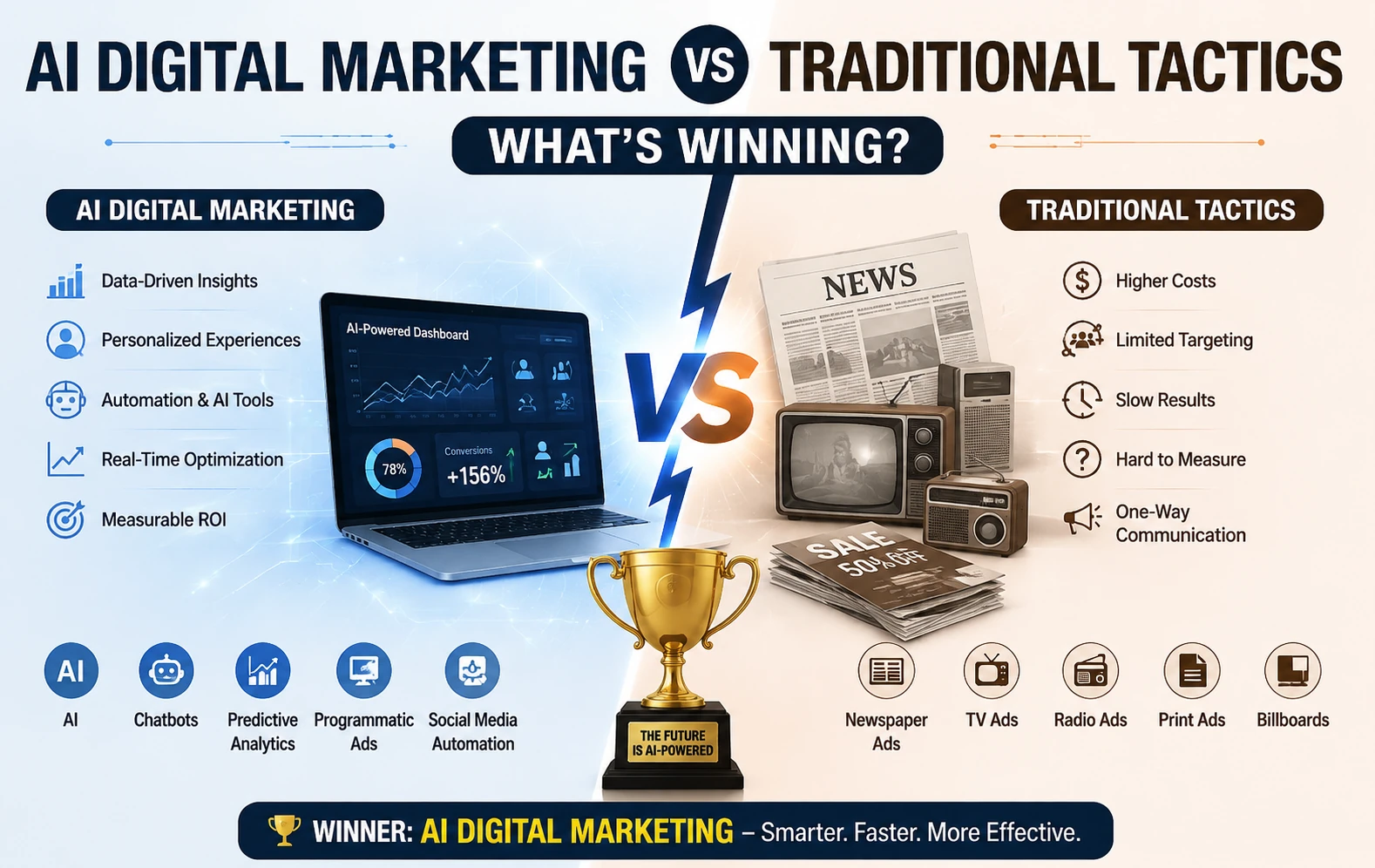
Every marketing department eventually reaches a fork in the road. On one path sits the algorithmic promise of AI digital marketing, humming with automation and predictive precision. On the other stands the well-worn trail of traditional tactics, built on decades of billboards, cold calls, and print circulars. Neither path is obsolete. Yet the terrain has shifted so dramatically that many practitioners are left wondering which route actually delivers. This article dissects both approaches across ten measurable dimensions to determine, with clear eyes, what is genuinely winning.
AI digital marketing encompasses a constellation of technologies: machine learning models that forecast purchase intent, natural language generators that draft ad copy, and recommendation engines that curate product feeds in real time. It is not a single tool but an ecosystem of interlocking systems designed to reduce guesswork. These platforms ingest behavioral exhaust—clicks, dwell time, scroll depth—and convert it into actionable signal. The result is a marketing apparatus that learns continuously rather than campaign by campaign.
Traditional tactics, by contrast, rely on broadcast logic. Television spots, radio jingles, direct mail, and outdoor signage all operate on the assumption that a wide net catches enough of the right fish. These methods are not primitive; they are simply engineered for a pre-digital attention economy. Their strength lies in tangibility and cultural permanence—a billboard does not require a login, and a printed catalog survives a power outage.
Where AI digital marketing distinguishes itself most starkly is velocity. A single analyst can now configure a campaign that self-optimizes across thousands of ad variants within hours. Bid adjustments happen in milliseconds, driven by auction dynamics invisible to the human eye. This is not incremental improvement; it is a categorical leap in operational tempo.
Traditional tactics move at the pace of production schedules and printing presses. A television commercial demands storyboarding, casting, filming, and post-production before it ever airs. This lead time, often measured in weeks, imposes a rhythm that feels almost anachronistic next to algorithmic iteration. The craftsmanship is undeniable, but the cadence cannot compete on raw throughput.
Modern AI systems can slice an audience into micro-cohorts so granular that two neighbors might see entirely different advertisements based on subtle behavioral divergence. This precision, sometimes called hyper-segmentation, allows brands to speak directly to a persona rather than a demographic bracket. The upshot is higher relevance and, frequently, better conversion economics.
Traditional marketing settles for coarser segmentation—age brackets, geographic zip codes, income tiers gleaned from census data. It is a blunter instrument, yet blunt instruments have their uses. Broad demographic targeting still works remarkably well for products with near-universal appeal, where nuance offers diminishing returns.
Once an AI digital marketing pipeline is built, the marginal cost of producing additional ad variations or reaching incremental users trends toward negligible. Cloud compute is cheap, and the same trained model can serve millions of impressions without proportional labor cost. This scalability compounds favorably over long time horizons.
Traditional campaigns carry stubbornly fixed overhead. Airtime purchases, print runs, and physical distribution all scale linearly with reach, meaning costs rarely shrink as volume grows. This linear cost structure makes traditional tactics a harder sell for budget-conscious teams chasing efficient customer acquisition costs.
For all its computational elegance, AI-generated creativity can drift toward the anodyne. Language models, trained on aggregate patterns, sometimes produce copy that feels statistically average rather than emotionally resonant. Audiences, whether consciously or not, often detect this synthetic smoothness and disengage.
Traditional creative departments still hold an edge in narrative idiosyncrasy. A copywriter with lived experience can inject pathos, irony, or cultural specificity that a model struggles to replicate authentically. This is why the most memorable campaigns in advertising history remain overwhelmingly human-authored, even as AI assists in the periphery.
AI digital marketing platforms offer dashboards that update by the second, surfacing conversion lift, cost-per-acquisition, and attribution paths almost instantaneously. This immediacy allows marketers to course-correct mid-flight rather than waiting for a campaign to conclude before learning what failed.
Traditional tactics depend on lagging indicators—brand lift surveys, foot traffic counts, or coupon redemption rates collected weeks after a campaign launches. The insight arrives late, sometimes too late to matter. This measurement gap remains one of the sharpest disadvantages of legacy channels.
A growing contingent of consumers express wariness toward overtly algorithmic marketing, associating it with surveillance or manipulation. Terms like dark patterns and behavioral nudging have entered mainstream vocabulary, and some audiences actively resist AI-personalized messaging as intrusive.
Traditional advertising, particularly in established categories, carries an air of institutional gravitas. A brand that has run the same reassuring television spot for a decade signals stability. This legacy equity is difficult to manufacture algorithmically and remains a genuine competitive moat for heritage companies.
Social platforms are the natural habitat of AI digital marketing. Native ad auctions, lookalike audiences, and dynamic creative optimization are all algorithmically mediated by default. Attempting to run social campaigns without leveraging AI is, at this point, a self-imposed handicap.
Print and broadcast remain comparatively untouched by AI's reach, though even here, programmatic television buying is encroaching. For now, these channels retain a traditionalist character, valued for reach density among audiences who consume media passively rather than interactively.
In categories demanding speed, personalization, and granular measurement—e-commerce, subscription services, app installs—AI digital marketing wins decisively. The efficiency gains are too substantial to ignore, and competitors who fail to adopt these tools risk structural disadvantage.
In categories built on emotional trust, cultural permanence, or offline behavior—luxury goods, civic institutions, and local businesses—traditional tactics retain genuine potency. The tactile, unhurried nature of these methods aligns with audiences who value continuity over novelty.
The contest between AI digital marketing and traditional tactics is not a zero-sum tournament with a single victor. It is a portfolio decision. Savvy marketers increasingly deploy both in tandem, letting algorithmic precision handle acquisition efficiency while human craftsmanship handles brand mythology. The organizations that thrive will be those who resist tribal loyalty to either camp and instead treat each tactic as a specialized instrument within a larger, deliberately orchestrated symphony.

Have a project in mind? Let’s build something amazing together.
Webbitech — A Leading Web Design & Web Development Company with 15+ Years of SEO & Digital Marketing Expertise, Delivering Countless Success Stories
From idea to execution, we help businesses create high-performing websites and applications.
Start your journey today and take your brand to the next level.